When artists are invited to participate in a themed exhibition, the first response is often analytical: What is the prompt asking for? But the more meaningful question comes later, and more quietly: What does this theme stir in me? This is where artists stop illustrating ideas and begin translating lived experience into form.
The exhibition One in Eight / The Teacup Project offered a clear conceptual framework. Conceived by GAGA Founder and exhibition designer Sylvia Benitez, herself a breast cancer survivor, the project is grounded not only in art history but in lived experience. The result is not a single visual narrative, but a chorus of distinct voices, each speaking without explanation, yet clearly understood.
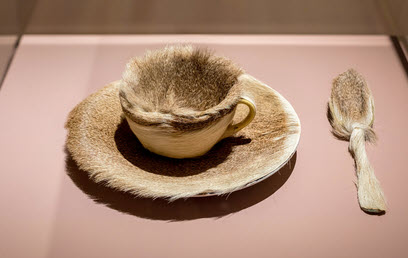
Artists were asked to interpret a teacup and saucer in response to breast cancer awareness. The idea draws inspiration from Meret Oppenheim’s fur-lined teacup—an ordinary domestic object transformed into something charged, unsettling, and unforgettable, and notably the first artwork by a woman acquired by the Museum of Modern Art. (Take this link to read the full story – it’s a good one.)
Those were the verbal guidelines. Everything else had to be discovered through looking, listening, and making. That combination has given artists permission to respond intuitively and honestly, whether through symbolic imagery, altered objects, or direct material references.
The challenge is not to illustrate the theme literally, but to recognize which images insist on being made. Some become two-dimension, some three-dimensional. Some are still unfinished.
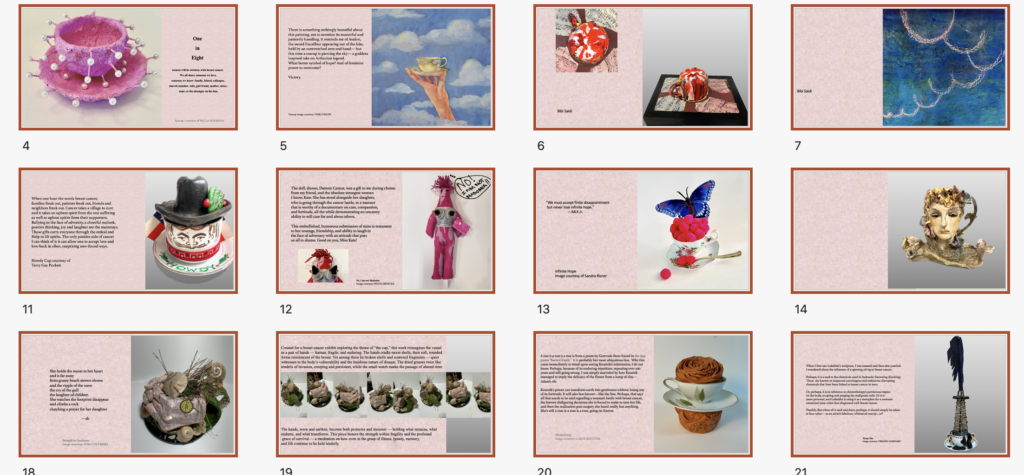
Teacup Interpretations in progress
For my piece, Held, the teacup became a container—not simply an object, but a state of being.
A woman’s face rests inside the cup, eyes closed, suspended between vulnerability and protection. The numbers one through eight circle the surface, not as a statistic to be explained, but as a persistent presence. They hover and repeat, blurred enough to resist certainty, yet impossible to ignore.
Rather than making a declarative statement about breast cancer, I wanted to explore what it must feel like to live with that knowledge—to carry it privately, bodily, and emotionally.
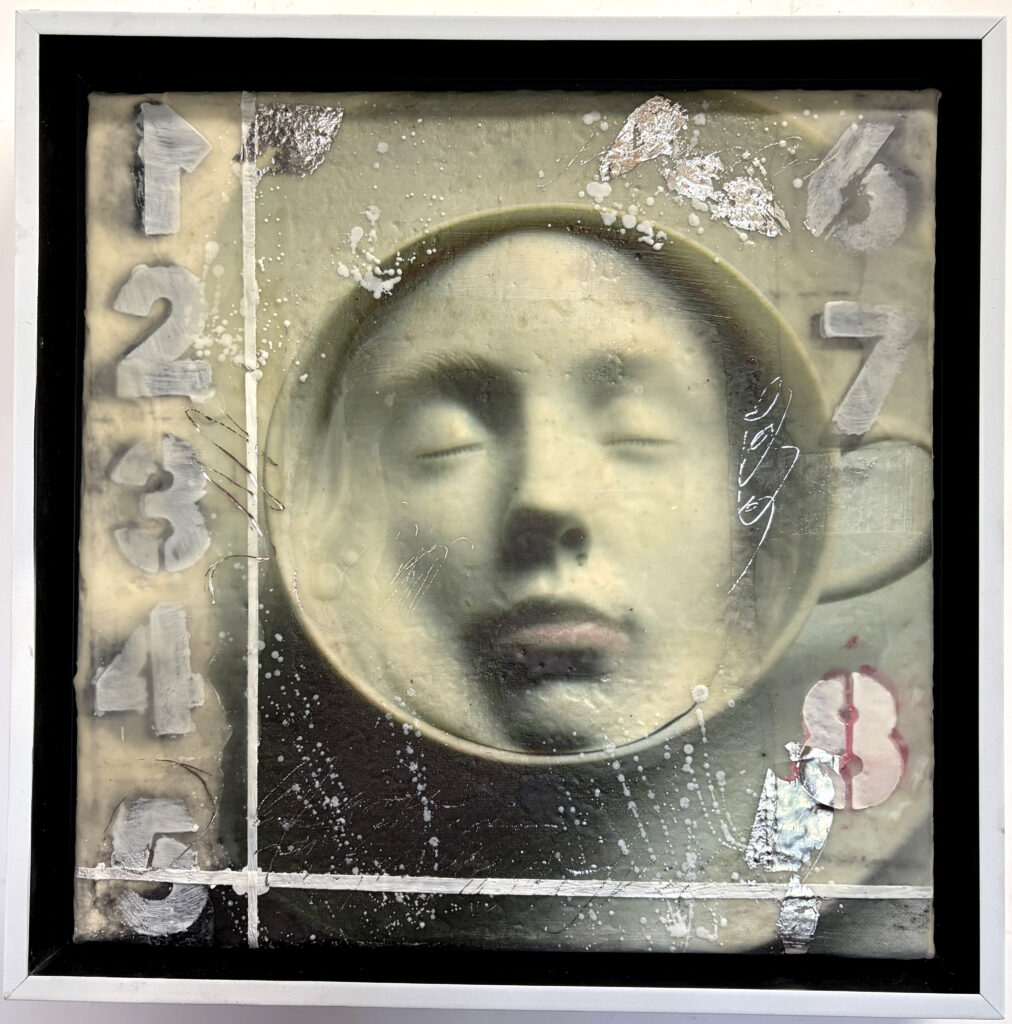
Encaustic was essential to this expression. Wax softens edges and obscures clarity. It allows images to hover in ambiguity, much like difficult truths themselves. Layers veil and reveal, holding space for complexity rather than resolution. The medium became part of the meaning. Even though I work often in three-dimensional assemblage, this felt right to me.
Material choice plays a powerful role in how artists interpret a shared theme. While I approached the teacup symbolically and atmospherically, other artists responded through direct engagement with the object itself. A real teacup carries familiarity and ritual. It is something we cradle in our hands, associated with warmth, pause, and care. When altered or recontextualized, that comfort can shift into something unsettling.
My friend Barbara took this idea one step further by placing a bra cup on a saucer. The gesture is immediate and unmistakable, collapsing metaphor and reality into a single form. The bra cup echoes the shape of the teacup while bringing the body directly into the conversation. Domestic object and intimate garment meet at the same scale, requiring no explanation. The meaning arrives visually, intuitively, and fully – and fluffy!
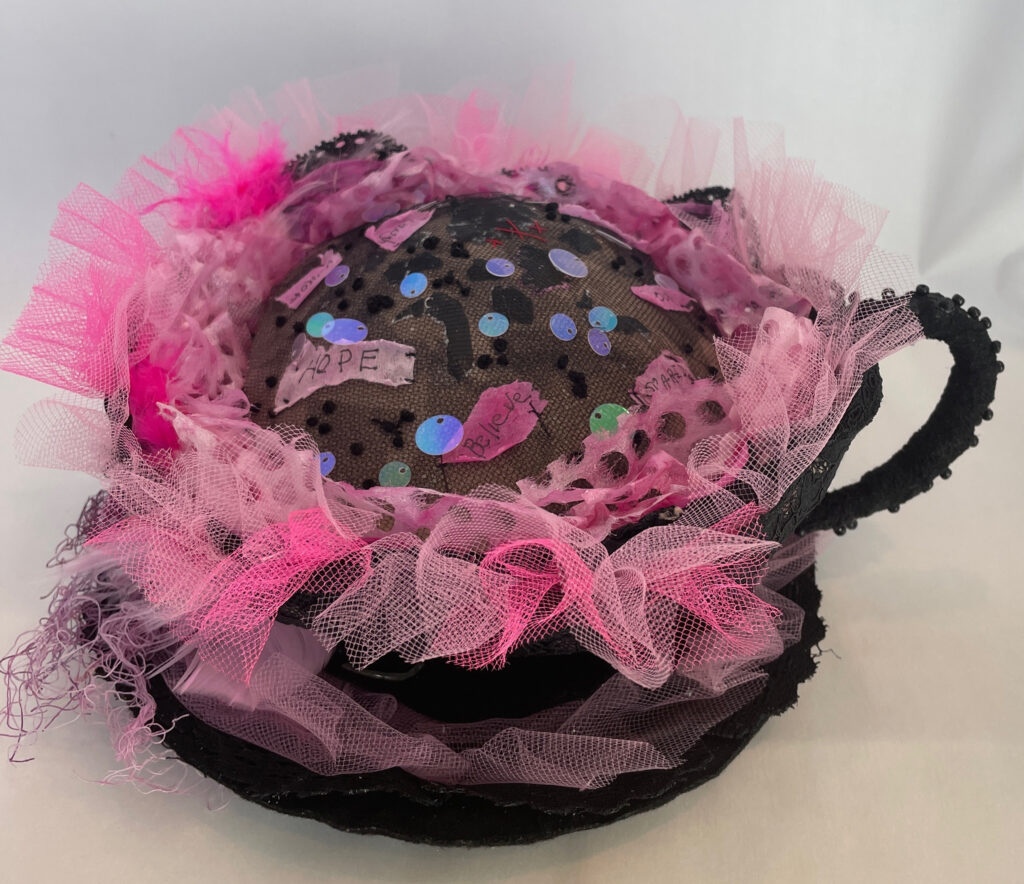
This is where non-verbal interpretation shows its strength. One artist may work symbolically, another literally. One may veil meaning in layers and atmosphere; another may present it plainly and directly. Neither approach is more valid than the other. Each is shaped by the artist’s relationship to the subject, their materials, and their personal history. What unites these responses is attentiveness—to the theme, to the body, and to the quiet knowledge we carry as women, caregivers, friends, and witnesses.
One in Eight / The Teacup Project is still in its development stage as a site exhibit, but the depth and immediacy of the responses so far suggest that it is already doing what meaningful exhibitions do best—opening space for reflection, connection, and shared understanding. When an idea invites this level of engagement before it even takes physical form, it feels less like a proposal and more like an inevitability—one that will, no doubt, soon become a lived and visible exhibition.
In the meantime, you can see the virtual exhibition on the GAGA website on December 29. Brava to Sylvia for inspiring us to find our personal voices inside this truly interesting shared theme!
Wonderful essay on inspiration. The McNay sponsors a program for students, K thru 12, who are exposed to a piece of art and then asked to create something in response. When I , as a docent, take these children to see the subject art, I try to explain just what you have done here…their work does not have to be a literal translation but can be an expression of what that art makes them feel. I’m always amazed at what school children come up with. Thank you for such a great description of the process. It will help me with these tours.
What a great reply and a wonderful program – I’m so glad you told me about this, Vera – you do good work everywhere! ♥
Sylvia is such an incredible woman and I am grateful to be a part of this amazing show of unity and strength. Terrific article Lyn !
Thanks, Paula – and I miss you!!