As part of getting ready for my upcoming exhibition, I’ve been thinking about the complicated subject of selling art—not from a business standpoint, but from a human one.
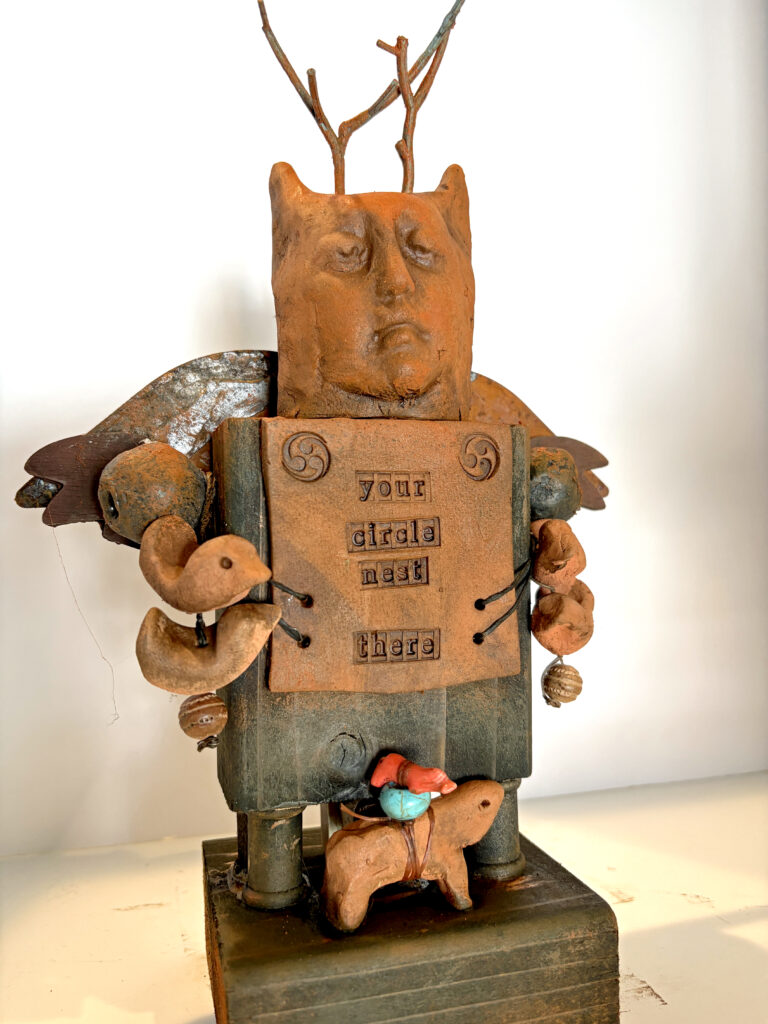
Mendicant Messenger: The Nest Keeper
Carries the knowledge that home is not claimed, but tended. Belonging is made through return, care, and the patient shaping of small, protective circles.
While working on my Encantos and Mendicant Messengers for the Taos show, it became very clear to me that there was no rational way to calculate their “value.” Every element was touched, considered, set aside, returned to, and finally placed with care. The work carried intention, patience, and a kind of spiritual listening that doesn’t show up on a spreadsheet. How do you put a price on that?

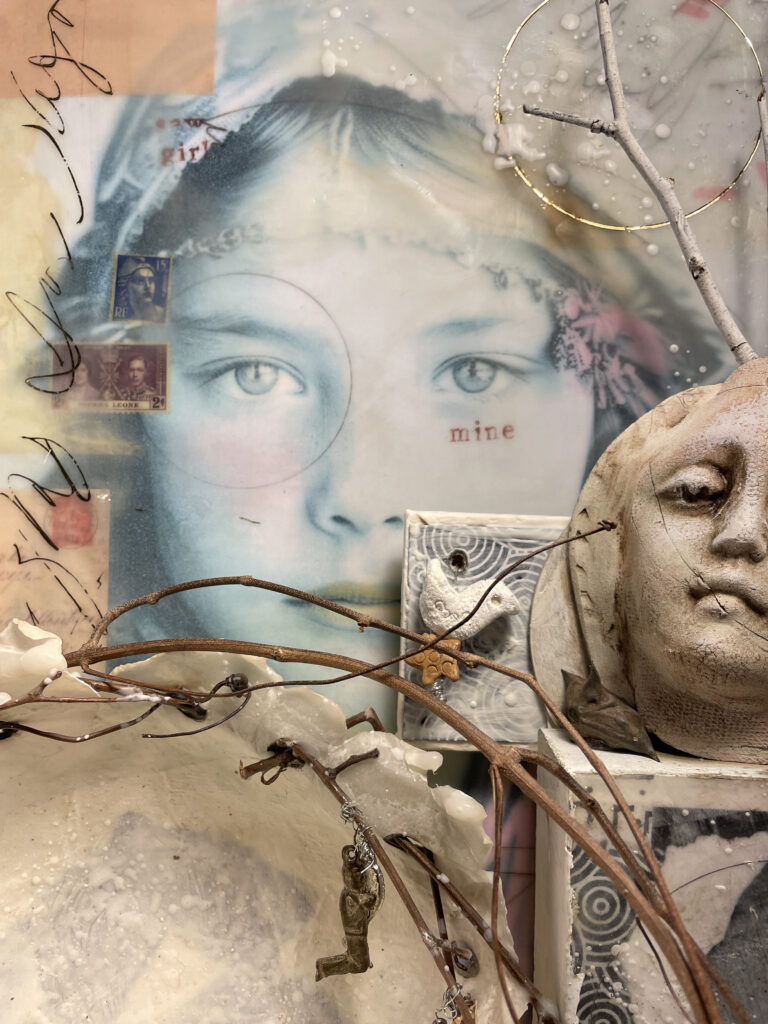
The Listener of Copper Paths: The Listener of Copper Paths encanto watches over people who carry hidden worries.
And yet, I still want these pieces to find homes where they’re needed. I want them to be accessible. They need to continue their lives beyond my studio. Somewhere between devotion and practicality sits the uncomfortable question: How do we translate process into money?
The first thing I keep coming back to is this: price is not a measure of meaning. It never has been. Money doesn’t pay for the spirit that went into the work. It simply allows the work to move—from studio to world, from maker to keeper. Price is not a judgment of worth; it’s a translation tool, a bridge between inner labor and outer systems.
Accessibility doesn’t mean undervaluing. Sometimes it means trusting that the right person will recognize the work, not consume it casually. Sometimes it means allowing the exchange itself to be part of the ritual of letting go—an acknowledgment that something cared for is being received with care.
And then there’s the bigger question that makes me pause: Is selling the ultimate goal for artists? If it were, art would feel thinner somehow. More transactional. Less alive.
Historically, artists have been motivated by things far deeper than sales: witness, transmission, service, continuity, remembering. Selling is just one possible outcome of that work—not its moral endpoint. When selling becomes the goal, art loses something. When art remains the goal, selling becomes quieter, more humane—a way of releasing work responsibly into the world.
If you feel sensitive or conflicted about pricing your work, that doesn’t mean you’re doing it wrong. It means your work still matters to you. The sadness isn’t about money—it’s about not wanting what you’ve made to be reduced to a transaction.
We’re allowed to hold both truths at once:
This work is priceless in spirit.
This work needs a number so it can find its way.
That tension isn’t a failure. It’s a sign that the work still has a soul. In the end, pricing is not a test you pass or fail. You can seek counsel, follow structure, and change your mind—but the number you choose is simply the one that feels like a respectful release.
Loved your thought process here -all so true and meaningful !
Thanks, Lesta – you do a good job with your own work – pricing it to be accessible but fair – xo
Thank you for these words! Price is something I have struggled with. I just always feel honored when someone appreciates a piece enough to have it in their space, and I realize that it is ok for me to also value the piece enough to put a reasonable price on it to let it go.
Yes! It’s weird – if you gave it to them for free, it wouldn’t be valued as much. It’s a strange dance – ♥
Well said!
The best article I have ever read on the subject!
Wow, thanks! It’s a never-ending discussion – 🙂
Thank you, Lynne!
I’m currently pondering pricing for a small show in January and there are a few pieces that I am in love with and may not decide to part with, but some others now I’m ready to honor and release them if it is meant to be—-i have deeper insights into this now and I’m grateful! Namaste
Good for you, Izzy! Those choices are so intuitive and difficult, but sounds as if you are handling it well. ♥
Oh, how I struggle with pricing! Size seems too mechanical but complexity and time it took to finally birth is so abstract.
I also factor in a little bit of—do I want it to return to my house and studio stored away for no one but me to see or do I want it enjoyed by others? So the price has to be considered in that.
I still feel I am not at the “name recognized” place I would like to be and therefore, perhaps underprice my work. The struggle is REAL!
It really is. You know one of the things about not being at a “name recognized” place (and I’m not sure you aren’t) is that your buyers purchase your work for the content that they love and not for the signature at the bottom! I ♥ your work.
I love this. As I grow older (nearing 80) I am more inclined to ‘give’ my art as gifts to family/friends who I know will appreciate and value it. It gives me pleasure to let creations go out into the world for all the reasons you talk about. I have always used $ from sales to ‘support my art habit’, but as I grow old I find I am creating less and there is less need to keep the circle going. I am gradually letting go of the process of creating and finding pleasure in just sharing.
That’s beautiful – and it’s another good answer, Kathleen. I love your work – https://www.etsy.com/shop/FullCircleArt
I agree!!! Pricing is always difficult for me.
It’s so darn complex – always good to hear from you, Cindy.
Beautiful essay, Lyn! I feel that every time I make something, hopefully I make it out of love and the desire to give voice to my ideas. To put a “reasonable” price on what others may be willing to pay for it is very difficult because it is often about finding another “like soul.” The interest of people who don’t or can’t buy is almost as meaningful to me as a sale. The drive to create something unique, or beautiful, or expressive pushes me onward. I hope the sales follow.
Lovely comment, Dee Dee – thank you!! I like the idea of the meaningfulness of those who don’t buy —
So thoughtful Lyn and so comforting. Quieted that internal conflict I feel about pricing. Now I will reread this whenever I’m stumbling trying to find the right release price for a piece. Thank you.
Oh, Judith – thanks. It’s never easy, and I think you and I could talk about this forever!
“a respectful release”
This thought feels just right and resonates beautifully with me. Thank you for sharing your wise insights.
Thank you, Holle – I’m glad it resonates – ♥
Lyn, when and where is your Taos show, I would like to run down say “hey “ and take a look see!
Karen, I would LOVE to see you!! It opens on Jan. 31 at the Taos Ceramic Center and runs through late March, don’t have the exact closing date yet. https://www.taosceramics.com/
It’s been too long!!!