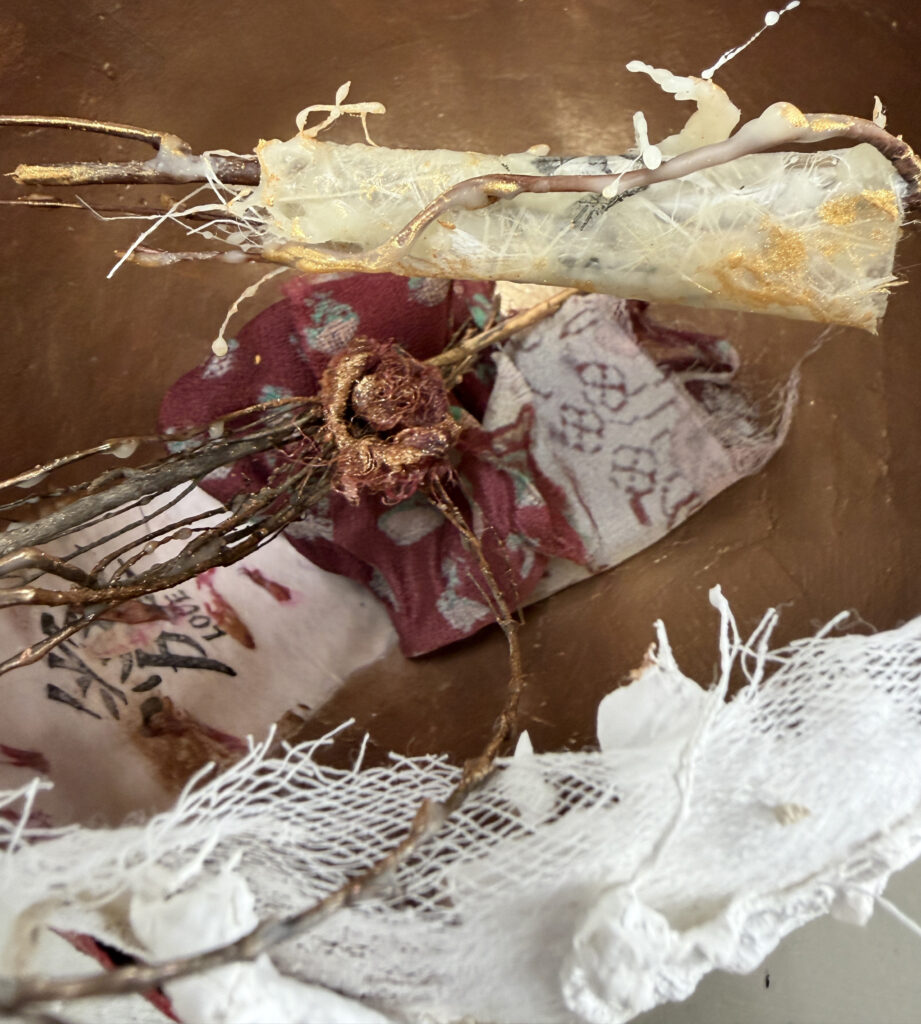
This is Part One of a two-part reflection on our weekend workshop, Vessel Alchemy: Tactile Poems in Fiber, Paper, Word, Light. Next week, I’ll share more vessels — and more of the words they are quietly holding.
This past weekend weekend, as I walked around the Droste Studio at UTSA/SW watching the students work, I found myself truly astonished.
Not just at the craftsmanship — though there was plenty of that. Careful joins. Thoughtful armatures. Fibers handled with restraint. Plaster edges left raw but intentional. Stitches placed where they mattered. Nothing hurried. Nothing ornamental without purpose.
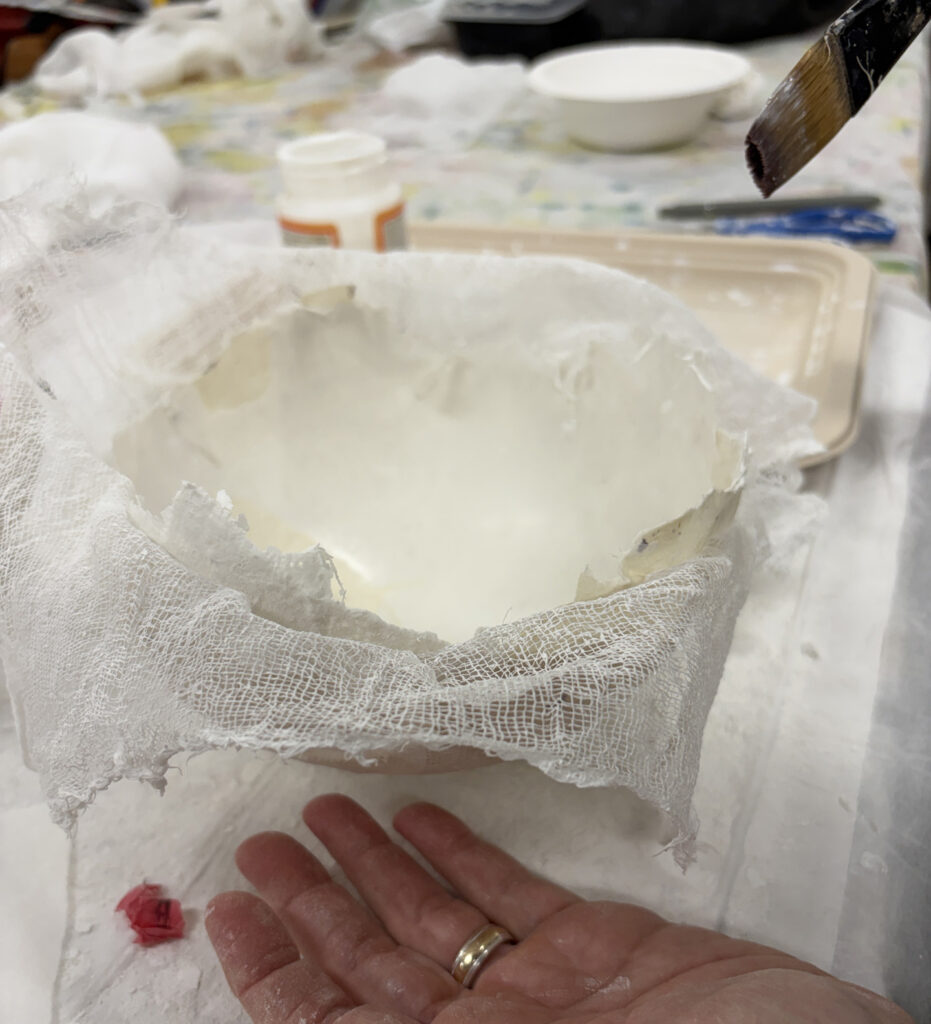
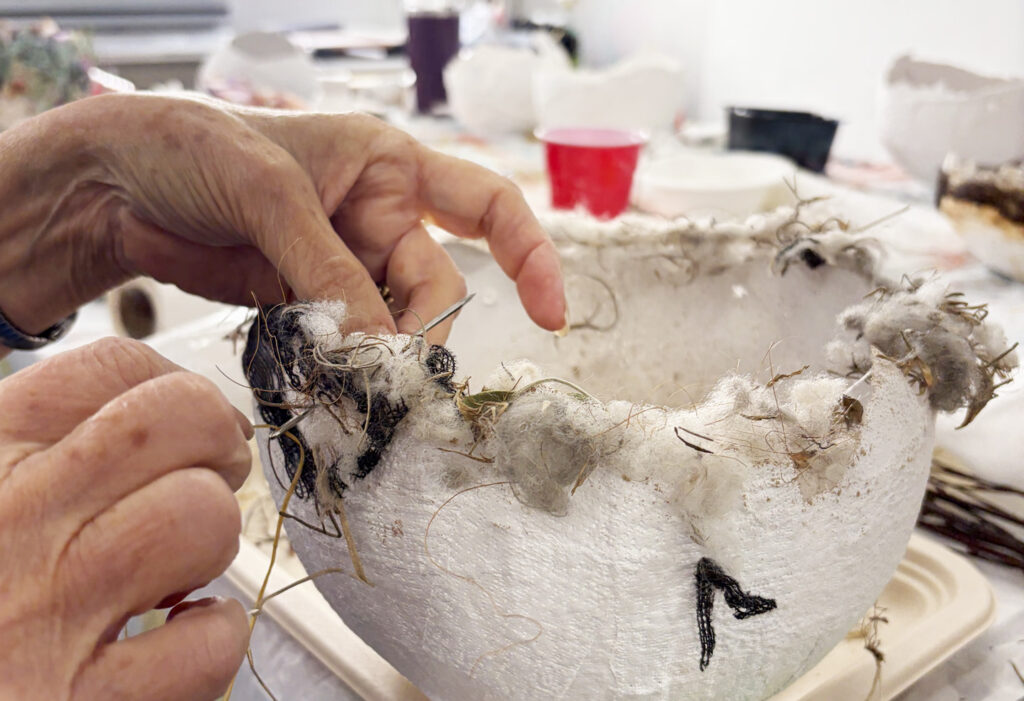
What moved me even more deeply was the respect for the materials. These students did not force sticks to behave unnaturally. They allowed cheesecloth to fray. They let paper tear along its own logic. They treated wax, fiber, wood, and found objects as collaborators rather than supplies. There is a joy in that kind of making.
But what truly stopped me was their understanding of language.
- They understood — instinctively — that words do not merely decorate a vessel.
They define it.
They anchor it.
They release it.
They grasped that words can be embedded like relics, stitched like mending, burned like memory, or inscribed along the interior curve of a bowl. They understood that a vessel does not simply hold words — it is shaped by them.
Here are three examples that I’ve tried to describe with words that mean more than size, shape, and color:
The Interior Script: A Bowl That Remembers
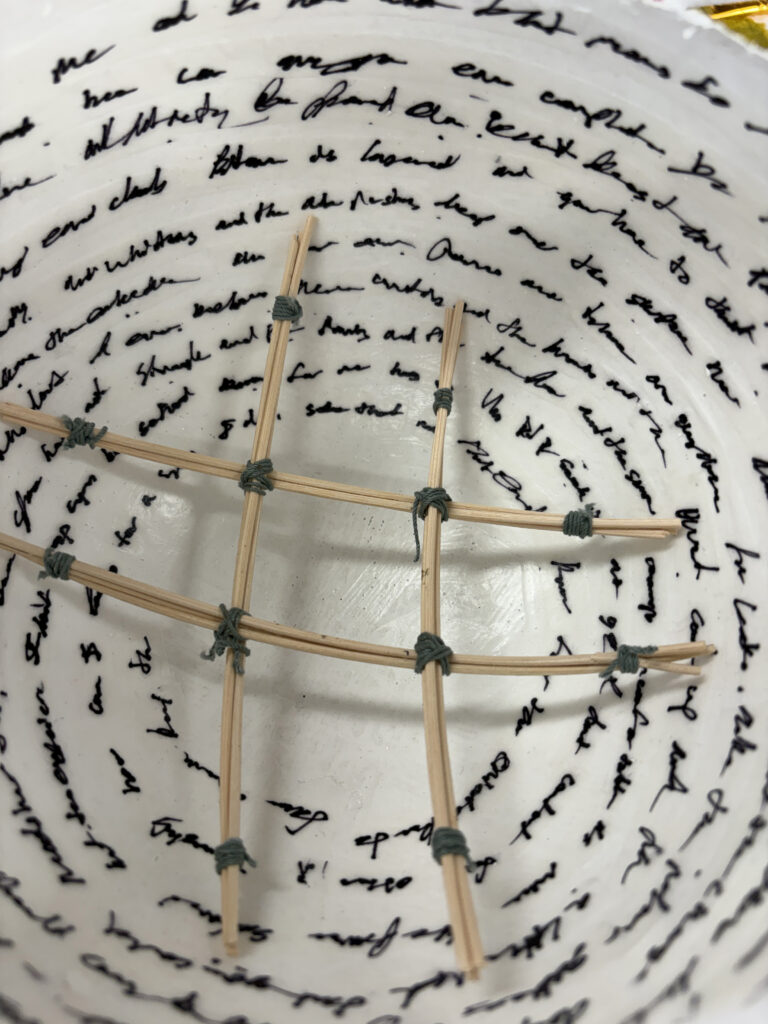
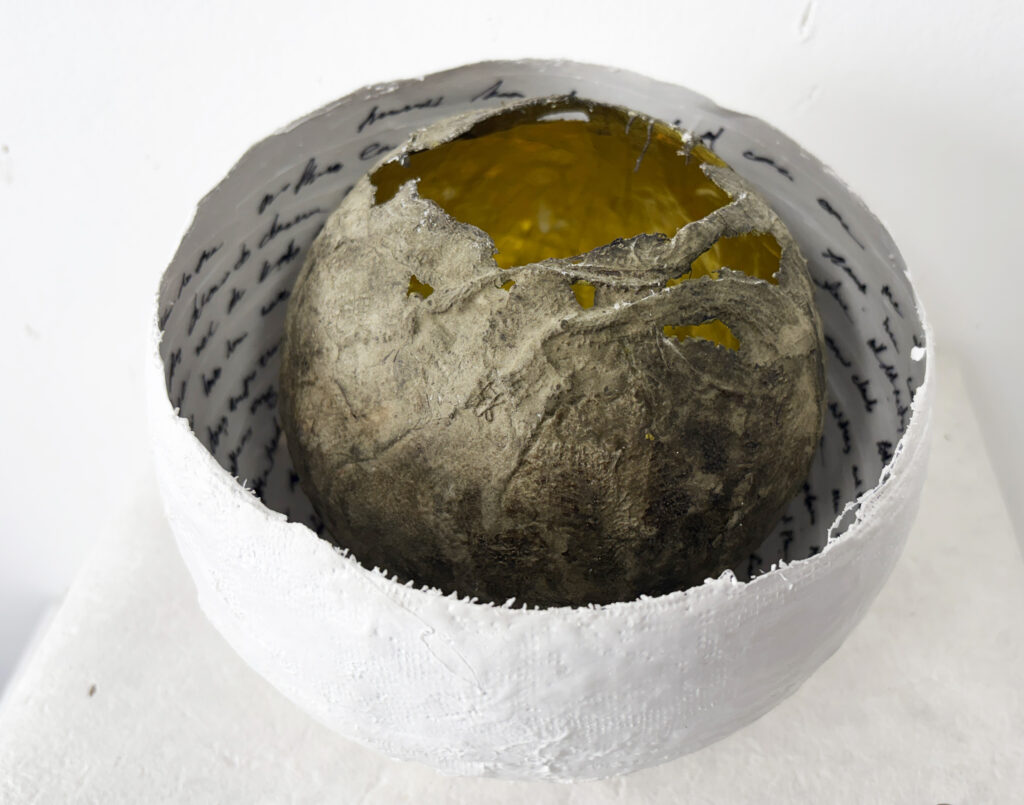
One student (Logan) lined the inside of his vessel with concentric, handwritten text. The words spiral inward, like thought itself. Over this interior landscape rests a simple lattice of thin wooden sticks, bound gently with gray thread — a structure that feels protective, almost like ribs. Actually, it cradles a second structure that fits inside this one like a Russian doll! I’ll show you that picture later.
The vessel invokes words like:
- remember
contain
listen
underneath
crossing
The spiral script suggests that meaning accumulates over time, layer upon layer, sentence upon sentence. The wooden lattice feels like a quiet restraint — or perhaps a trellis. The words are both sheltered and structured. The vessel becomes a meditation on interior life. Here is the vessel with its nested second vessel – the scrip becomes secret language. The second vessel is lined with gold joss paper. Breathtaking!
The Furrowed Edge: A Vessel of Shelter and Weather
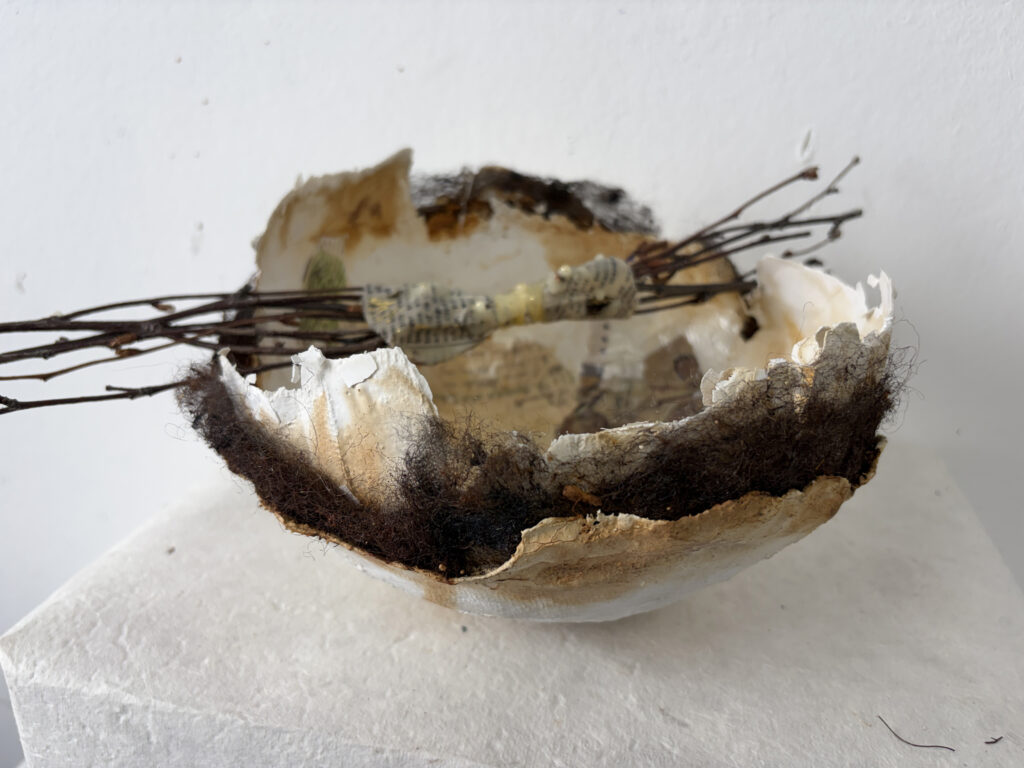
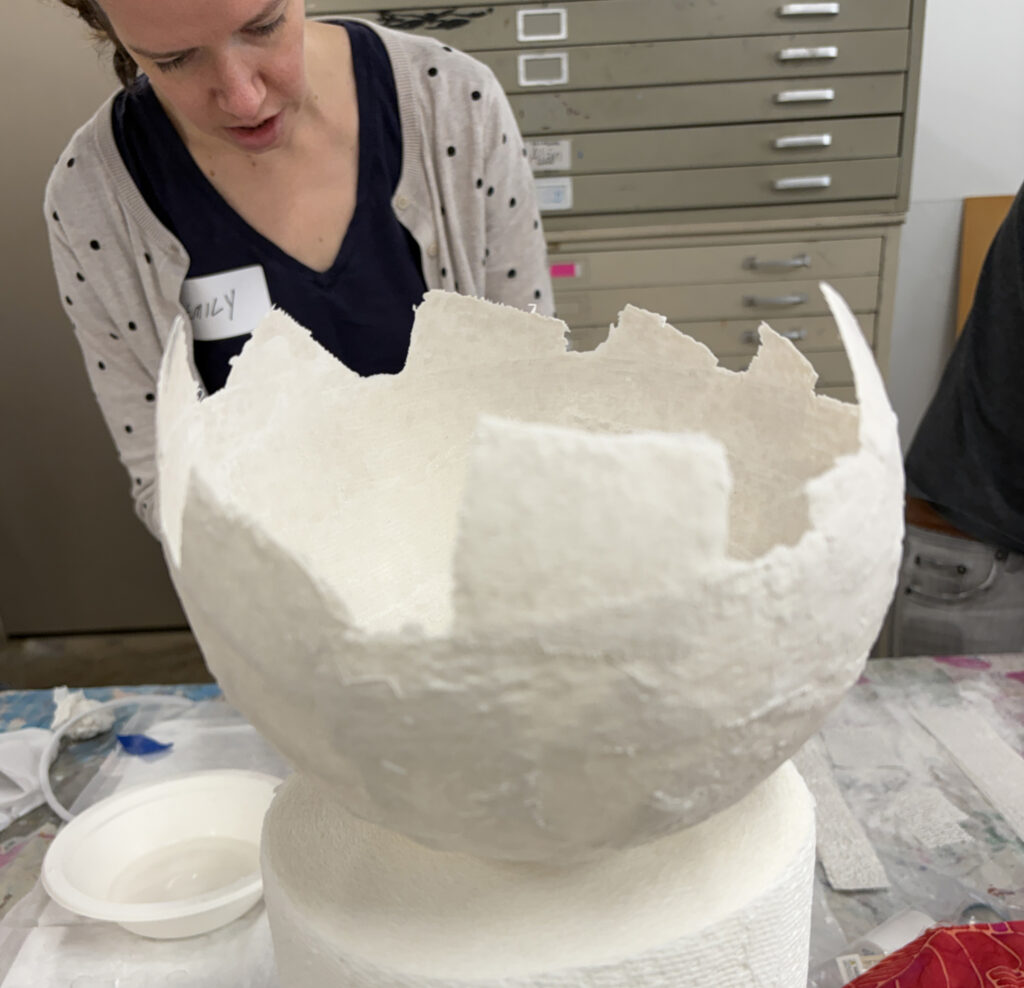
Another student (Carol) created a bowl with torn, irregular edges, rimmed in dark fiber that reads almost like char or earth. Across its opening stretches a small bundle of paper and twigs — bound, weathered, fragile.
This vessel calls forth words like:
- weathered
threshold
endurance
tenderness
scar
The torn plaster edge feels vulnerable but deliberate. The dark fiber suggests something elemental — soil, ash, hair, memory. Can you guess what it is? The bound paper at the top feels like a message carried across a crossing. It is not pristine. It is honest. The vessel speaks of protection that has already been tested.
Two Vessels: What Opens / What Remains
These are two vessels created by Dawn, who made a total of five beautiful containers for her words and poems during the two days we were together.
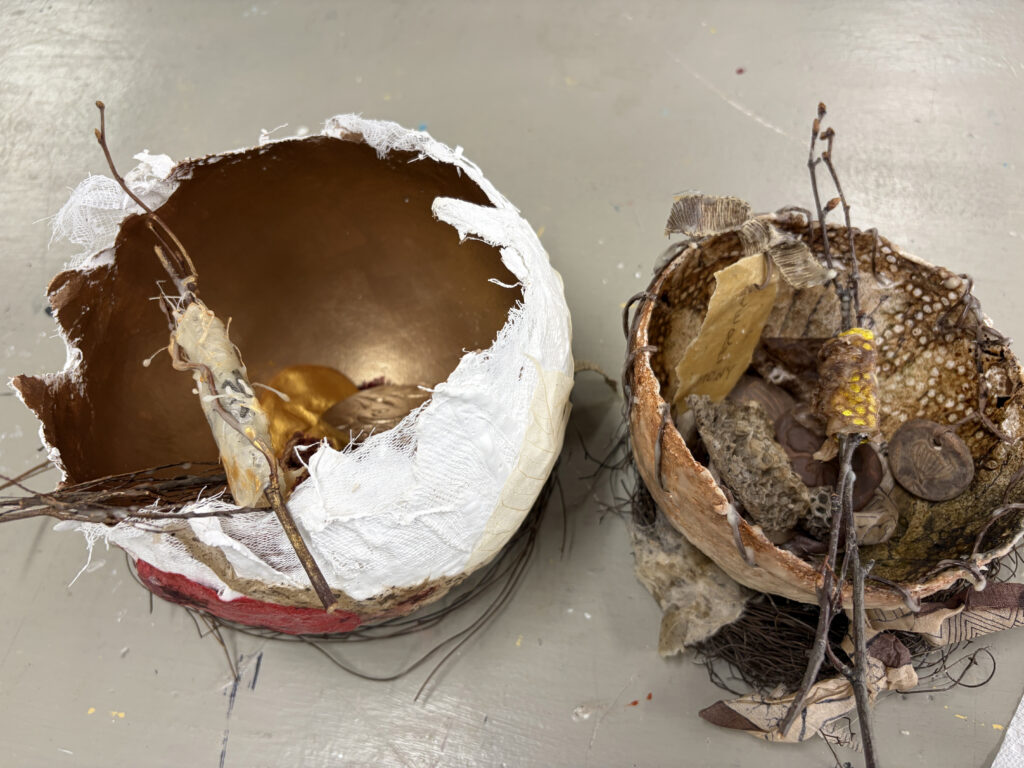
The Luminous Vessel (Left)
This one feels like a breath held and then released.
It evokes:
- revelation
offering
interior light
vulnerability
threshold
secret treasure
There is something tender about its torn white rim. The glowing interior suggests not wealth, but illumination — the kind of light discovered only after something cracks open. The twig-bound element across the top feels less like restraint and more like a blessing.
This vessel whispers:
What is hidden is not lost.
What is broken may be luminous.
The Earth Vessel (Right)
This one feels grounded, sedimentary, layered.
It evokes:
- memory
accumulation
archive
weathered
gathered fragments
ancestral
talisman
burial
keeping
endurance
The interior reads almost like an excavation — objects embedded, tucked, remembered. The textures feel archaeological. The upright slip of paper suggests a marker, a naming, a quiet declaration among relics.
This vessel’s words are:
Nothing is wasted.
What has been lived becomes structure.
Together
As a pair, they evoke:
light and earth
reveal and retain
blessing and burial
opening and holding
chapter and echo
same story, different hour
They feel like two movements in a single composition — one speaking of illumination, the other of preservation.
______________________________________________________
A final note for this first part – what I saw in these works was not just technique. It was comprehension.
The students understood that when we write inside a vessel, we are mapping an interior. When we bind sticks across an opening, we are negotiating protection and permeability. When we leave an edge torn, we are honoring imperfection rather than correcting it.
They were not simply making objects. They were making language visible. Visible poetry.
And maybe that is what we are always doing — whether with plaster or paper, ink or fiber. We are shaping containers for what matters. We are giving our unspoken words somewhere to rest.
Let’s hope we continue to make vessels that hold what needs holding — and release what no longer does. More to come next week!
As always, a thoughtfully considered & beautifully written post. What presence & reverence you bring to workshops & words alike.
Joy, so many thanks!! I love hearing from you – your comments are uplifting.
What magical space you have created for these students…
Lucky me!! You know, Sue, how special that is -you are that kind of teacher!
Amazing workshop
Your work was awesome, Alicia – completely original, completely YOU.
A resonant and contemplative workshop and your remarks about the wonderful pieces created are illuminating! I love how you write and inspire and create such connection and introspection in the artists you mentor! Thank you for sharing! The work created has such a feeling of depth and deep personal meaning Beautiful workshop creations!
☺️ Exceptional results…Bosha
Thanks, as always, Bosha – your aesthetic and mine have always been in synch. I’m so glad you liked the students’ work.
Wow, that workshop must have been amazing to attend in person. I have bought the on-line version, but nothing beats being there. I live in New Zealand, and would be prepared to travel to a workshop in the US at some stage.
I am inspired all over again now to complete my vessel which has lain un-loved, un-finished, and un-inspiring.
I wish we could work together in person – one of the differences is that an online video class can teach techniques, but when we discuss the concepts and complexities in person and work together in a very specific and limited time, everything is focused and compressed. I asked my students to think of a theme for the vessels based on several approaches – here is one of them. Use it for your own vessel and finish it with love!
Theme: What I Am Ready to Release
Energy:
Lightness, exhale, loosening, untangling, soft departure.
Guiding Words:
release
unburden
open hand
drift
shed
lighter
enough
untie
forgive
air
How Words Shape the Form
Instead of beginning with structure, begin with a single word written several times:
release release release
Notice how it feels in the hand. Does the word trail? Does it taper? Does it feel vertical or horizontal?
Let the word determine the architecture.
If the word feels airy, create an open vessel — irregular rim, lifted edges, perhaps asymmetrical.
If the word feels like shedding, allow the plaster or paper to tear rather than cut cleanly.
If the word feels like untying, incorporate fiber that can be loosened, partially unwound, or left trailing.
The vessel should not feel tightly sealed. It should feel permeable.
Process Suggestions
Write the word on thin tissue and partially embed it so only fragments remain visible — like something already fading.
Attach a strip of handwritten paper that extends beyond the rim, as if mid-flight.
Stitch loosely, leaving threads hanging rather than neatly secured.
Use lighter colors inside the vessel than outside, suggesting air replacing density.
What the Vessel Becomes
This vessel is not a container for keeping.
It is a structure that makes space.
It may hold very little physically.
But it holds intention.
It becomes a visible exhale.
Everything you write is poetic. Everything you do fills my vessel with hope. Thank you. Patsye
Wow, Patsye – that made my day!! ♥ Thank you –