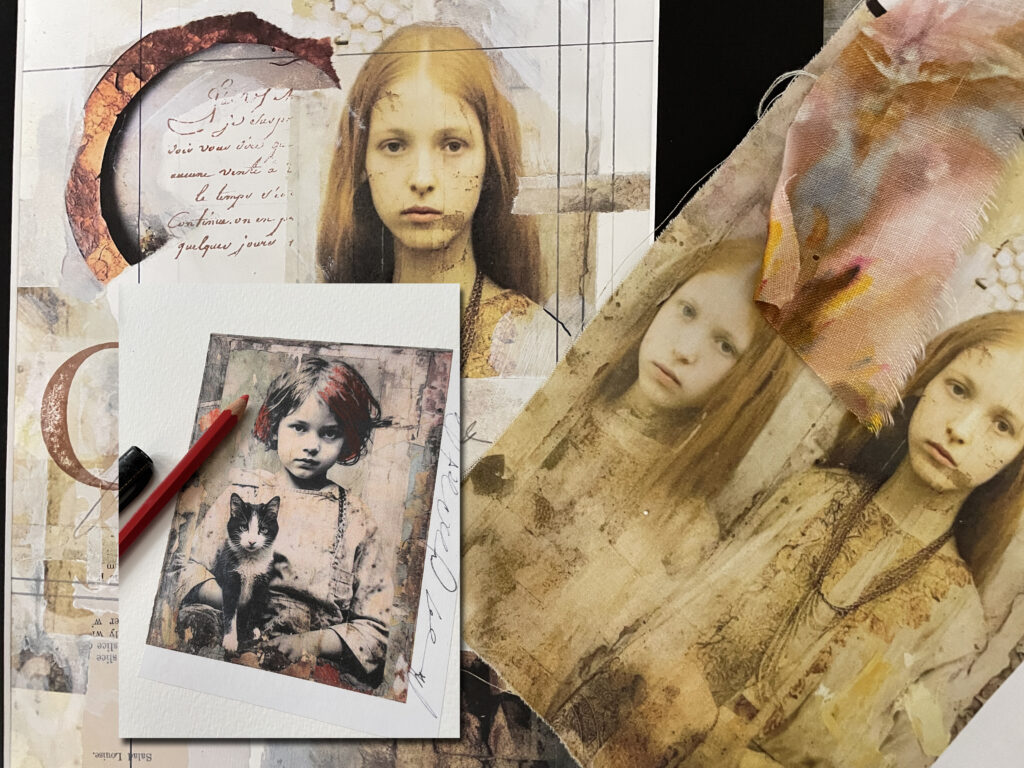
Part 3: Layered Images — The Original Language in My Practice
A three-part series on Fragments, Vessels & Layers
(Part Three: Layered Images)
Series Introduction
Recently, the artist and teacher Crystal Marie Neubauer invited me to talk with her online group about my work. It was an honor — Crystal’s influence on my creative life goes back years — but it also presented a surprising challenge. How do you describe an art practice that moves through so many materials and forms? Encaustic, collage, fiber, clay, found objects… I’ve never been a one-medium artist, and trying to explain everything at once felt impossible.
Then I realized that my work isn’t united by medium at all. It’s united by object and intention — by the three forms that keep reappearing no matter what I’m making.
And when I stepped back, those paths became clear:
-
Santos & Shards — guardians, icons, and the stories held in fragments
-
Vessels — boats, bowls, pods, and the metaphor of holding
-
Layered Images — collage, wax, and the revelations inside translucence
These three paths intertwine across everything I do. And this series grows out of that realization — an invitation to look closely at where my work comes from and how meaning travels across forms.
Today’s final post in this series returns to the oldest language in my practice: layered collage.
Layered Images — The Core and Heart of My Work
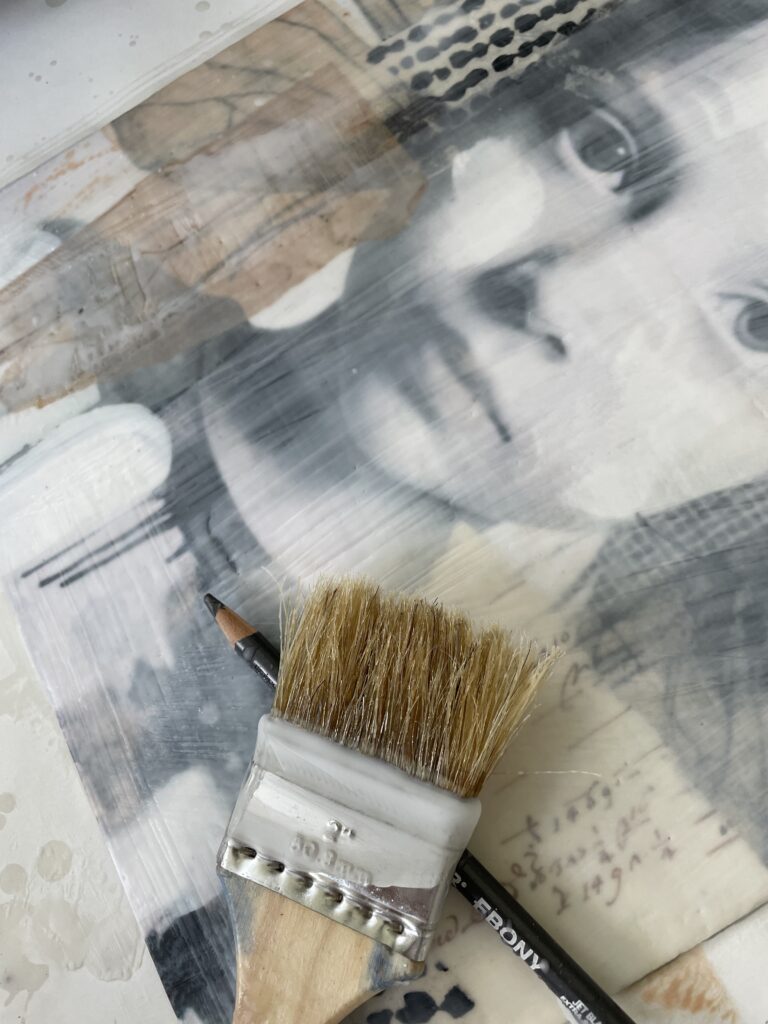
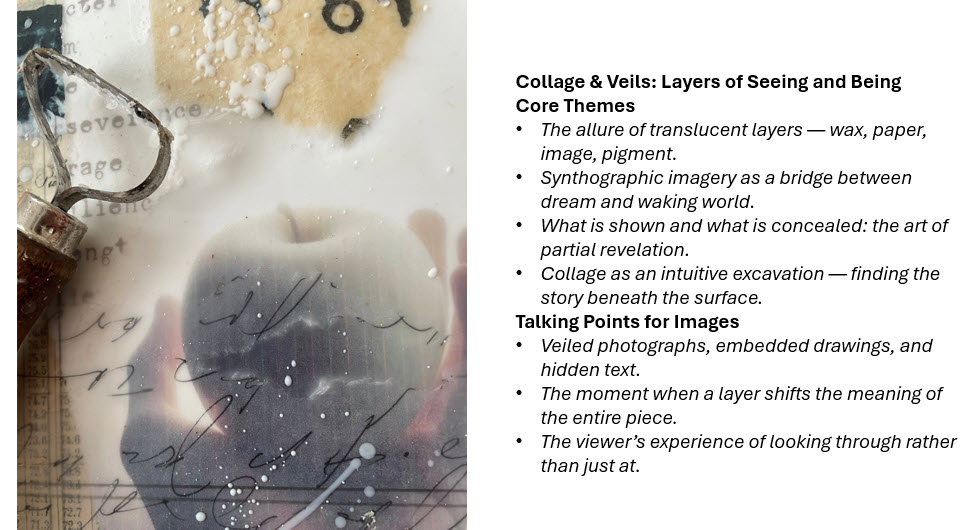
Before my Santos emerged, before I began building boats and pods and sheltering forms, I was working in layers — paper, pigment, image, and – more recently – wax. Collage was my first real artistic home on the flat surface, and it remains the place I return to whenever I need to rediscover what I’m trying to say.
If Shards & Santos are about what we mend, and Vessels are about what we hold, then Layered Images are about what we choose to reveal — and what we allow to remain veiled. I’ve always worked in collage and for the last 15 year I’ve concentrated on encaustic layering thanks to my dear friend Michelle Belto who introduced me to the medium.
Why does Wax play so well with collage? Because It behaves Like Memory
Encaustic wax feels like the perfect collaborator because it mirrors the way memory works:
-
luminous in some places
-
fogged or obscured in others
-
layered with traces of earlier thoughts
-
holding what came before, even as new layers are added
Wax isn’t just a sealant or surface — it’s a way of thinking. It slows everything down. It requires heat, patience, and attention. It asks: Are you sure you want this visible? Are you sure you want that hidden?
I don’t use much colored wax at all – I’m not an “encaustic painter,” rather an artist who uses encaustic techniques to tell mixed-media stories. The pale translucency of beeswax is my go-to collage medium of choice.
A Layered Image Is a Conversation
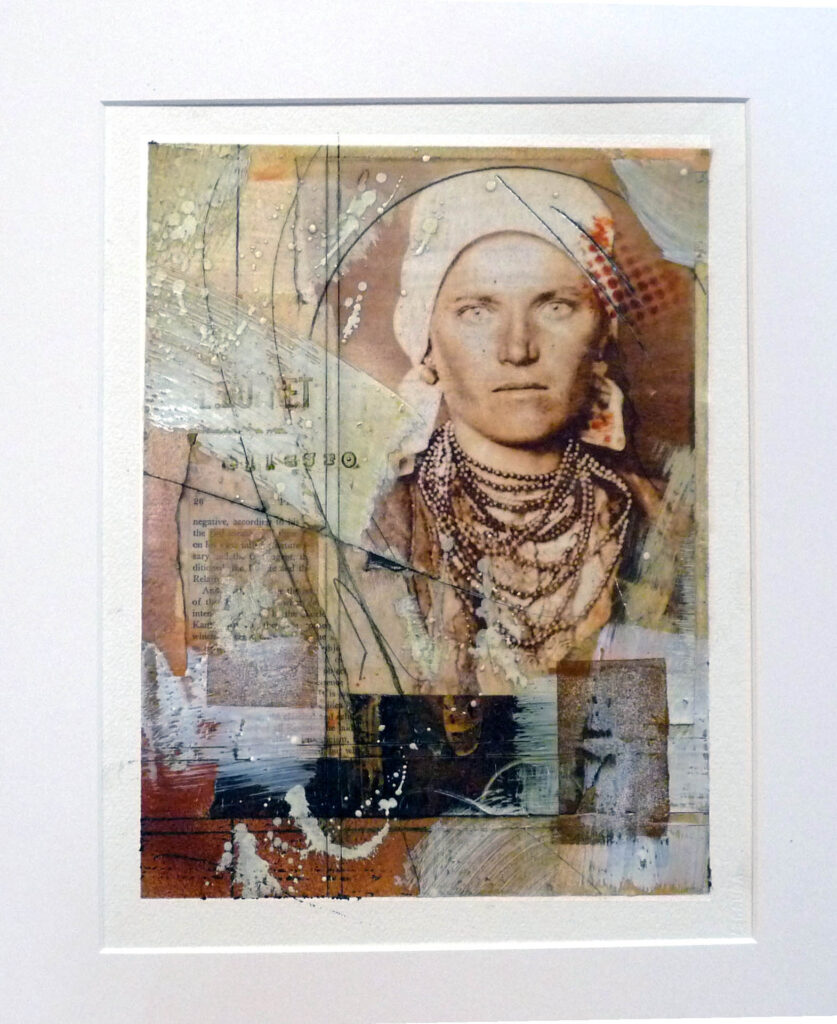
When I work in collage and wax, I’m not composing an image; I’m listening to it. Layer by layer, the piece begins to speak –a scrap of ledger paper peeks through, a synthographic figure emerges or dissolves, an accidental texture becomes the thing the piece needed all along. Even removal becomes part of the conversation. Scraping back a surface to reveal earlier marks often leads me to meanings I didn’t anticipate. Encaustic is not a linear process. It loops. It reveals. It forgets and remembers.
Just like we do.
A Return to Old / A Portal to New
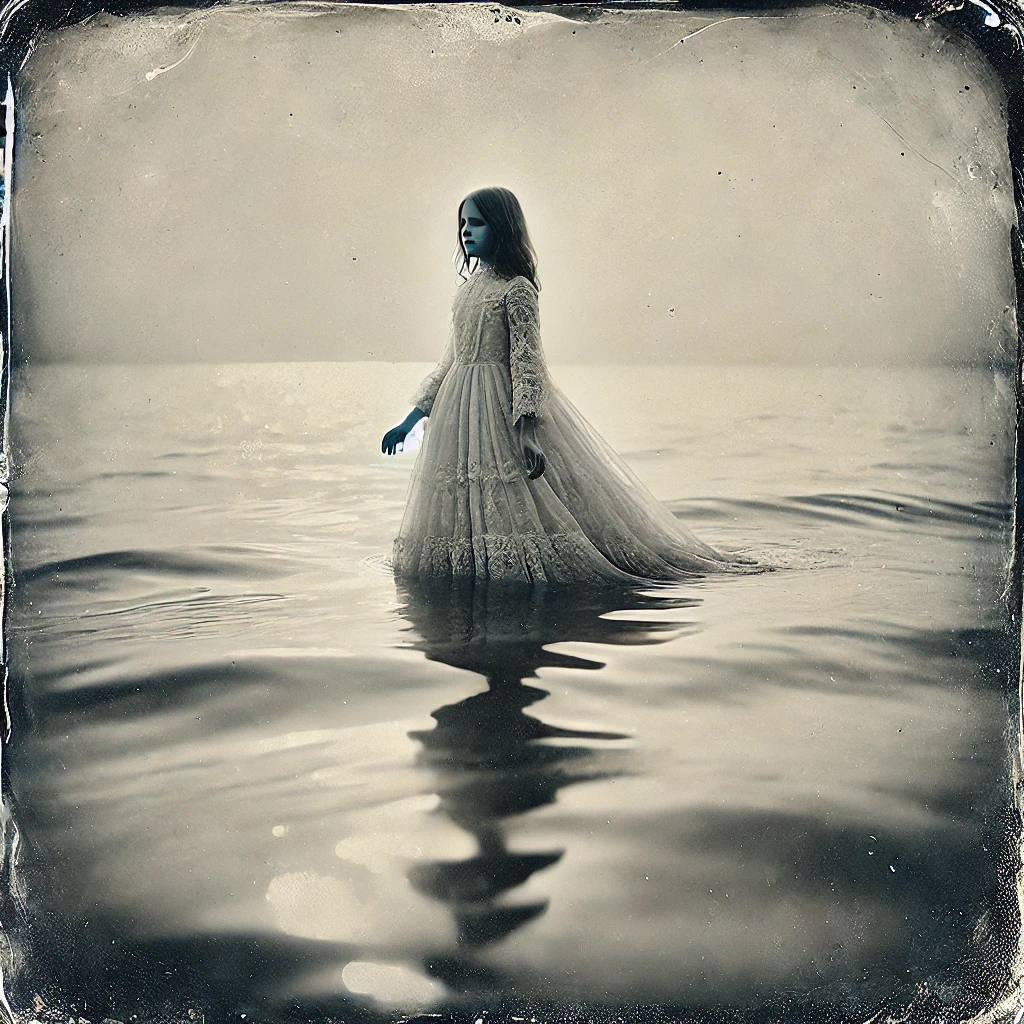
What I love most is that this old, familiar collage path has become a bridge to my newest work with synthographic imagery. The dream-logic of AI images blends beautifully with the ancient, tactile behavior of wax. One creates possibility; the other brings it to earth. If you’ve taken my recent Painting with Fire Lesson, Synthography and Wax, you understand.
The two together create a layered world where fantasy becomes grounded, realism becomes dreamlike, and the viewer is invited inside the luminous in-between
It feels like a collaboration across centuries — digital imagination meeting an art form older than painting itself. These aren’t just surfaces — they are strata.
Inviting You Into the Layers
Even if you don’t work in collage or encaustic, layering is a language almost every artist speaks. It’s about building meaning slowly, letting some things rest beneath the surface, allowing others to shine through.
Layers give us permission to be complex. To hold contradictions. To let time become part of the piece. As an example, here is a new (almost done but not yet – the edges are still taped) series that goes with my Encanto assemblages and will be in the Taos Exhibit in 2026.
I’m creating four layered encaustic collages, 20″x20″, each representing a child saint or Santo Niño. Technically, some are probably female Santas, but gender is not an issue here. Fusion is, fusion of layers and culture.
These Santo Niños inhabit the liminal space where Indigenous cosmologies and European Catholic iconography meet, overlap, and transform one another. The white-painted faces echo ritual marking found across Native traditions, signaling spiritual passage, ancestral presence, and worlds in transition. Their frames and gold-leaf halos recall Spanish devotional art, yet the children themselves do not belong fully to that lineage.
They are hybrid beings—part saint, part spirit-guardian—born of a cultural collision that reshaped the sacred landscape of the Southwest.
I’ve layered mulberry paper printed with carpet designs and birds than might be found in a European drawing room with white painted synthographic faces of anonymous children to create contradictions and layers of metaphor and storytelling. Here they are so far – they may end up with one more layer of meaning but I’m just not sure:
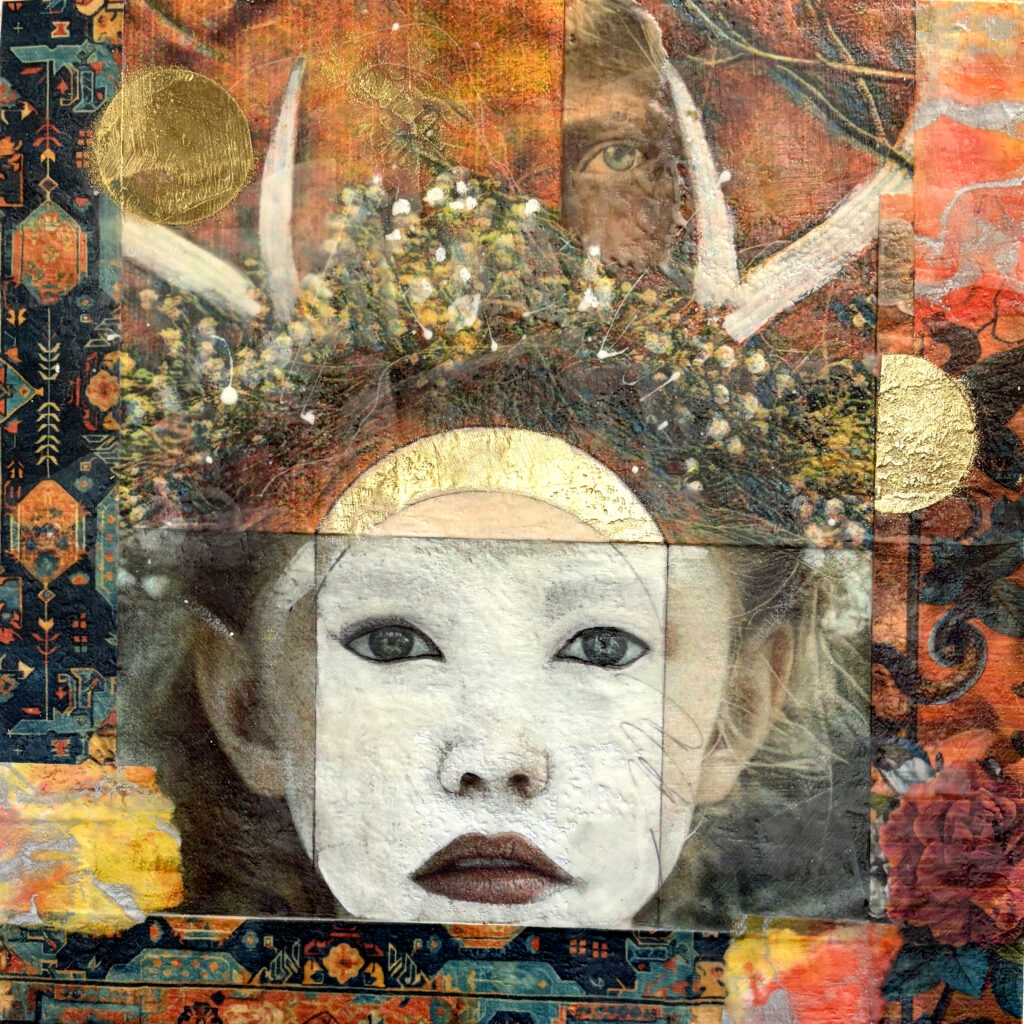
Santo Niño of the Antlers and the Hidden Path
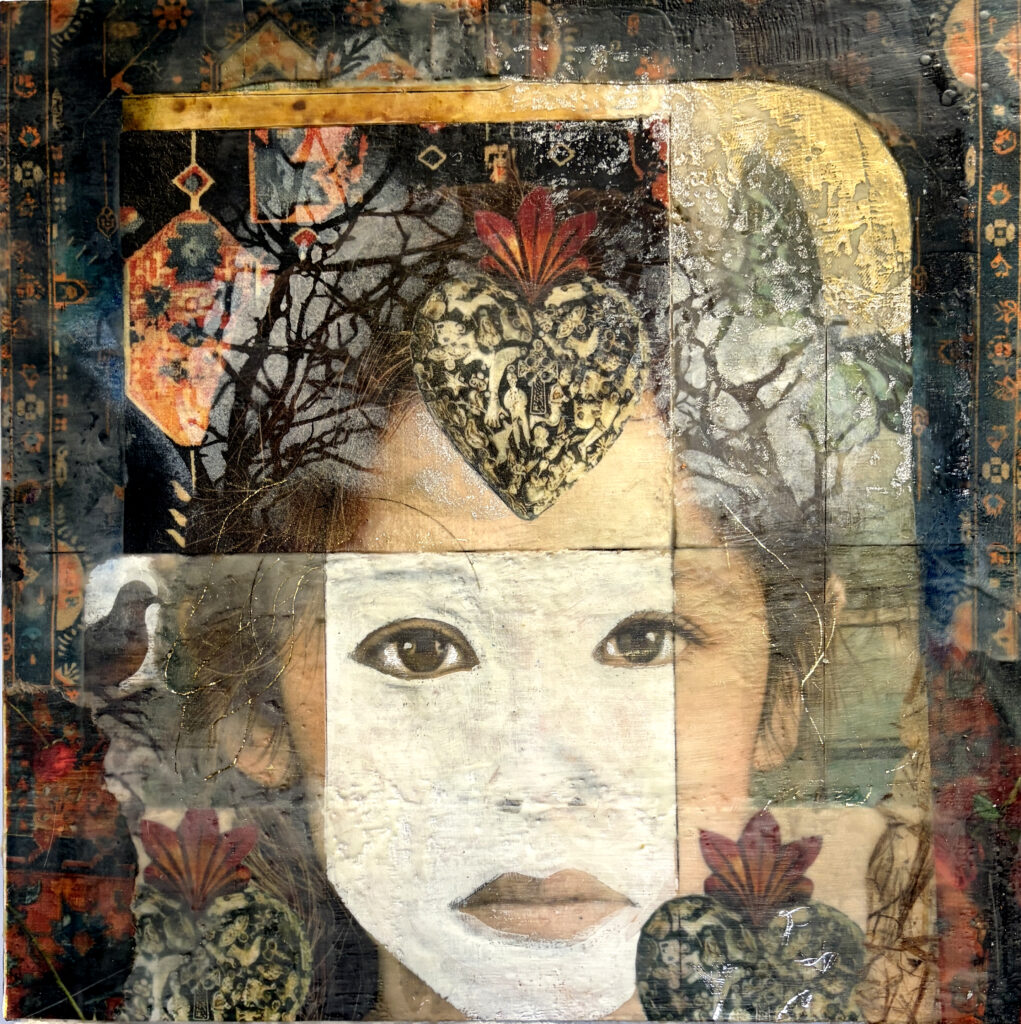
Santo Niño of the Sacred Heart Seed
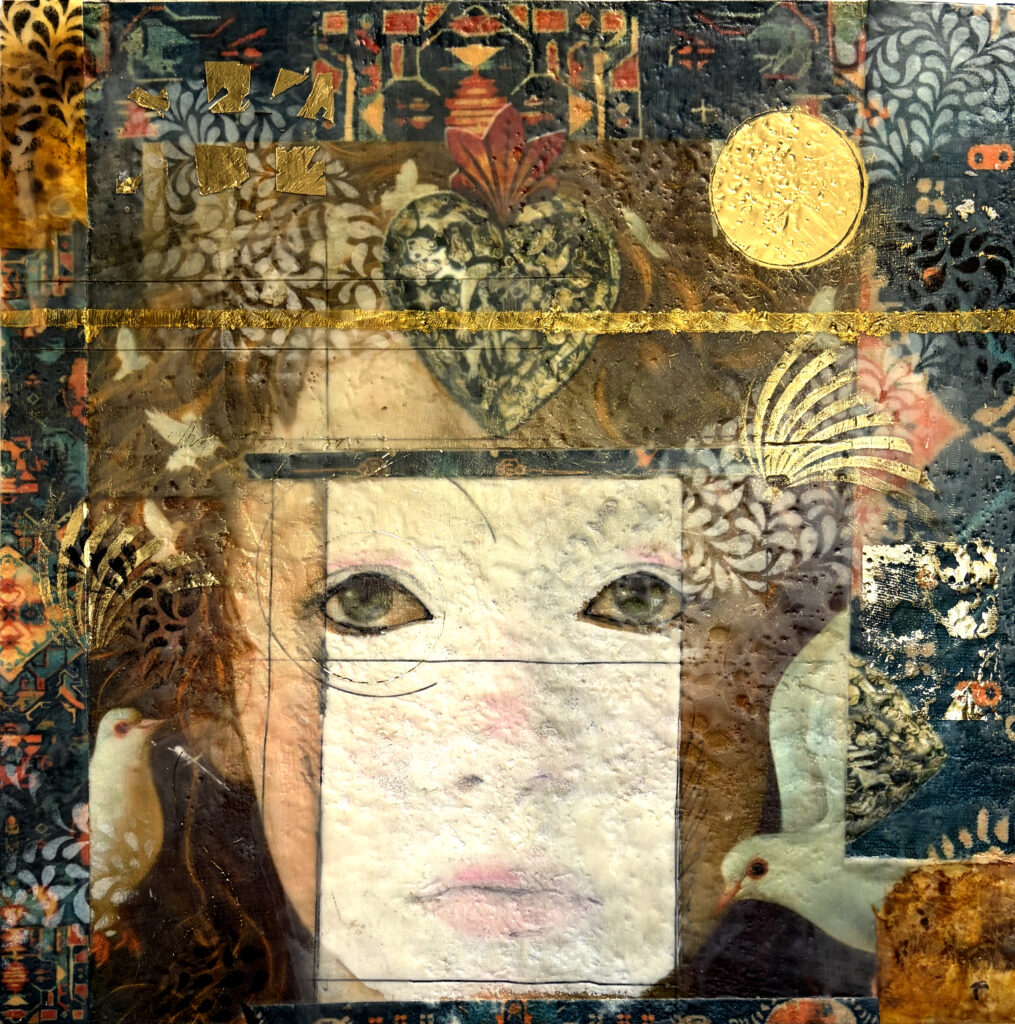
Santo Niño of the Two Doves
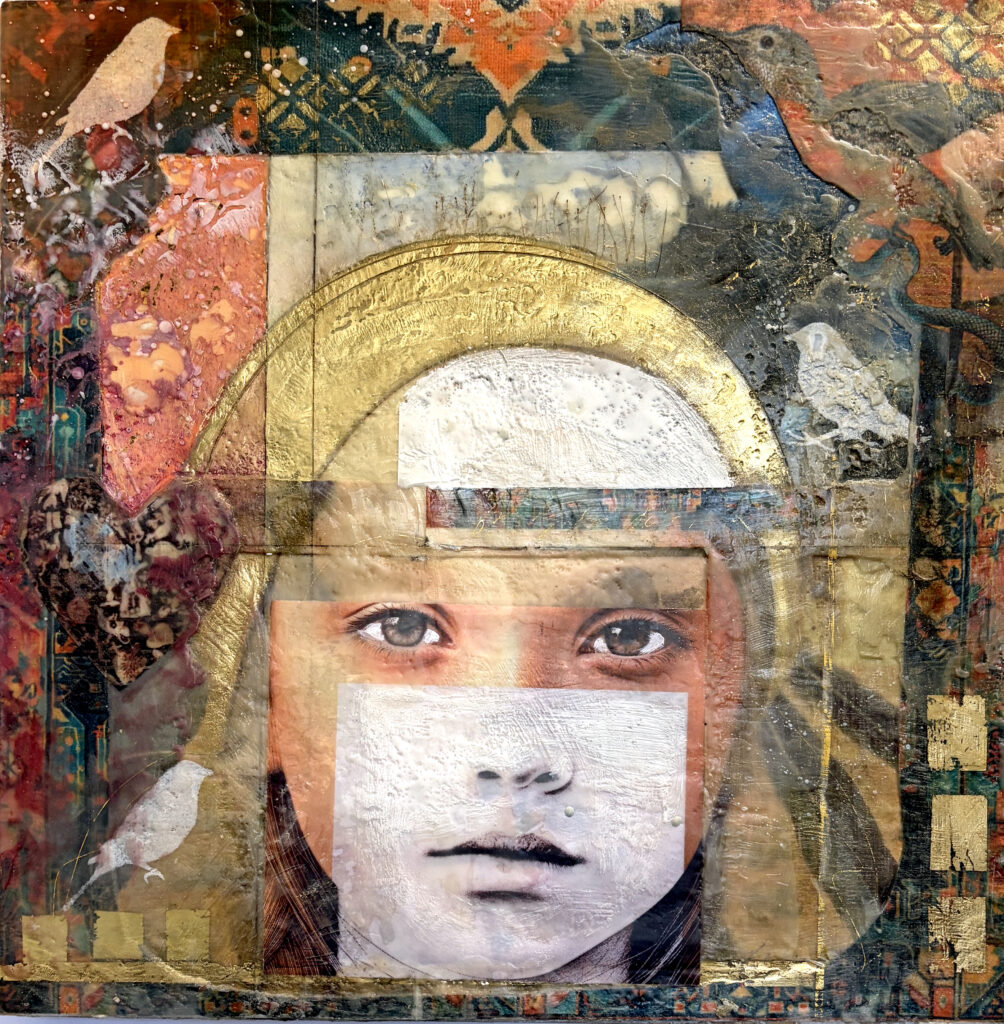
Santo Niño of the Watching Birds
There is more color in these layered pieces (surprise!), but the printed color is pushed back by the veiling layers of wax, almost as if time-faded. I’m having an amazing time fitting the images to the layers of history and meaning in the whole concept of Encantos and objects of hope and devotion in a world where such things need to be extracted again from our deep sense of humanity.
Whew! That was lot to talk about!
Here are a few prompts to bring into your own studio:
-
What early layer in your work deserves to resurface?
-
What do you want to soften — not erase — with a new layer?
-
How might your materials become translucent instead of opaque?
-
Is there an image in your practice that wants to hide and reveal itself at the same time?
Closing the Trilogy
With this third post — fragments, vessels, layers — the series comes full circle. Each path has shaped my work in different ways, but together they form a single through-line:
We create meaning from what we mend, what we hold, and what we choose to reveal.
Thank you for walking with me through all three.
This has been wonderful, Lyn. I’ll always be grateful to you for teaching me to love encaustic and all it can do.
Thank you, Adeleise! You have been so thoughtful in your comments – that means a lot!
❤️❤️❤️
Back atcha!
♥
You’ve done so much thinking about your art no wonder it displays a sensitivity to the medium and clear direciton for the art. Knowing what inspires us and what touches our heart is the key to creating pieces that are both memoriable and enticing. Congratulations especially on your clarity. xox LL
It is so beautiful
Thanks Lyn – insightful and informative- your Santos Ninos series is magical and mystical. A bit of a deviation in size and color and love this new direction for you. Looking forward to seeing the final results – please share when they go on display and are for sale.
Oh, Lyn. Such therapeutic thoughts. Thanks. I am applying your prompts to my challenging state of being in my LIFE. What early layer in your work deserves to resurface?
What do you {I} want to soften — not erase — with a new layer {relationship}?
How might your {my} materials {words and actions} become translucent instead of opaque?
Is there an image {facet} in your practice {of my personality and true self} that wants to hide and reveal itself at the same time?
I’ve loved this series, and bought your online course and am making Spirit Boats. You’ve dragged me back to my studio, after a long absence, due to your compelling language about embedding meaning into my images. Wish you could TAPE your upcoming live event, so I could experience that as well. You are a holiday blessing, Lyn.
You are an awesome teacher as well as artist!