If you’ve traveled along with me on my artist journey for a while, you know about my fascination with images of human faces. I return again and again to the Library of Congress and Flickr Commons to examine the expressions of people who lived ordinary and extraordinary lives, whose faces were captured in the moment with tintype photographs and sepia processes.
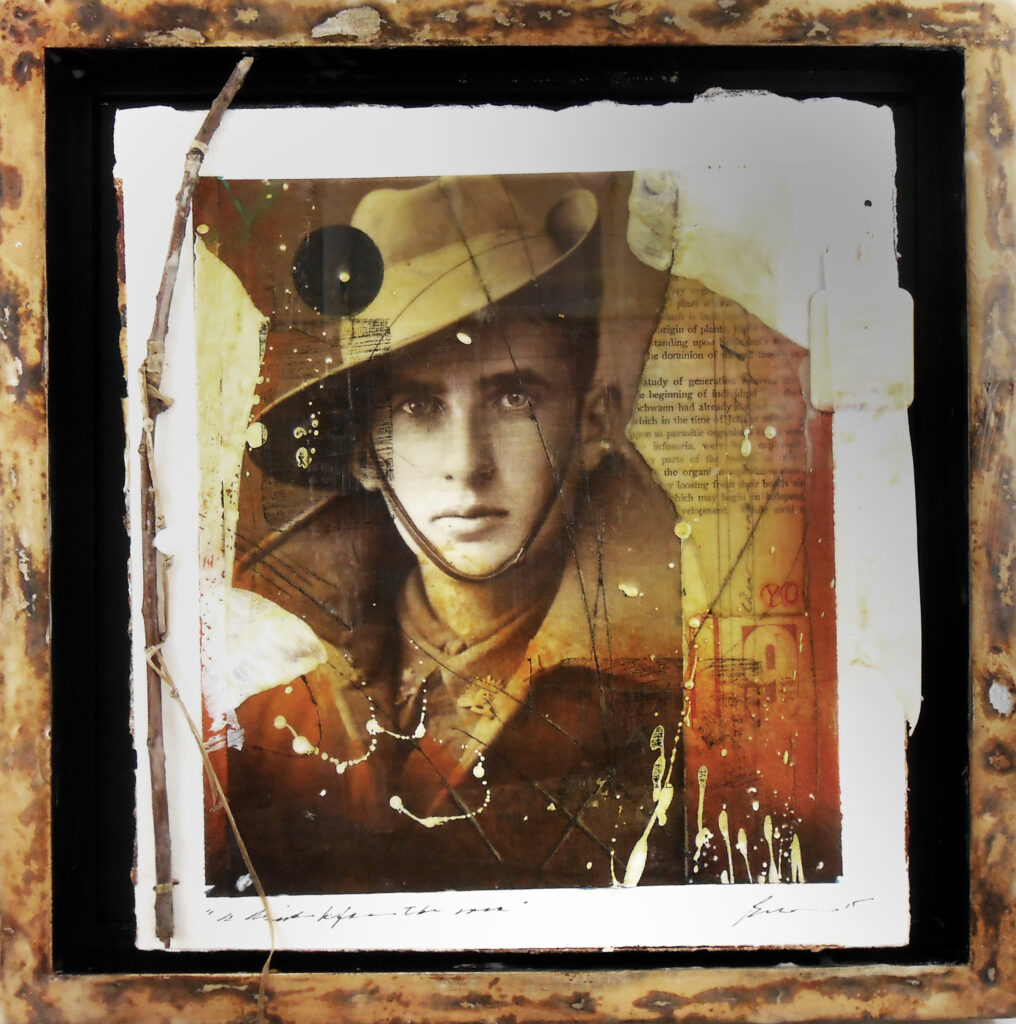
If a face is particularly striking, I save it to a special folder to use in my work – this one, for example, is an encaustic collage I did in 2015 featuring the mesmerizing image of an Australian World War One soldier, probably taken in 1917:
There are hundreds of thousands of photographs to explore on these sites. I generally limit my search to “portraits,” often of women or children like those taken by Lewis Hine.
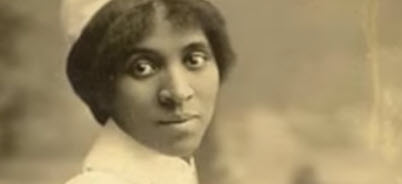
So, on with the story – here is a photographic portrait that literally took my breath away when I found it in the archives of The Commons about eight years ago:
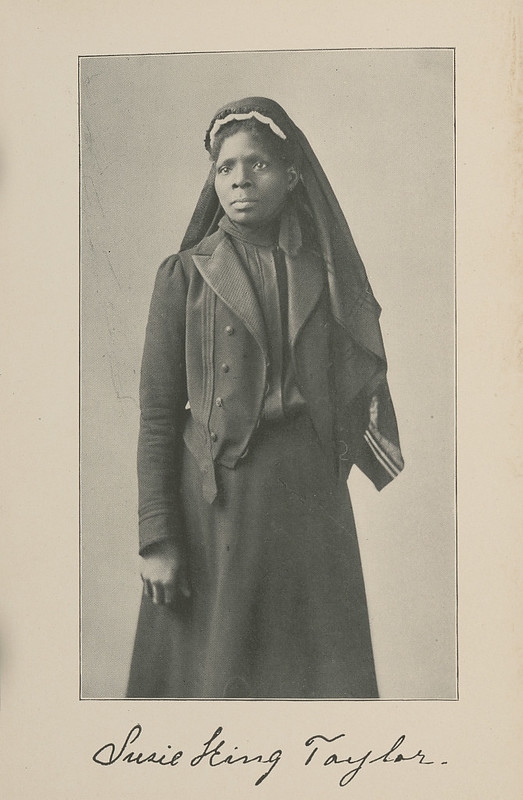
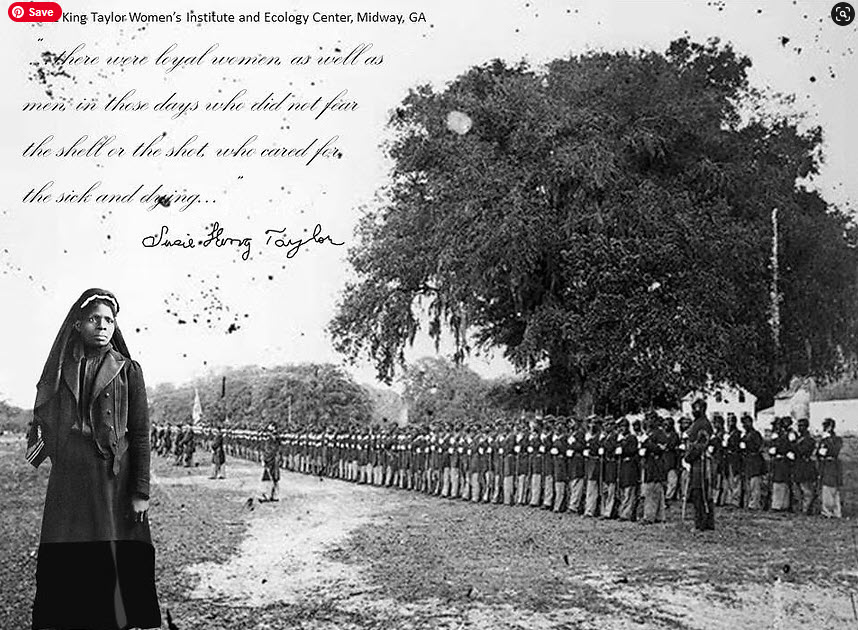
I had no idea who she was, but researched her name and found that Susie King Taylor served more than three years as nurse with the 33rd U.S. Colored Troops Infantry Regiment during the American Civil War. She also taught children and adults to read while serving with the regiment. You can read more of the story here.
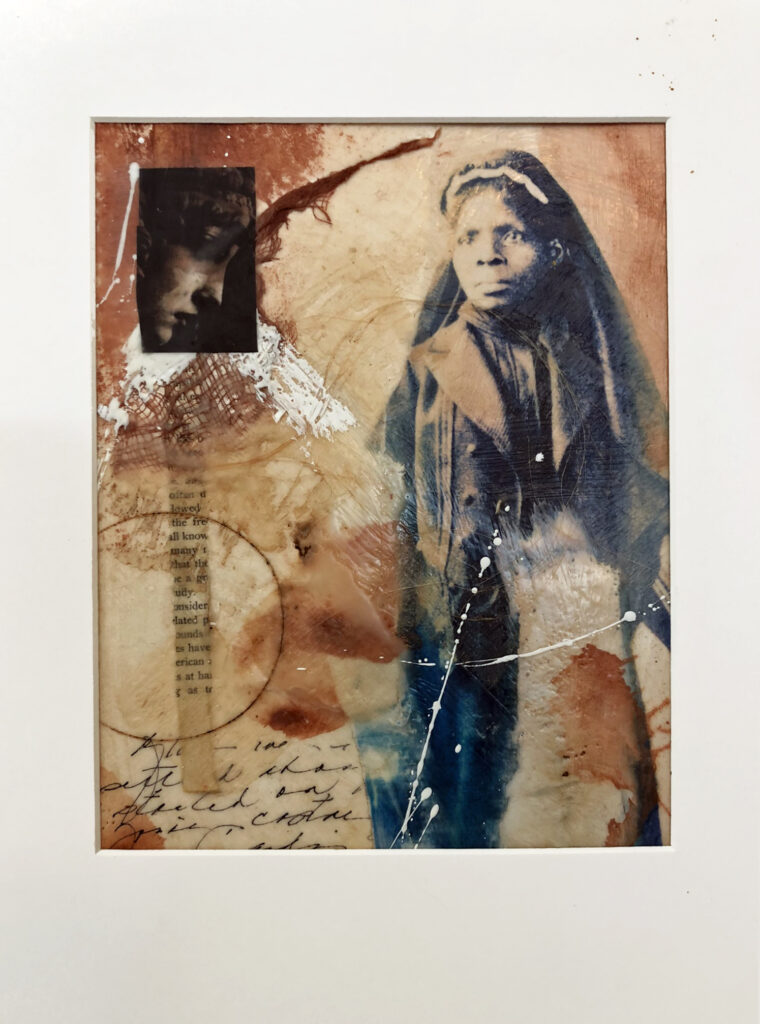
Her portrait inspired this encaustic collage.
 Susie
Susie
Encaustic Collage, 2021
by Lyn Belisle
_____________
Description: This encaustic collage honors Susie King Taylor, the first Black Army nurse during the Civil War. I discovered her photograph in the public archives of The Commons, where her presence immediately caught my attention. As I learned more about her life, I was deeply moved by her courage and service tending soldiers of the 33rd United States Colored Infantry Regiment. In this piece, layers of encaustic wax, vintage text, gauze, and horsehair evoke both the fragility and resilience of that moment in history. The materials reference the field conditions of wartime care while honoring the strength and dignity reflected in Taylor’s portrait. Creating this work became a way of acknowledging a remarkable woman whose story deserves to be remembered and shared.
______________
I never offered this work for sale (it just didn’t seem right),although I wrote a blog post about her in 2021.Susie has been on a shelf in my studio for the last four years. I also ordered the book that Susie King Taylor wrote in 1902 called Reminiscences of My Life in Camp with the 33d United States Colored Troops to learn more about her experiences.
If that had been the end of the story, it would have been enough just to know about this remarkable woman. But wait – there’s more!!
Recently, I came across Susie’s book about her life in the Civil War, and was thinking about her when an email came in from the contact form on my website:
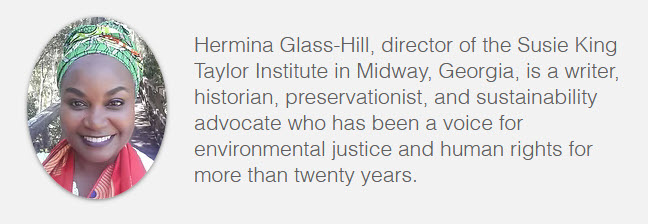
“Good Afternoon, Ms. Belisle. I am Hermina Glass-Hill the founder of the Susie King Taylor Gullah Geechee Museum in Midway, GA – Mrs. King’s hometown. I came across your wonderful artwork that includes a likeness of her. I would like to know if it is for sale. The museum has a collection of artwork in which she is the focus. I would be honored to hear from you. Respectfully Yours, Hermina”
_____________________________________
I was stunned at the synchronicity of the timing. After four years of living in my studio, this is where Susie belonged! I wrote back,
Dear Hermina,
This is such a wonderful letter and a strange coincidence. Today I was replacing some books on my studio bookshelf and one of these was My Life in Camp. I was looking at it and thinking about Susie King Taylor and her remarkable story – and then came your letter!
I’m attaching an image of the encaustic collage I did of her in 2020. Here is an excerpt from an article that I wrote for the Winter Issue of Encaustic Arts Magazine that year which explains how I work with historic images and how that image of Susie King Taylor just grabbed me when I saw it in a library archive.
It would be my honor to make a gift the original work to the Susie King Taylor Gullah Geechee Museum. You are doing a magnificent job of preserving and celebrating the memory and accomplishments of this remarkable woman.
___________________________________________
Hermina answered: Wow! Thank you for connecting with me so quickly. Isn’t it amazing that out all the things that could possibly happen in the universe that two people could connect thoughts like this. My heart is filled with so much gratitude for your kindness and generosity.
With joy, I prepared the artwork for shipping to send Susie on her journey home to the Institute that bears her name and to Hermina, its founder.
We continue to email, and I continue to explore the Institute’s website and learn even more about this remarkable woman – here is an excerpt about Susie’s early education:
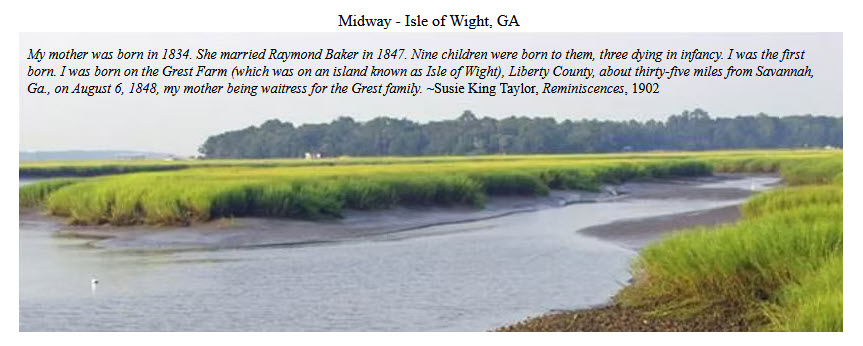
“I was born under the slave law in Georgia, in 1848, and was brought up by my grandmother in Savannah. There were three of us with her, my younger sister and brother. My brother and I being the two eldest, we were sent to a friend of my grandmother, Mrs. Woodhouse, a widow, to learn to read and write. She was a free woman and lived on Bay Lane, between Habersham and Price streets, about half a mile from my house. We went every day about nine o’clock, with our books wrapped in paper to prevent the police or white persons from seeing them.”
Even as a child, Susie understood that knowledge was power—and that learning carried risk. The simple act of carrying books wrapped in paper so they would not be seen speaks volumes about the courage that shaped her life. Education, healing, and service would become the threads that wove through her extraordinary story.
When I read passages like this, I feel even more grateful that her portrait found its way into my studio all those years ago. Sometimes an image calls to us before we understand why. Something in the gaze, the posture, the quiet dignity of the person reaches across time and asks to be seen again.
And sometimes it takes years for that story to unfold.
What moves me most about this experience is not just Susie King Taylor’s bravery—though that alone is remarkable. It is also the intuition that guided Hermina Glass-Hill to reach out across the digital world to a stranger who had once felt the same pull toward Susie’s story. Hermina has devoted her life to preserving the history and legacy of the Gullah Geechee people and of Susie King Taylor in particular. Something led her to search for images, to follow a trail, and eventually to my website.
That kind of intuitive curiosity is something artists understand well.
We follow threads that we cannot fully explain. We collect images, fragments, and stories. We assemble them in our studios without knowing where they may eventually belong. And sometimes—if we are fortunate—those pieces find their way back to the places where they can speak most clearly.
Sending this artwork to the Susie King Taylor Women’s Institute and Ecology Center feels less like giving something away and more like completing a circle. The portrait that once spoke to me in an archive will now live in a place dedicated to honoring her life and educating future generations.
Art has a quiet but powerful way of creating these connections.
A photograph taken more than a century ago.
An artist working in wax and collage.
A historian preserving a legacy in coastal Georgia.
An email arriving at just the right moment.
It reminds me that when we make art from the heart—and when we share it openly—we never really know where it might travel or whose story it might help tell.
Sometimes a face in an archive is not just an image waiting to be discovered.
Sometimes it is a messenger.
And sometimes, if we listen closely enough, it finds its way home.
What a beautiful story! Thanks for sharing it.
Kathy, so glad it resonated with you – it was one of those really fortunate experiences!
Wow…this is all so powerful! Thank you for sharing with us!
Robin, thanks! And I know your art touches so many! ♥
Wow! What an incredible story of the stars aligning to create this magic. Your art practice continues to inspire me and helps me understand that I can, and should, reach for more.
Thank you, Cindy – I’m still a little in awe about all of this. It’s one of those small things that keeps us going 🙂
Reading this gave me chills. What a brilliant convergence. Thank you for sharing this story with us. ♥️
Thank you, Adeliese, for your wonderful comments – you are always so kind to read and reflect and share with me.
Lyn
Thank you for sharing this beautiful and inspiring story! That is truly remarkable and I love how these art pieces find the perfect home and go on to inspire. Your many classes and work have been so exciting and encouragement to make art for the love of art. I would love to join one of your classes one day. I always love receiving your emails and stories on new work, museum pieces and galleries. Also, just wanted to thank you for being so generous with your sources and materials. So helpful to someone not always immersed in these areas. In Gratitude, Wendy Keown
Wow, Wendy – your note totally brightened my day. Thanks so much for the encouragement. We are all in this together, and I’m so glad you are here!
What an amazing story! Thank you for sharing.
What an amazing story!
Melanie, thanks – and you are one of those people who absolutely gets those small miracles 🙂
What amazing timing! What an inspiring story! And what a loving example of giving and receiving. So cool, Lyn!
Ann, you are such an inspiration for sharing and for putting yourself on the line for love and good – thank you so much, my friend!
I always look forward to the SHARD emails and tuck them away to read when I am fully present because they always inspire me in some way. This story is amazing and so fitting. You put so much of yourself out into the universe that resonates with what we so desperately need, a connection with the beauty and courage that still is all around us. Thank you.
Pamela, it’s always so good to hear from you!! And I love what you said – thank you for reading and writing and for the good work you do.
Thank you so much, Lyn, for sharing this beautiful story. How wonderfully uplifting it is to hear about the connections that can be made and of the lives and works that can be honored across time & space.
You said it beautifully, Gloria – “connections that can be made and of the lives and works that can be honored across time & space.” Thanks!
FANTASTIC! Your beautiful work found its way home, the place where it belongs & your legacy of talent & attention lives larger for your generous spirit. Love this story.
Oh, Connie, me too! Thanks for such an encouraging comment! ♥
Wow! Feeling grateful and Inspired!
Thanks, Mary – I felt grateful too – sometimes life still surprises me. Hope all is well with you!
What a beautiful story and a beautiful person. Thank you so much for sharing it, Lyn. Your work is always inspiring.
Sandra, thank you for taking the time to write – it means the world to me!
this is lovely in every way. In solidarity,
So many thanks, Janet – in solidarity, indeed. Looking forward to receiving your new book, Working-Class Girls Don’t Become Artists – thank you for your compelling narratives.
As always — a beautiful story and connection!
Thanks, my friend – ♥ – takes a storyteller to know a storyteller!
I am flummoxed by the artistic, spiritual, historical and charitable influences involved in this particular circle of occurrences. In my view, this is a clear example of the openness and curiosity of an artist which develop into a creation which, even before a story is known, is intuitively expressed by the artist.
I am particularly touched by Nurse Taylor’s sharing of the stealth required by her family and friends to teach her and her siblings how to read. It is not lost on me that an African American, during those times in the United States, risked much to learn how to read or to access education: To be found out, at the very least, was to be denied the opportunity or it brought punishment and in some cases, death.
I am grateful to you, Lyn, for keeping your eyes and heart open, for pursuing and exploring information on the dignity of Nurse Taylor’s life and for your generosity in gifting your art to the Susie King Taylor Institute.
What a rich, empathetic, and thoughtful reply, Miranda – thank you. I will bring Nurse Taylor’s book to our workshop if you like for you to borrow. It’s an extraordinary biographical account. ♥
Yes,please. I look forward to being a student in this upcoming class.
What a wonderful story! This was all meant to be!
Great story Lyn! How fantastic!!
Pingback: Building a Portrait | SHARDS: fragments and reflections