Art has a soul – so what should it cost?

As part of getting ready for my upcoming exhibition,  I’ve been thinking about the complicated subject of selling art—not from a business standpoint, but from a human one.
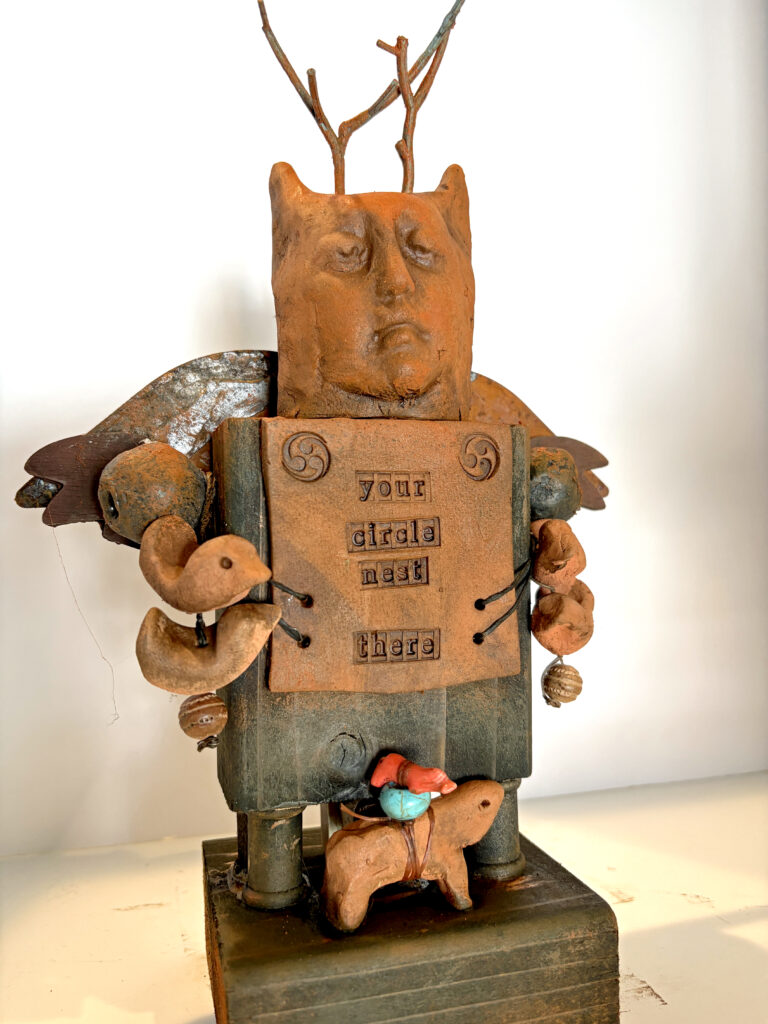
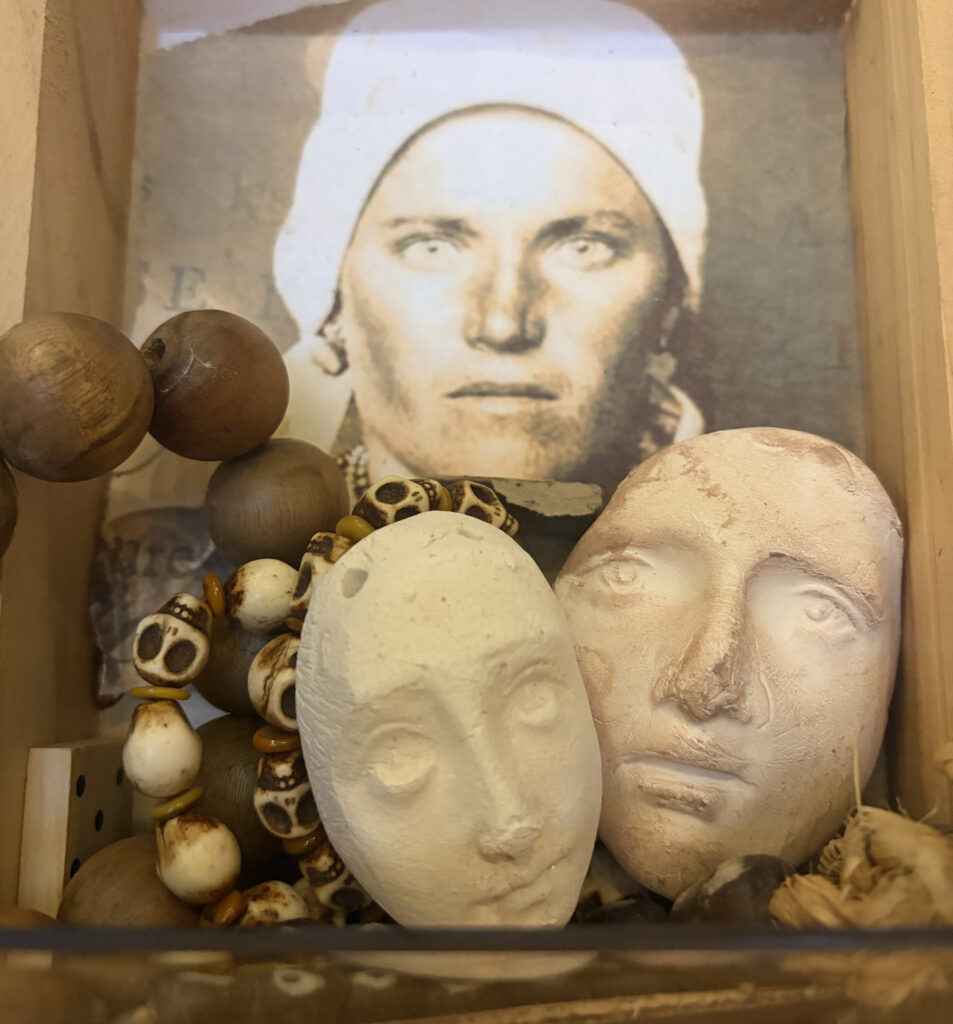
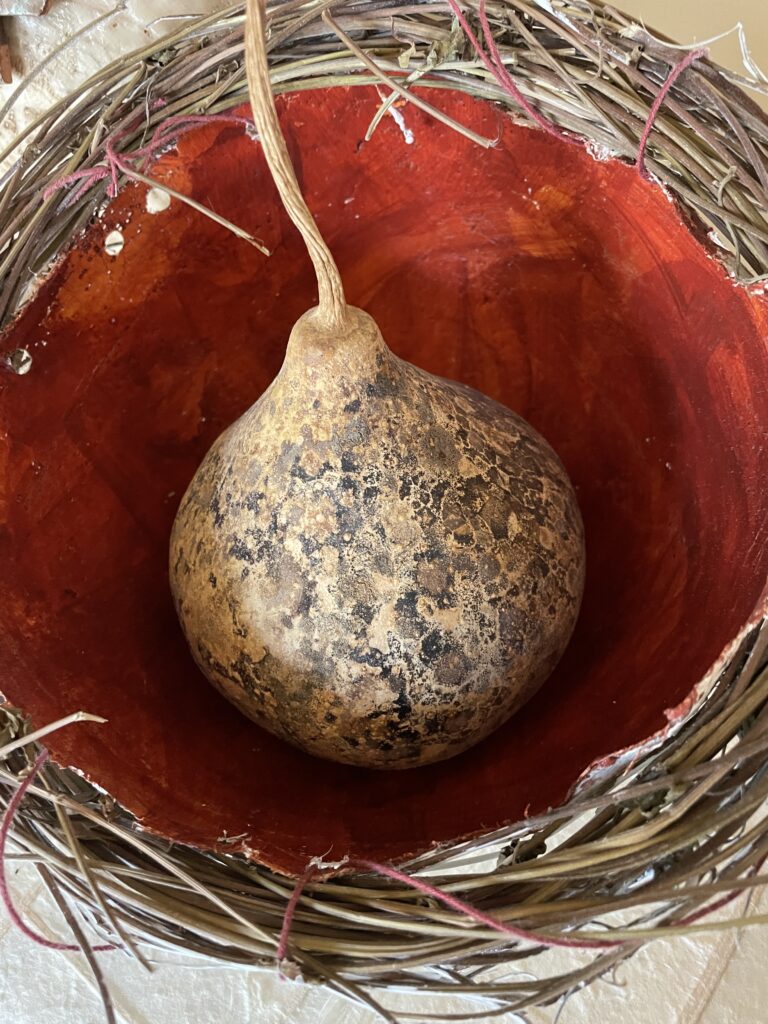
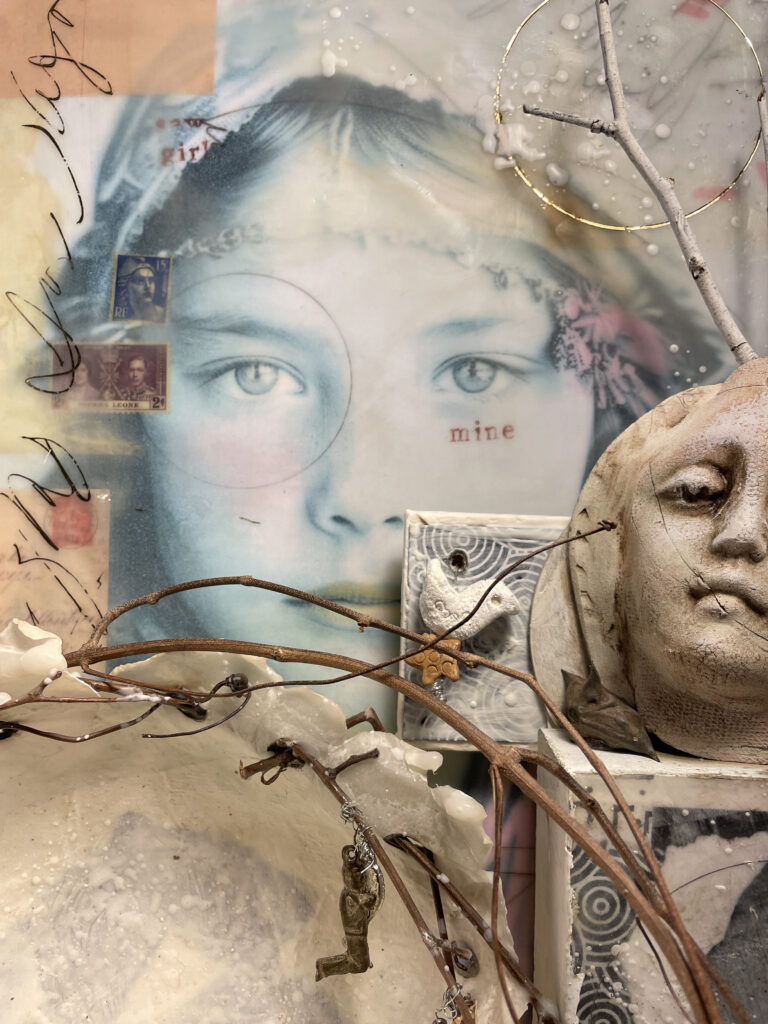
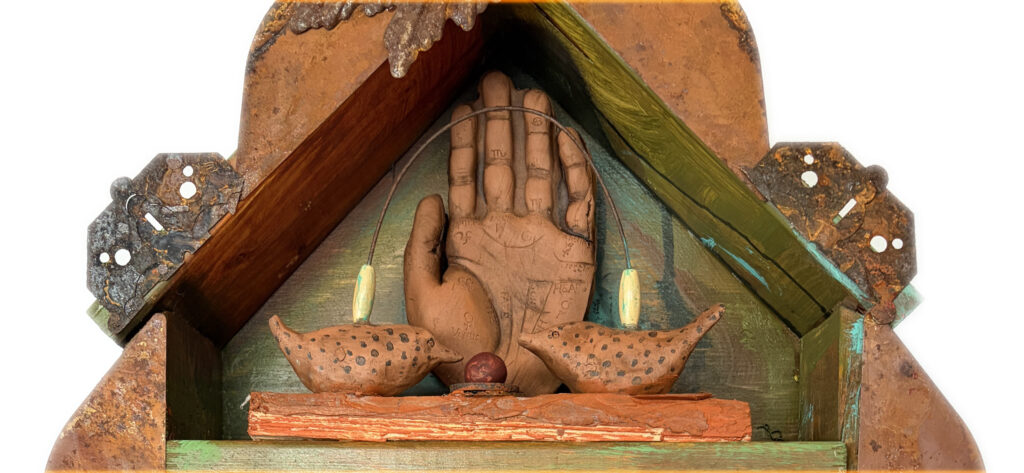
Mendicant Messenger: The Nest Keeper
Carries the knowledge that home is not claimed, but tended. Belonging is made through return, care, and the patient shaping of small, protective circles.

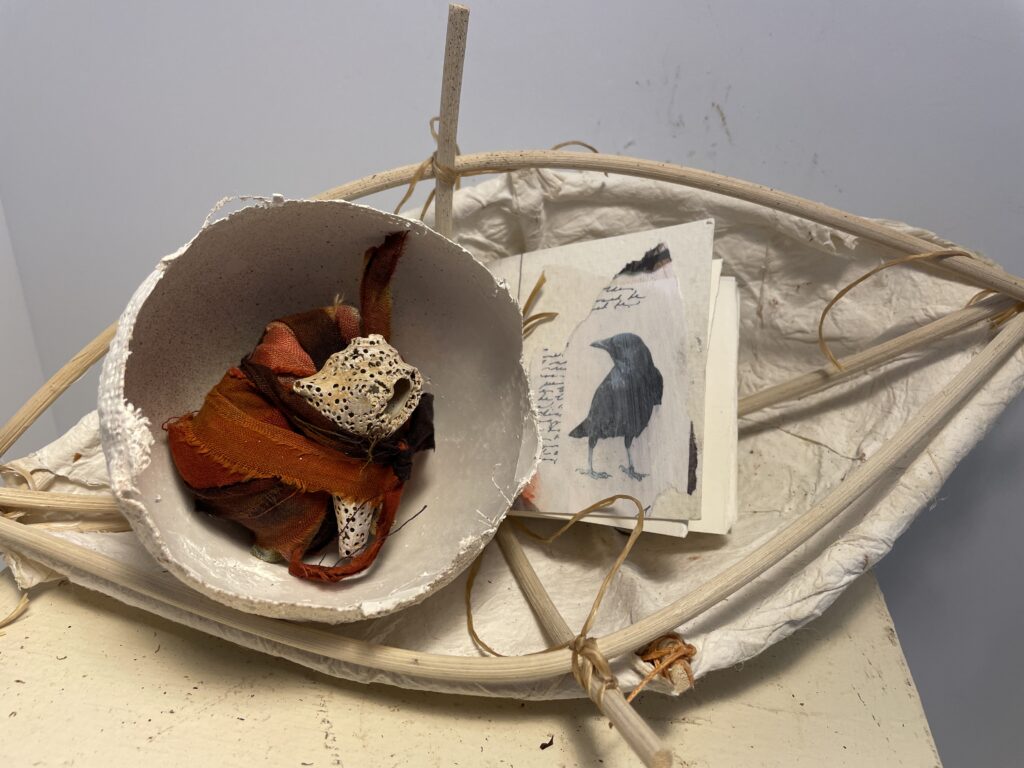
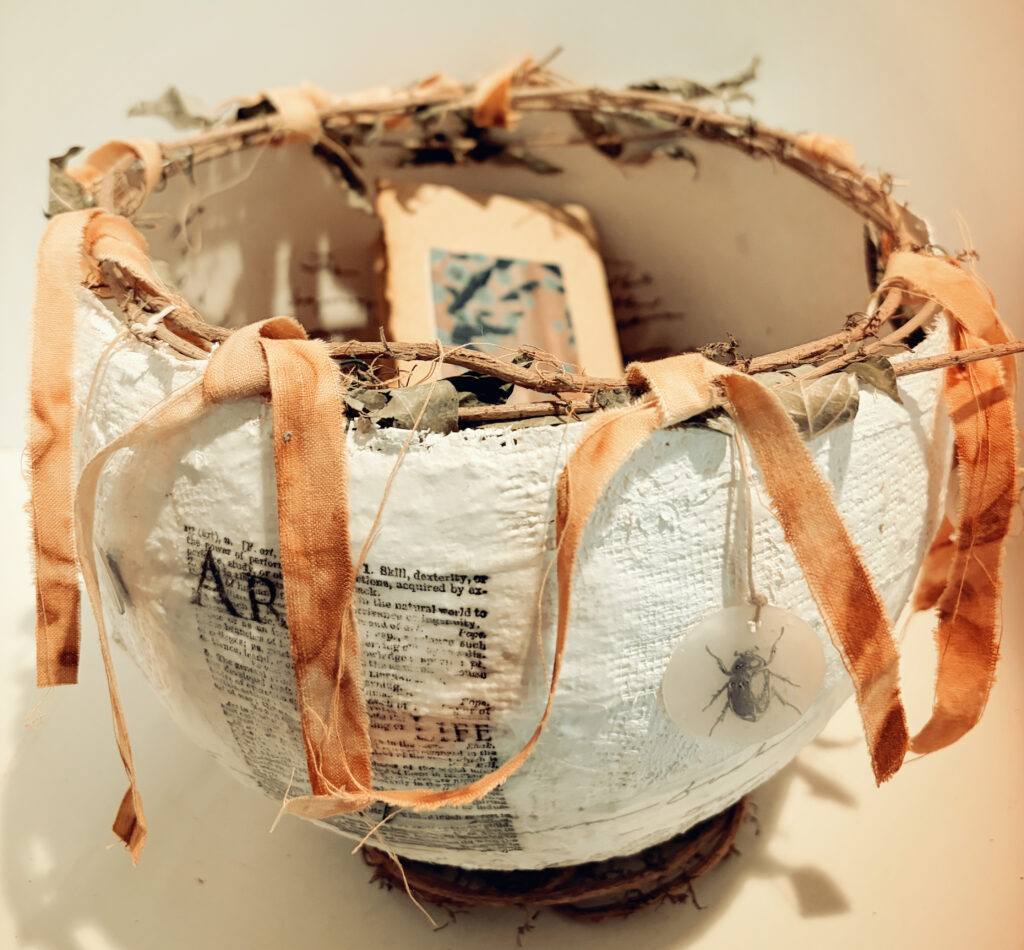
While working on my Encantos and Mendicant Messengers for the Taos show, it became very clear to me that there was no rational way to calculate their “value.” Every element was touched, considered, set aside, returned to, and finally placed with care. The work carried intention, patience, and a kind of spiritual listening that doesn’t show up on a spreadsheet. How do you put a price on that?

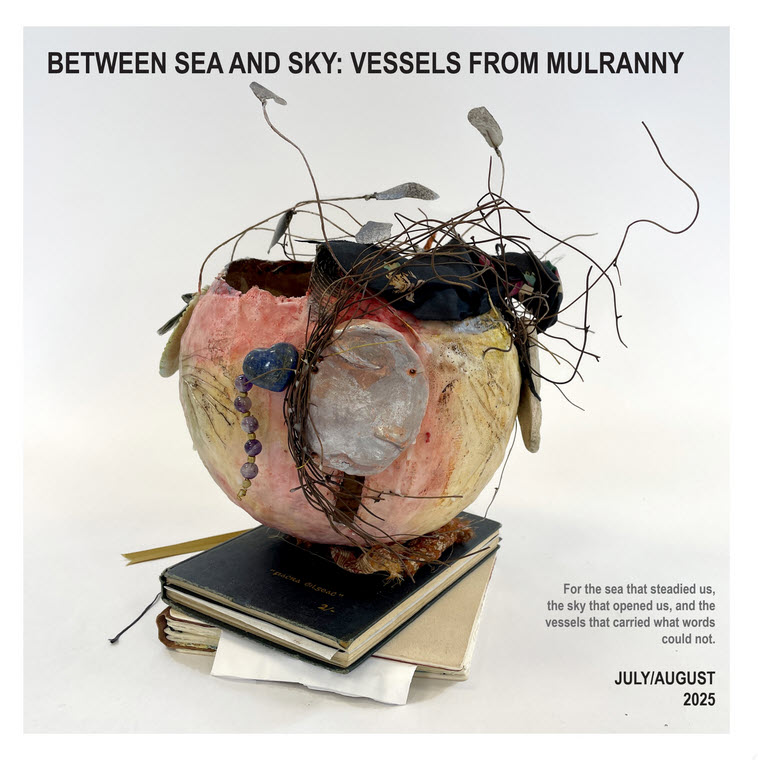
The Listener of Copper Paths:  The Listener of Copper Paths encanto watches over people who carry hidden worries.

And yet, I still want these pieces to find homes where they’re needed. I want them to be accessible. They need to continue their lives beyond my studio. Somewhere between devotion and practicality sits the uncomfortable question: How do we translate process into money?

The first thing I keep coming back to is this: price is not a measure of meaning. It never has been. Money doesn’t pay for the spirit that went into the work. It simply allows the work to move—from studio to world, from maker to keeper. Price is not a judgment of worth; it’s a translation tool, a bridge between inner labor and outer systems.

Accessibility doesn’t mean undervaluing. Sometimes it means trusting that the right person will recognize the work, not consume it casually. Sometimes it means allowing the exchange itself to be part of the ritual of letting go—an acknowledgment that something cared for is being received with care.

And then there’s the bigger question that makes me pause: Is selling the ultimate goal for artists? If it were, art would feel thinner somehow. More transactional. Less alive.

Historically, artists have been motivated by things far deeper than sales: witness, transmission, service, continuity, remembering. Selling is just one possible outcome of that work—not its moral endpoint. When selling becomes the goal, art loses something. When art remains the goal, selling becomes quieter, more humane—a way of releasing work responsibly into the world.

If you feel sensitive or conflicted about pricing your work, that doesn’t mean you’re doing it wrong. It means your work still matters to you. The sadness isn’t about money—it’s about not wanting what you’ve made to be reduced to a transaction.

We’re allowed to hold both truths at once:

This work is priceless in spirit.
This work needs a number so it can find its way.

That tension isn’t a failure. It’s a sign that the work still has a soul. In the end, pricing is not a test you pass or fail. You can seek counsel, follow structure, and change your mind—but the number you choose is simply the one that feels like a respectful release.
Gifts and Presence

Gifts I’m Carrying Into the New Year

As the year turns, I find myself less interested in presents and resolutions and more drawn to offerings—the thoughtful, non-material gifts that actually sustain a creative life.

It’s been a year that asked a lot of us. One that felt heavy in ways that were hard to name, where clarity was scarce and holding steady sometimes counted as progress. In moments like that, I find myself returning to the work—not for answers, but for anchoring.

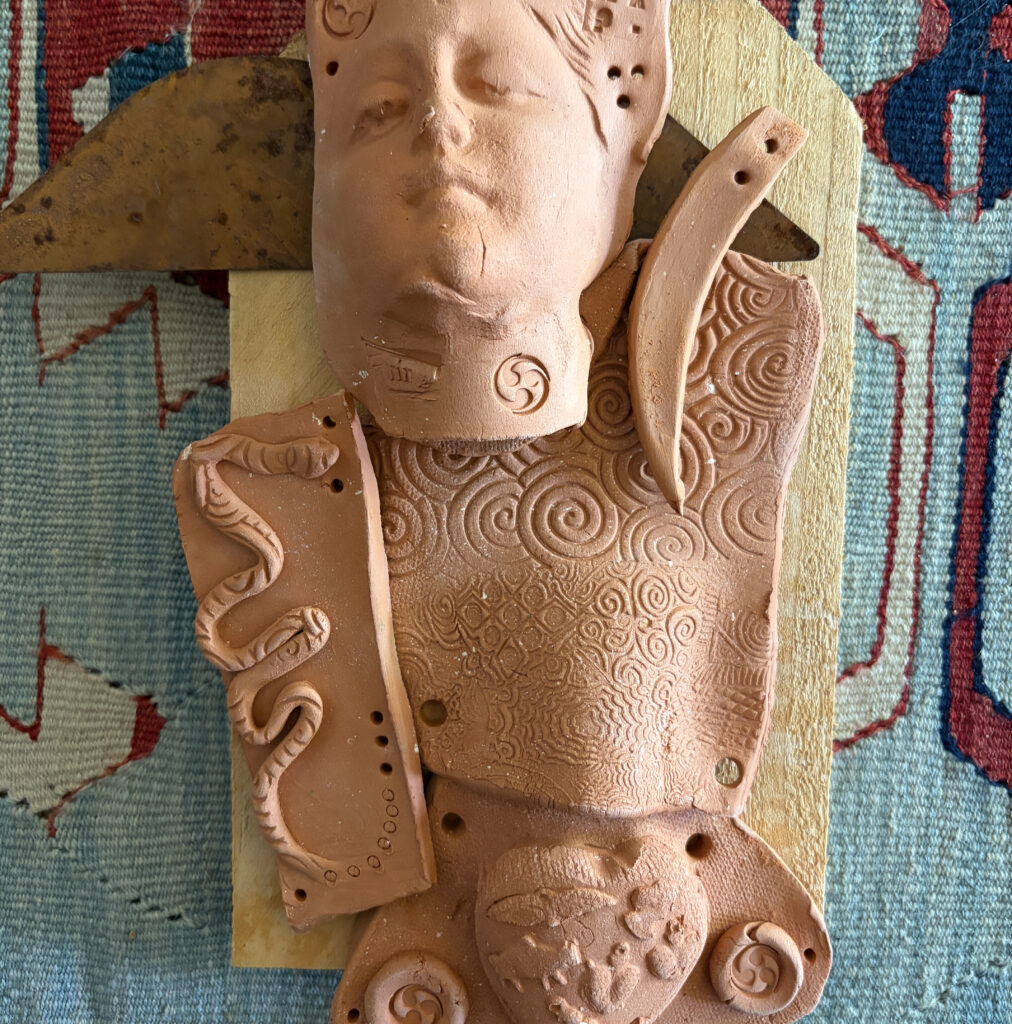
Three of the Seven Messengers, Earthenware and Found Objects, Lyn Belisle, 2025

In the Encanto collection I’m creating for the Taos exhibition, nothing begins as whole. Each piece is assembled from fragments: shards of material, memory, intuition, and story. Individually, they hold meaning. Together, they become something new—a vessel, a guardian, an altar that didn’t exist before their meeting.

That feels like the right metaphor for the year ahead. Not a clean beginning, but a gathering. A year shaped less by starting over than by recognizing what is already in our hands—saved fragments, carried questions, pieces that refused to be discarded.

The work ahead isn’t about inventing something entirely new, but about listening closely enough to hear how the shards and clues want to speak to one another, and trusting that connection itself is a form of creation.

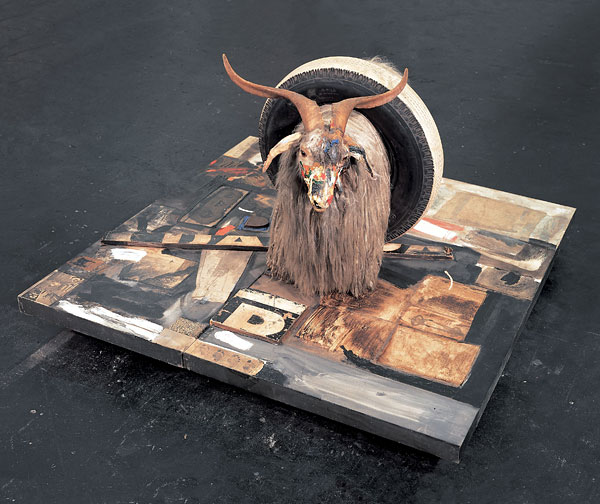
For Robert Rauschenberg, especially in his Combines series, the work was rarely about inventing new imagery from scratch. Instead, it emerged from listening to what disparate materials wanted to say together: a quilt, a newspaper clipping, a photograph, a brushstroke, a found object.

assemblage

Robert Rauschenberg, Monogram, 1955-59 Freestanding combine Oil, printed paper, printed reproductions, metal, wood, rubber heel and tennis ball on canvas, with oil on angora goat and tyre on wooden base mounted on four casters, 106.6 x 160.6 x 163.8 cm

Individually, these elements carried their own histories. But when brought into proximity, they began a conversation that produced meaning neither could hold alone.

He trusted that relationship itself was generative. The act of placing, juxtaposing, and allowing tension or harmony to arise was the creative act. In that sense, the artwork wasn’t imposed—it was discovered through attentive assembly. This concept means the world to me.

Robert Rauschenberg, Odalisk, 1955-1958 Freestanding combine Oil, watercolour, crayon, pastel, paper, fabric, photographs, printed reproductions, newspaper, metal, glass, pillow, wooden post and lamps on wooden structure with stuffed rooster, 210.8 x 64.1 x 68.8 cm

So, about those gifts — one gift I’m carrying forward is permission—to work slowly, to trust that fragments don’t need to explain themselves right away. Shards know how to wait. They reveal their connections in time.

Another is attention, the soft, ongoing, background kind. The listening that notices how one piece leans toward another. How an image answers a question posed months ago. How intuition doesn’t hand us a map, but offers clues – “a secret handshake“.

I’m also carrying continuity. The understanding that the work doesn’t reset on January 1st. We bring our fragments with us—unfinished ideas, saved scraps, half-formed thoughts—and the new year simply offers a fresh surface on which to assemble them. It also gives us a grounded connection to where we have been.
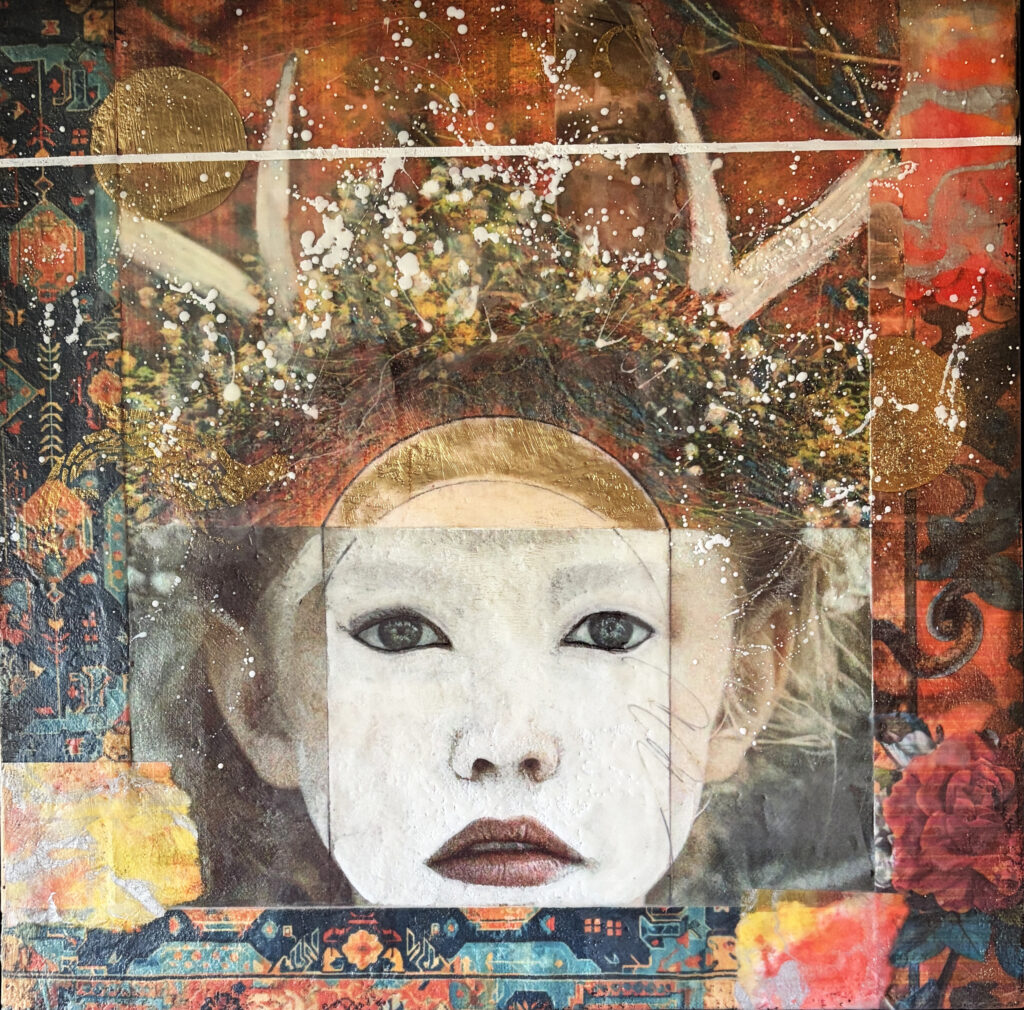
Santa Nina, Encaustic Collage, Lyn Belisle, 2025

And finally, companionship. The knowledge that we never gather shards alone. We are guided by shared histories of making, by other artists (like Rauschenberg) working in the past or in parallel, by unseen hands that have always known how to build meaning from pieces.

  • Permission
  • Attention
  • Continuity
  • Companionship

If there is a gift in these words, it’s this: a reminder that you don’t need to arrive whole to begin the year. Thank goodness! What you carry—your fragments, saved pieces, unfinished ideas, and intuitive longings—is already enough. My hope is that you’ll treat them with the same care we give to cherished shards in the studio, trusting that when the time is right, they will find their place and become something new.

Thanks for your presence, thanks for giving me attention and companionship, and for meeting these thoughts with the intelligence and generosity that only the best readers bring. Happy Holidays!

Teacups: Finding a Personal Voice Inside a Shared Theme

When artists are invited to participate in a themed exhibition, the first response is often analytical: What is the prompt asking for? But the more meaningful question comes later, and more quietly: What does this theme stir in me? This is where artists stop illustrating ideas and begin translating lived experience into form.

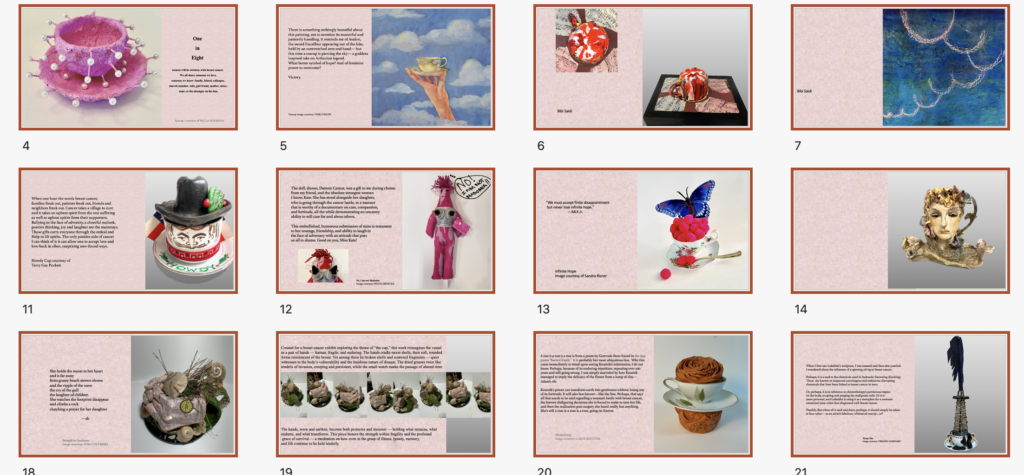
The exhibition One in Eight / The Teacup Project offered a clear conceptual framework. Conceived by GAGA Founder and exhibition designer Sylvia Benitez, herself a breast cancer survivor, the project is grounded not only in art history but in lived experience. The result is not a single visual narrative, but a chorus of distinct voices, each speaking without explanation, yet clearly understood.

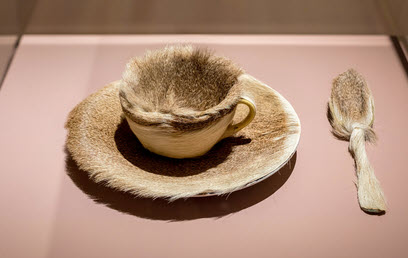
Artists were asked to interpret a teacup and saucer in response to breast cancer awareness. The idea draws inspiration from Meret Oppenheim’s fur-lined teacup—an ordinary domestic object transformed into something charged, unsettling, and unforgettable, and notably the first artwork by a woman acquired by the Museum of Modern Art. (Take this link to read the full story – it’s a good one.)

Those were the verbal guidelines. Everything else had to be discovered through looking, listening, and making. That combination has given artists permission to respond intuitively and honestly, whether through symbolic imagery, altered objects, or direct material references.

The challenge is not to illustrate the theme literally, but to recognize which images insist on being made. Some become two-dimension, some three-dimensional. Some are still unfinished.

Teacup Interpretations in progress

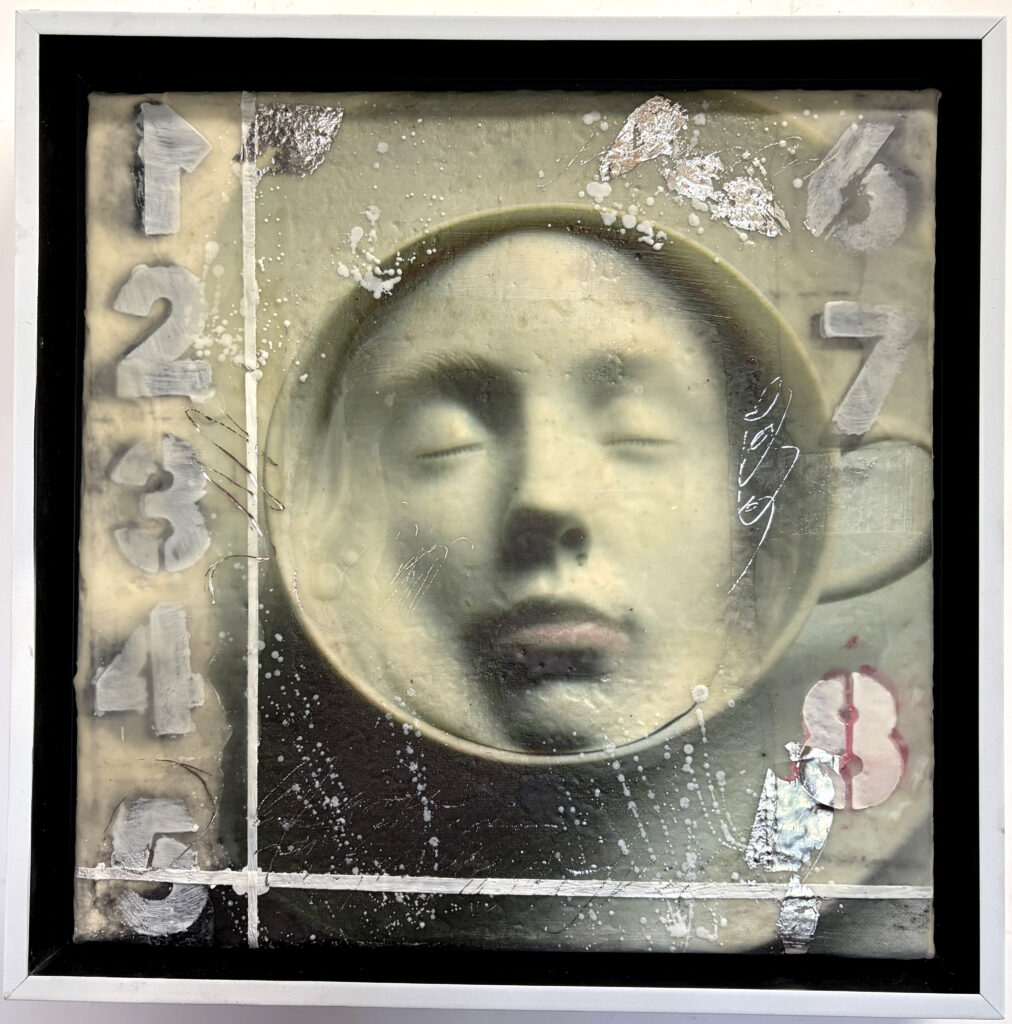
For my piece, Held, the teacup became a container—not simply an object, but a state of being.

A woman’s face rests inside the cup, eyes closed, suspended between vulnerability and protection. The numbers one through eight circle the surface, not as a statistic to be explained, but as a persistent presence. They hover and repeat, blurred enough to resist certainty, yet impossible to ignore.

Rather than making a declarative statement about breast cancer, I wanted to explore what it must feel like to live with that knowledge—to carry it privately, bodily, and emotionally.

Encaustic was essential to this expression. Wax softens edges and obscures clarity. It allows images to hover in ambiguity, much like difficult truths themselves. Layers veil and reveal, holding space for complexity rather than resolution. The medium became part of the meaning. Even though I work often in three-dimensional assemblage, this felt right to me.

Material choice plays a powerful role in how artists interpret a shared theme. While I approached the teacup symbolically and atmospherically, other artists responded through direct engagement with the object itself. A real teacup carries familiarity and ritual. It is something we cradle in our hands, associated with warmth, pause, and care. When altered or recontextualized, that comfort can shift into something unsettling.

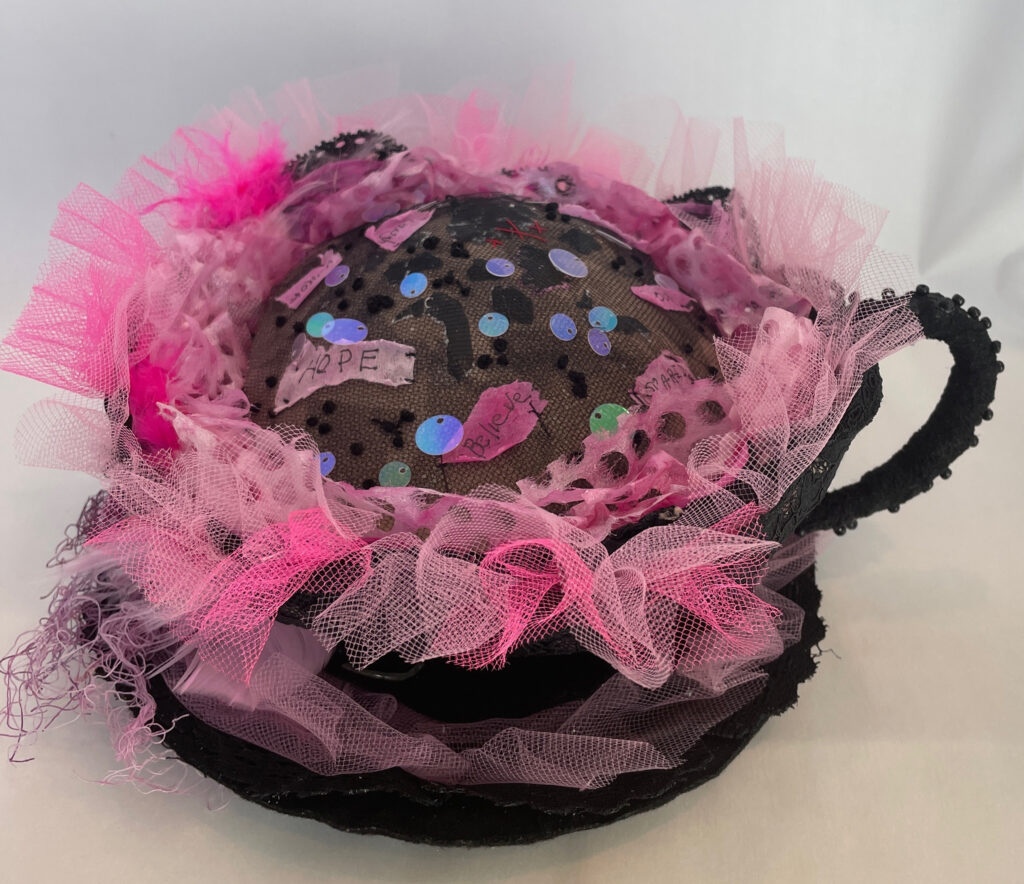
My friend Barbara took this idea one step further by placing a bra cup on a saucer. The gesture is immediate and unmistakable, collapsing metaphor and reality into a single form. The bra cup echoes the shape of the teacup while bringing the body directly into the conversation. Domestic object and intimate garment meet at the same scale, requiring no explanation. The meaning arrives visually, intuitively, and fully – and fluffy!

This is where non-verbal interpretation shows its strength. One artist may work symbolically, another literally. One may veil meaning in layers and atmosphere; another may present it plainly and directly. Neither approach is more valid than the other. Each is shaped by the artist’s relationship to the subject, their materials, and their personal history. What unites these responses is attentiveness—to the theme, to the body, and to the quiet knowledge we carry as women, caregivers, friends, and witnesses.

One in Eight / The Teacup Project is still in its development stage as a site exhibit, but the depth and immediacy of the responses so far suggest that it is already doing what meaningful exhibitions do best—opening space for reflection, connection, and shared understanding.  When an idea invites this level of engagement before it even takes physical form, it feels less like a proposal and more like an inevitability—one that will, no doubt, soon become a lived and visible exhibition.

In the meantime, you can see the virtual exhibition on the GAGA website on December 29. Brava to Sylvia for inspiring us to find our personal voices inside this truly interesting shared theme! 

Fragments, Forms and Layers: Part Three

Part 3: Layered Images — The Original Language in My Practice

A three-part series on Fragments, Vessels & Layers
(Part Three: Layered Images)

Series Introduction

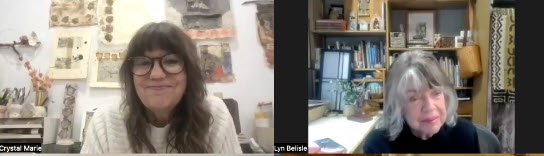
Recently, the artist and teacher Crystal Marie Neubauer invited me to talk with her online group about my work. It was an honor — Crystal’s influence on my creative life goes back years — but it also presented a surprising challenge. How do you describe an art practice that moves through so many materials and forms? Encaustic, collage, fiber, clay, found objects… I’ve never been a one-medium artist, and trying to explain everything at once felt impossible.

Then I realized that my work isn’t united by medium at all. It’s united by object and intention — by the three forms that keep reappearing no matter what I’m making.
And when I stepped back, those paths became clear:

  • Santos & Shards — guardians, icons, and the stories held in fragments

  • Vessels — boats, bowls, pods, and the metaphor of holding

  • Layered Images — collage, wax, and the  revelations inside translucence

These three paths intertwine across everything I do. And this series grows out of that realization — an invitation to look closely at where my work comes from and how meaning travels across forms.

Today’s final post in this series returns to the oldest language in my practice: layered collage.


Layered Images — The Core and Heart of My Work

Before my Santos emerged, before I began building boats and pods and sheltering forms, I was working in layers — paper, pigment, image, and – more recently – wax. Collage was my first real artistic home on the flat surface, and it remains the place I return to whenever I need to rediscover what I’m trying to say.

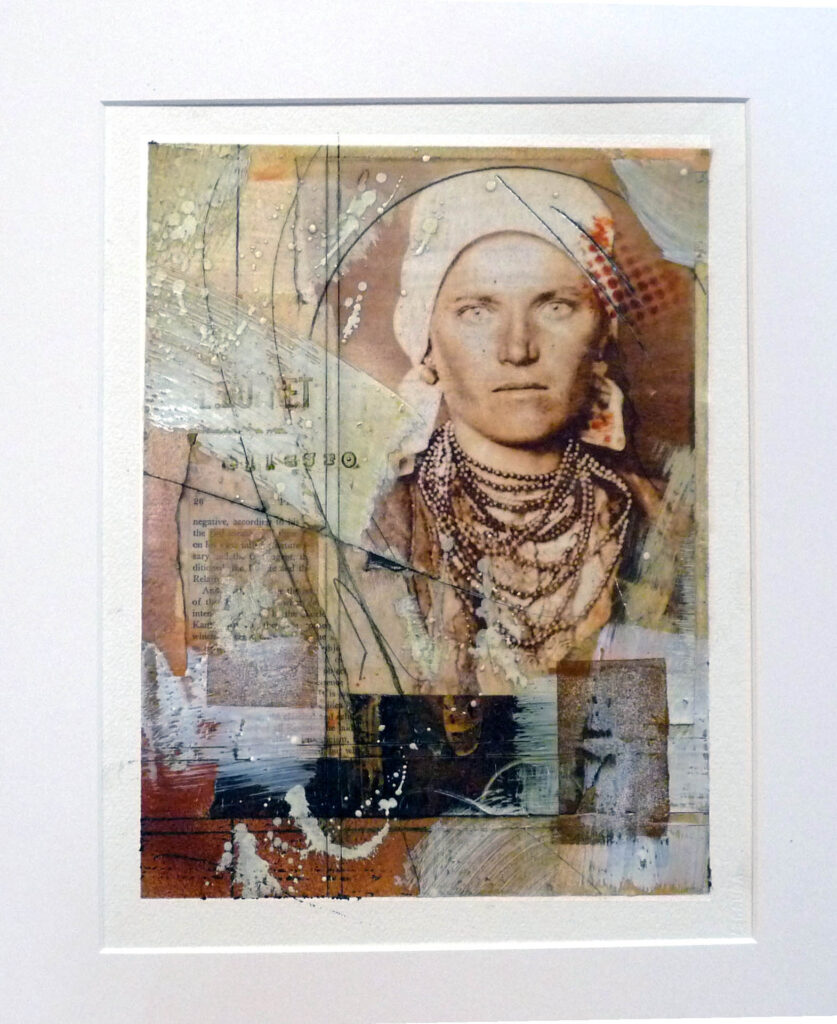
If Shards & Santos are about what we mend, and Vessels are about what we hold, then Layered Images are about what we choose to reveal — and what we allow to remain veiled. I’ve always worked in collage and for the last 15 year I’ve concentrated on encaustic layering thanks to my dear friend Michelle Belto who introduced me to the medium.

Why does Wax play so well with collage? Because It behaves Like Memory

Encaustic wax feels like the perfect collaborator because it mirrors the way memory works:

  • luminous in some places

  • fogged or obscured in others

  • layered with traces of earlier thoughts

  • holding what came before, even as new layers are added

Wax isn’t just a sealant or surface — it’s a way of thinking. It slows everything down. It requires heat, patience, and attention. It asks: Are you sure you want this visible? Are you sure you want that hidden?

I don’t use much colored wax at all – I’m not an “encaustic painter,” rather an artist who uses encaustic techniques to tell mixed-media stories. The pale translucency of beeswax is my go-to collage medium of choice.

A Layered Image Is a Conversation

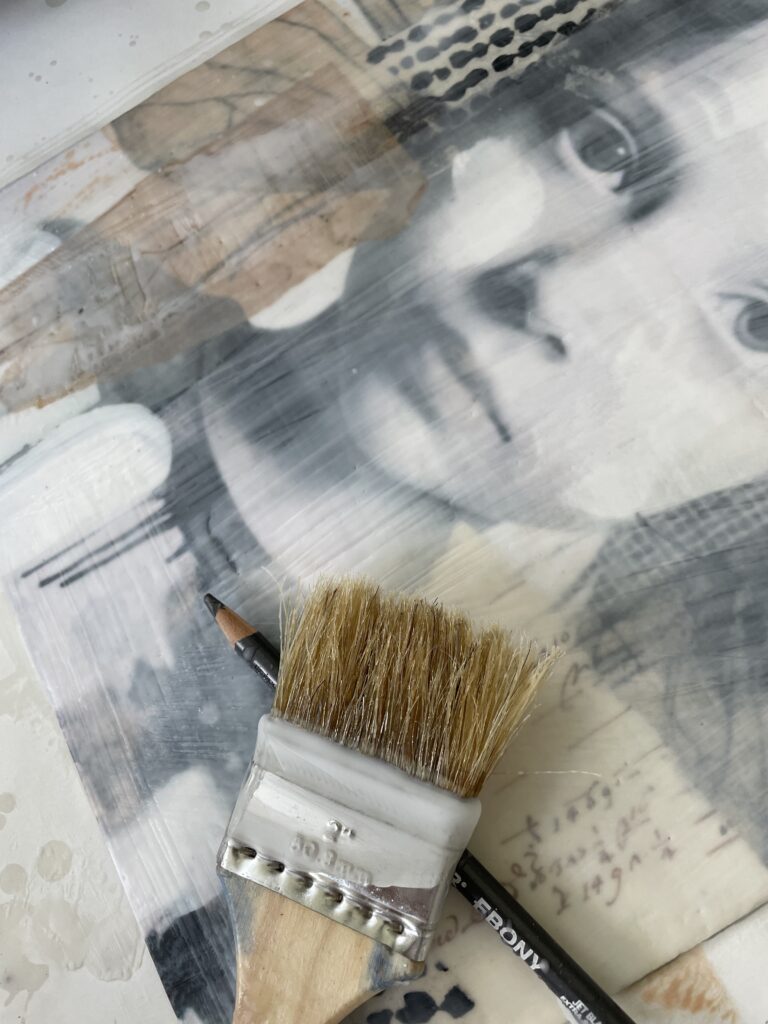
When I work in collage and wax, I’m not composing an image; I’m listening to it. Layer by layer, the piece begins to speak –a scrap of ledger paper peeks through, a synthographic figure emerges or dissolves, an accidental texture becomes the thing the piece needed all along. Even removal becomes part of the conversation. Scraping back a surface to reveal earlier marks often leads me to meanings I didn’t anticipate. Encaustic is not a linear process. It loops. It reveals. It forgets and remembers.
Just like we do.

A Return to Old / A Portal to New

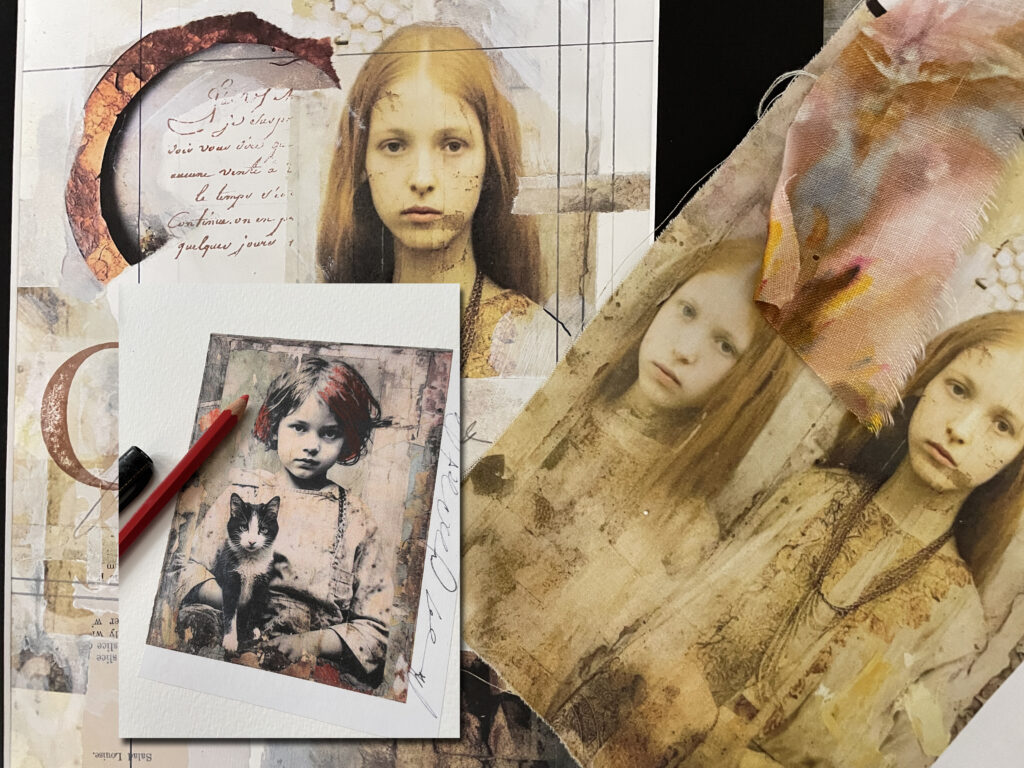
What I love most is that this old, familiar collage path has become a bridge to my newest work with synthographic imagery. The dream-logic of AI images blends beautifully with the ancient, tactile behavior of wax. One creates possibility; the other brings it to earth. If you’ve taken my recent Painting with Fire Lesson, Synthography and Wax, you understand.

The two together create a layered world where fantasy becomes grounded, realism becomes dreamlike, and the viewer is invited inside the luminous in-between

It feels like a collaboration across centuries — digital imagination meeting an art form older than painting itself. These aren’t just surfaces — they are strata.

Inviting You Into the Layers

Even if you don’t work in collage or encaustic, layering is a language almost every artist speaks. It’s about building meaning slowly, letting some things rest beneath the surface, allowing others to shine through.

Layers give us permission to be complex. To hold contradictions. To let time become part of the piece. As an example, here is a new (almost done but not yet – the edges are still taped) series that goes with my Encanto assemblages and will be in the Taos Exhibit in 2026.

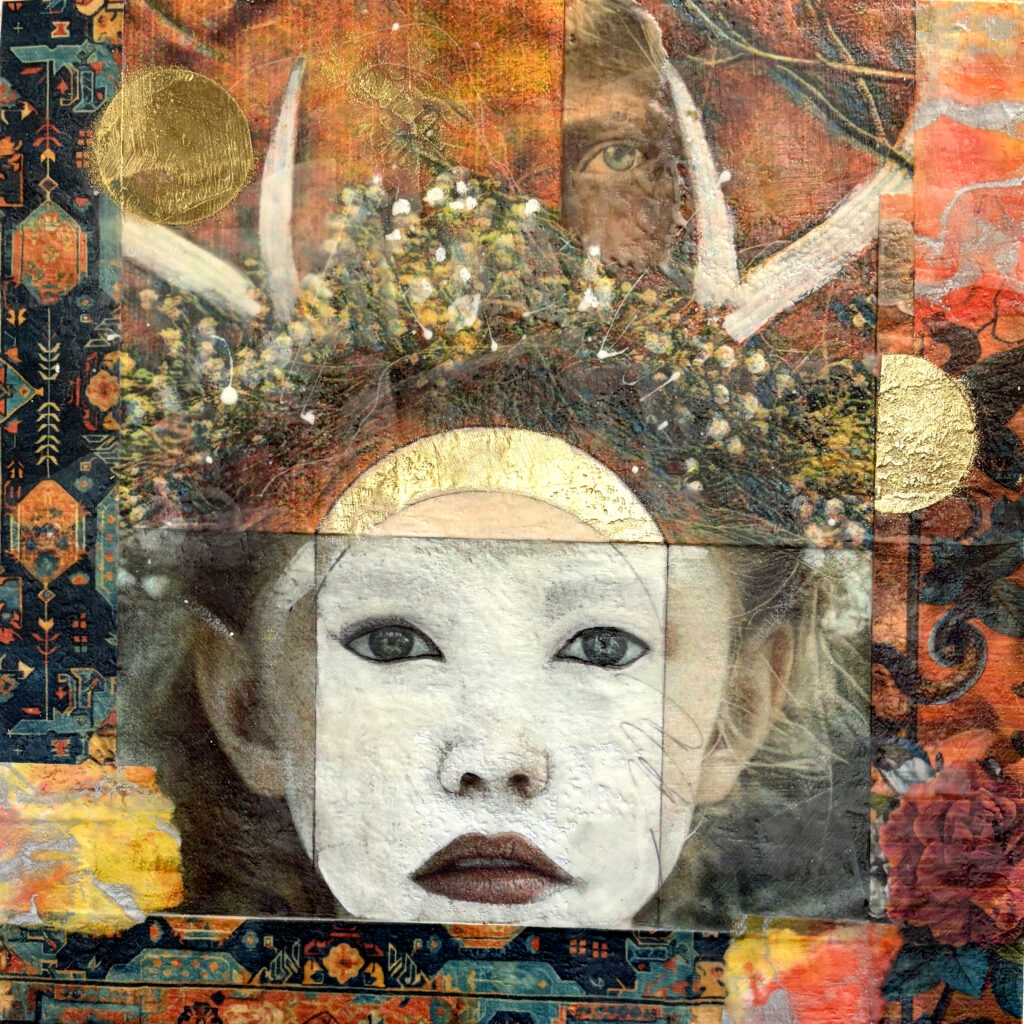
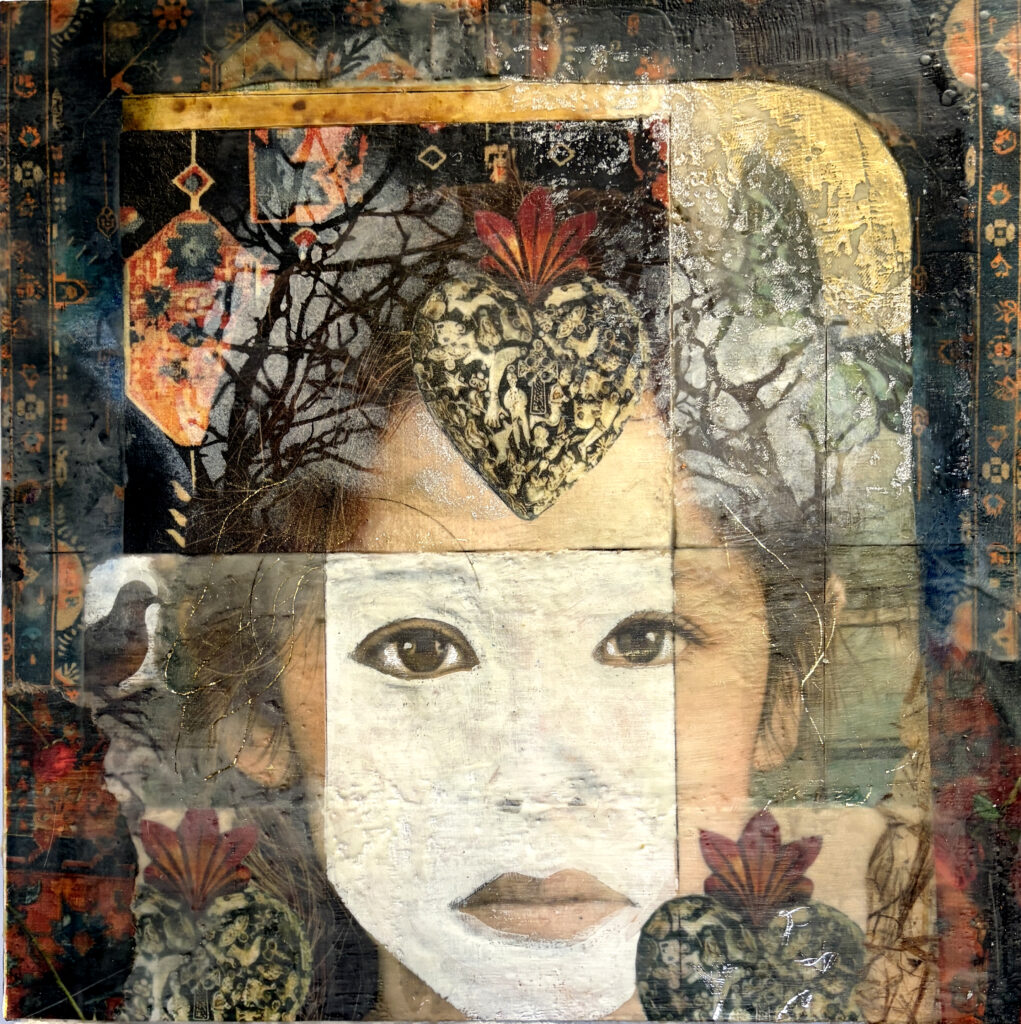
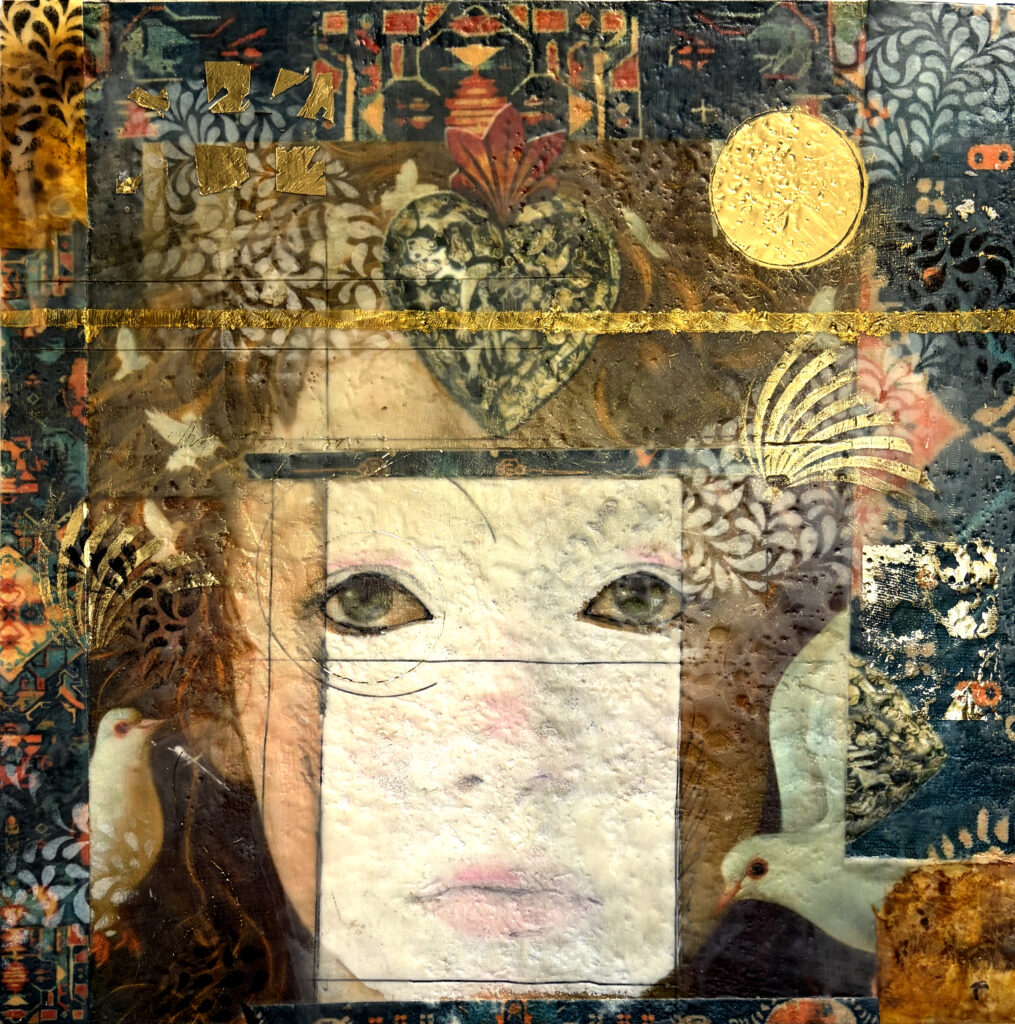
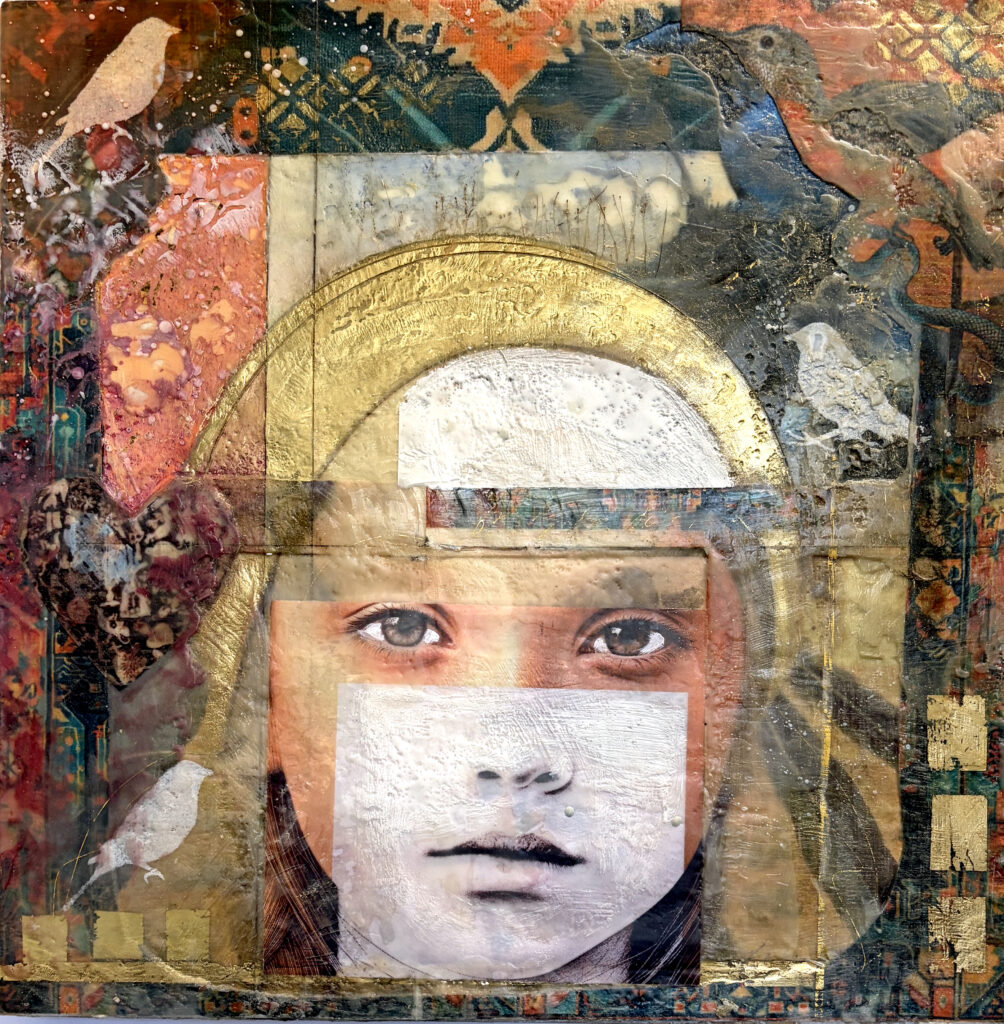
I’m creating four layered encaustic collages, 20″x20″, each representing a child saint or Santo Niño. Technically, some are probably female Santas, but gender is not an issue here. Fusion is, fusion of layers and culture.

These Santo Niños inhabit the liminal space where Indigenous cosmologies and European Catholic iconography meet, overlap, and transform one another. The white-painted faces echo ritual marking found across Native traditions, signaling spiritual passage, ancestral presence, and worlds in transition. Their frames and gold-leaf halos recall Spanish devotional art, yet the children themselves do not belong fully to that lineage.

They are hybrid beings—part saint, part spirit-guardian—born of a cultural collision that reshaped the sacred landscape of the Southwest. 

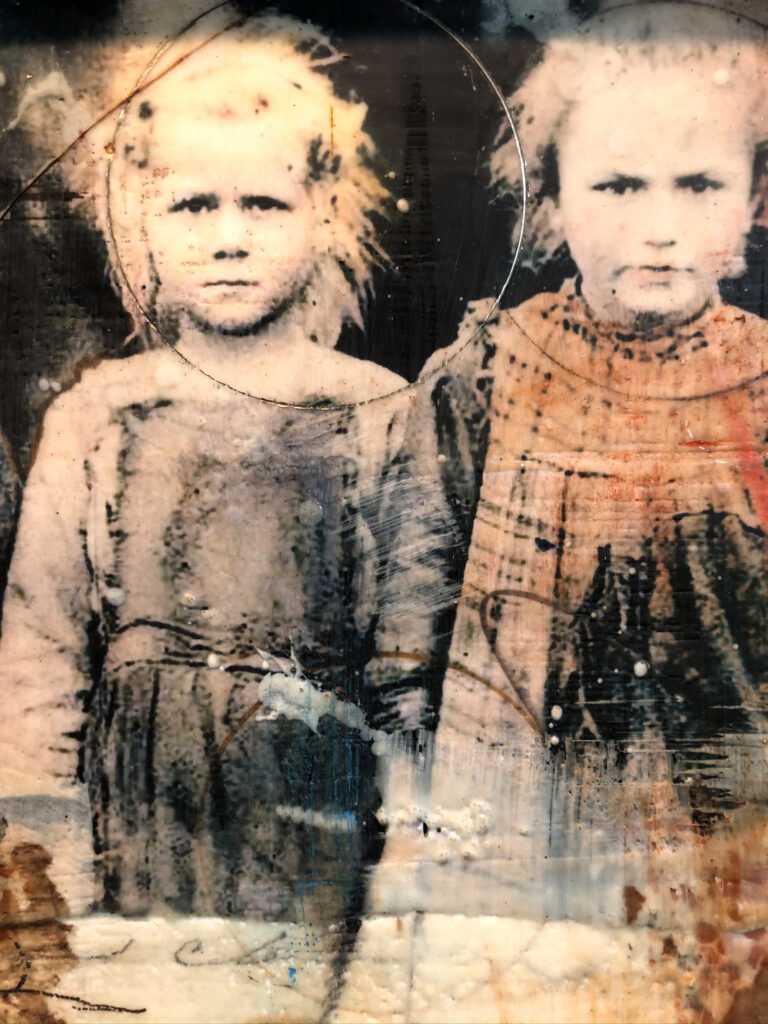
I’ve layered mulberry paper printed with carpet designs and birds than might be found in a European drawing room with white painted synthographic faces of anonymous children to create contradictions and layers of metaphor and storytelling. Here they are so far – they may end up with one more layer of meaning but I’m just not sure:

Santo Niño of the Antlers and the Hidden Path

Santo Niño of the Sacred Heart Seed

Santo Niño of the Two Doves

Santo Niño of the Watching Birds

There is more color in these layered pieces (surprise!), but the printed color is pushed back by the veiling layers of wax, almost as if time-faded. I’m having an amazing time fitting the images to the layers of history and meaning in the whole concept of Encantos and objects of hope and devotion in a world where such things need to be extracted again from our deep sense of humanity.

Whew! That was  lot to talk about!

Here are a few prompts to bring into your own studio:

  • What early layer in your work deserves to resurface?

  • What do you want to soften — not erase — with a new layer?

  • How might your materials become translucent instead of opaque?

  • Is there an image in your practice that wants to hide and reveal itself at the same time?


Closing the Trilogy

With this third post — fragments, vessels, layers — the series comes full circle. Each path has shaped my work in different ways, but together they form a single through-line:

We create meaning from what we mend, what we hold, and what we choose to reveal.

Thank you for walking with me through all three.

Fragments, Forms & Layers: Part Two

Last week, the remarkable artist and teacher Crystal Marie Neubauer invited me to speak with her online community about my work — an honor, and also an unexpected challenge. How do you describe an art practice that moves fluidly through so many materials? Encaustic, collage, clay, fiber, found objects… it’s never been about one medium.

What I realized is that my work is held together not by technique but by form and intention. Three recurring paths kept surfacing:

Santos & Shards — guardians, icons, and the stories held in fragments
Vessels — boats, bowls, pods, and the metaphor of holding
Layered Images — collage, wax, and the quiet revelations inside transparency

These forms thread through everything I make and shape how I think about narrative, memory, devotion, and protection. This three-part series grew from that conversation with Crystal’s group — an invitation to look more closely at how these paths emerge and how others might recognize echoes of their own practice along the way.

Part 2: Vessels of Holding — Forms That Carry Memory

A three-part series on Fragments, Vessels & Layers

In PART ONE, we talked about shards and stories and fragments.

If fragments are the invitations, vessels are the responses — the forms we create when we need to hold something gently, carry something forward, or protect something fragile. In my work, vessels have always been metaphors for care: what we shelter, what we offer, what we carry alone, and what we carry together.

This part of the series turns to the second creative path in my practice, one shaped deeply by my time teaching Spirit Vessels & Boats in Ireland. That workshop showed me how universally we understand the language of vessels — not just as objects, but as personal metaphors.

NOTE: If you read to the bottom of the post, there is some information about a new in-person Vessels workshop coming up in February.

Vessels as Small Architectures for Memory

A vessel is more than a container. It’s a small architecture — a structure built from tenderness and intention.

In my own studio, I return again and again to:

  • cane lashed into curved frames,

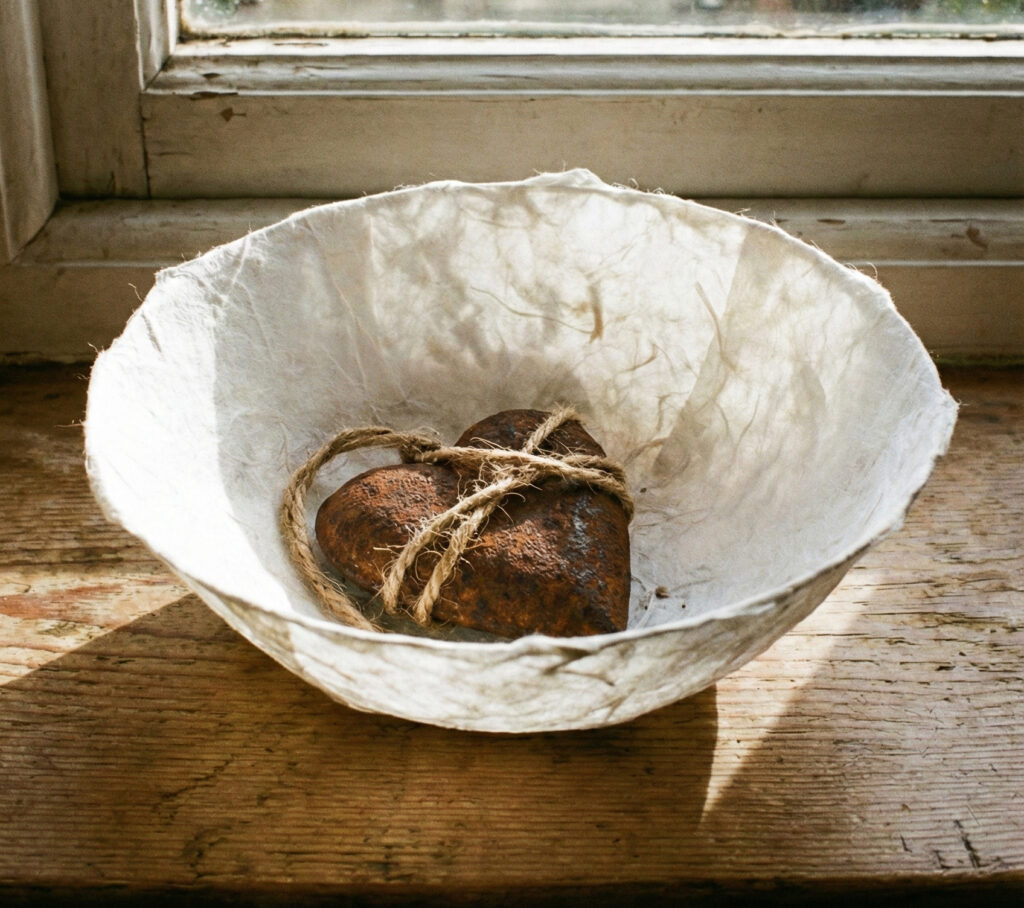
  • mulberry paper toughened with wax,

  • bits of rusted metal becoming anchors,

  • fiber and thread creating protection or boundary.

Each material changes the meaning of what the vessel carries. Wax, especially, offers a luminous kind of shelter — the sense that something is being preserved inside layers of translucence.

Teaching in Ireland: A Workshop of Passage and Light

When I taught this work in Mulranny, surrounded by sea light, tidal flats, and the slow breathing of the bay, my students immediately understood that they were making more than objects. They were making carriers — of memory, metaphor, hope, grief, gratitude.

Their vessels took on astonishing variety:

  • Some resembled wind-bent boats, as if carrying stories across an invisible tide.

  • Some were seed-like pods holding untold wishes.

  • Some were protective containers woven from cane, stitched paper, and beeswax, glowing like small lanterns.

There was a shared sense that these forms — however small — were honoring something beyond themselves.

Interior Space / Exterior Form

One of the most compelling conversations in the workshop was about the relationship between:

  • the space inside the vessel,

  • the form surrounding it,

  • and the meaning created by the tension between the two.

In a vessel, the interior always matters. It holds the intention. The exterior only reveals part of the story — the rest is protected within. This interplay mirrors how we move through the world: showing some things, guarding others, and trusting the container to hold what words cannot.

_________________________________________

Speaking of words, I am teaching a new two-day in-person Vessel workshop next year on Valentines Day weekend at UTSA/SW. It’s called Vessel Alchemy: Tactile
Poems in Fiber , Paper , Word, Light. Here’s a partial description from the catalog:

“In this immersive workshop, we’ll explore how simple
materials (sticks, cheesecloth, mulberry paper, fiber scraps,
ink) can be transformed into vessels that speak to memory,
meaning, and the ephemeral. Each day invites an unfolding
of form and story as we sculpt, wrap, write, embed, and
embellish.”

We’ll be doing some writing – words and poems and asemic mark making – here is a beautiful example from my friend Jean Dahlgren, who will be my TA for this class.

I love Jean’s asemic writing – she’s promised to write some lines on tissue paper for us to use in the workshop!

Workshop Registration for Friends of the School opens today, and it opens to the public on December 9th. I’d love to see you there!

If you can’t make it to the in-person workshop in February, you are welcome to checkout my online workshop called Spirit & Form: Creating Vessels of Passage and Purpose.

Here is a link to a sample lesson and the registration information. It’s self-paced and only $59 for lifetime access.

Inviting You Into the Studio: What Are You Carrying?

Even if you’ve never lashed cane or dipped mulberry paper into wax, you’ve likely made vessels in your own way — forms that hold meaning.

So here are some studio invitations for your own practice:

  • Could a boat, bowl, pod, or wrapped bundle be a metaphor waiting to be explored?
  • What would a “protective container” look like in your materials?

  • What happens when you build a structure around an emotion, a memory, or a small sacred object?

  • What materials in your studio feel inherently protective — wax, fiber, metal, clay?

A vessel doesn’t need to be functional to be truthful. It can simply be a place where meaning rests.

Looking Ahead

Next week, in Part Three, I’ll explore the last of the three intertwined paths: Layered Images — how veiled surfaces, hidden elements, and translucent strata reveal what is usually unseen.