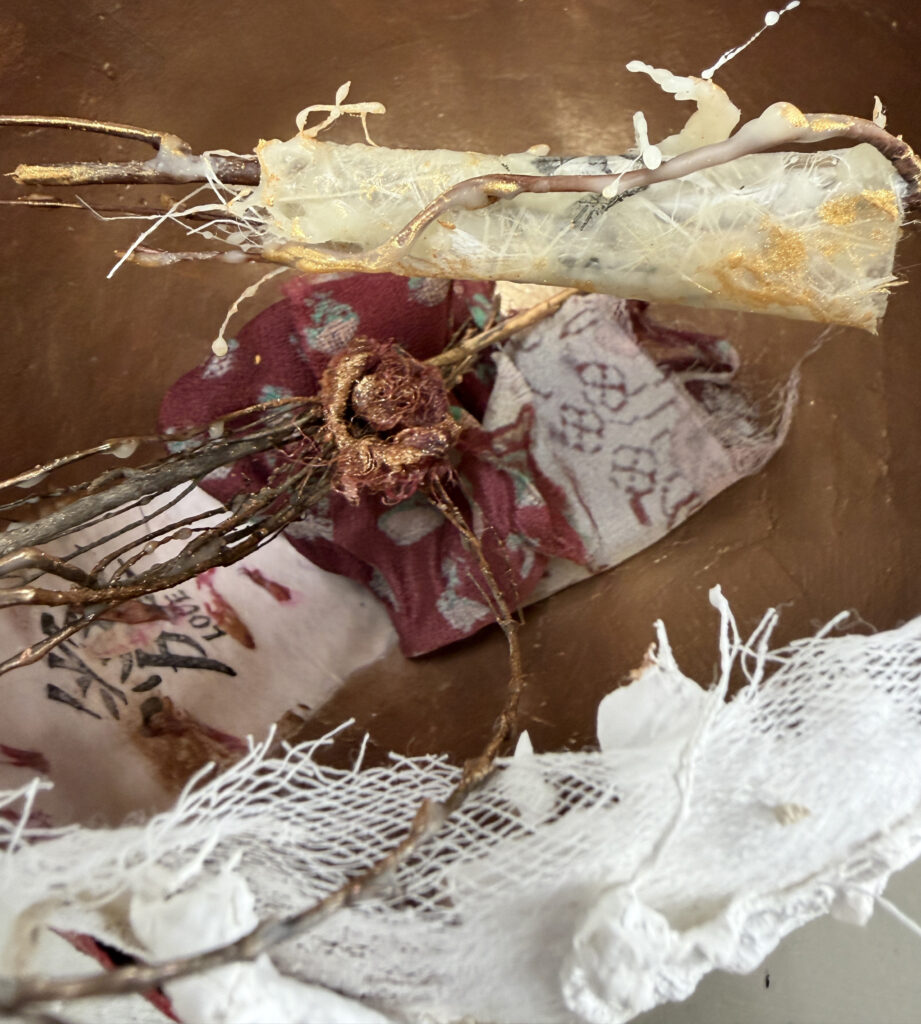
The Language of Holding: Student Work from the Workshop

This is Part One of a two-part reflection on our weekend workshop,  Vessel Alchemy: Tactile Poems in Fiber, Paper, Word, Light. Next week, I’ll share more vessels — and more of the words they are quietly holding.

This past weekend weekend, as I walked around the Droste Studio at UTSA/SW watching the students work, I found myself truly astonished.

Not just at the craftsmanship — though there was plenty of that. Careful joins. Thoughtful armatures. Fibers handled with restraint. Plaster edges left raw but intentional. Stitches placed where they mattered. Nothing hurried. Nothing ornamental without purpose.

What moved me even more deeply was the respect for the materials. These students did not force sticks to behave unnaturally. They allowed cheesecloth to fray. They let paper tear along its own logic. They treated wax, fiber, wood, and found objects as collaborators rather than supplies. There is a joy in that kind of making.
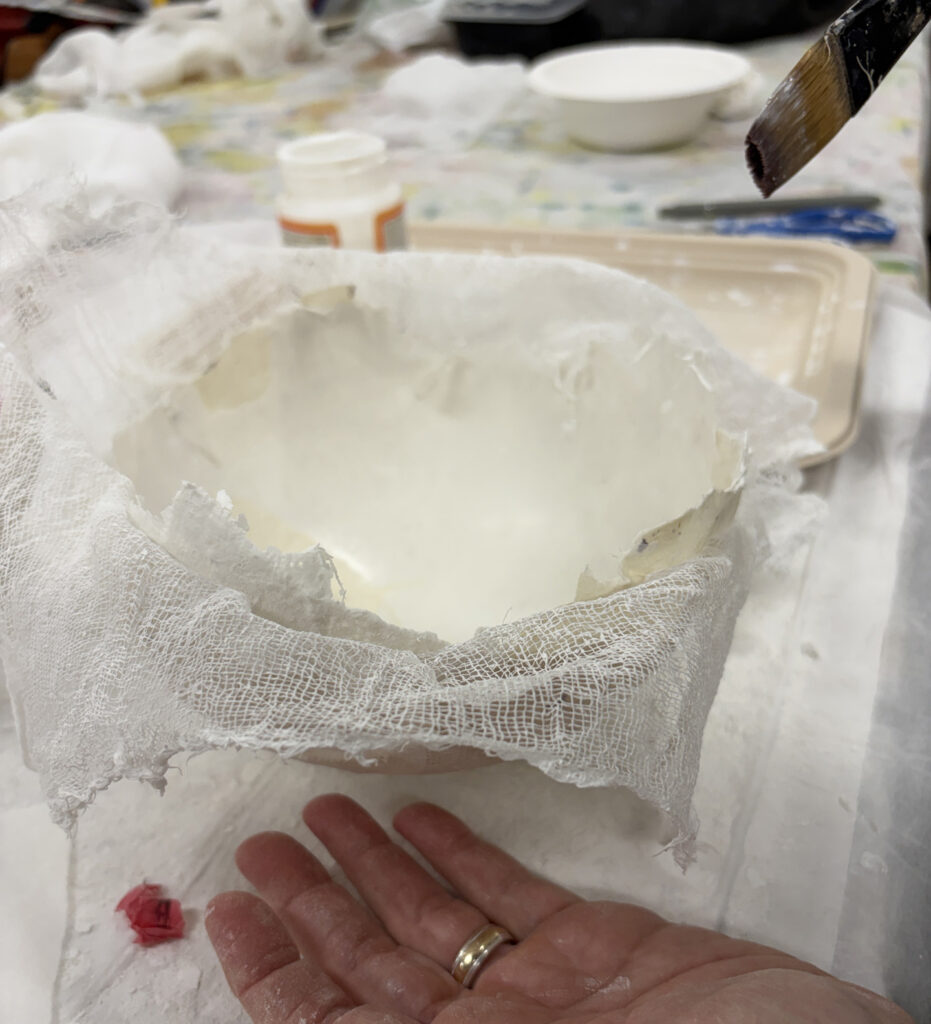
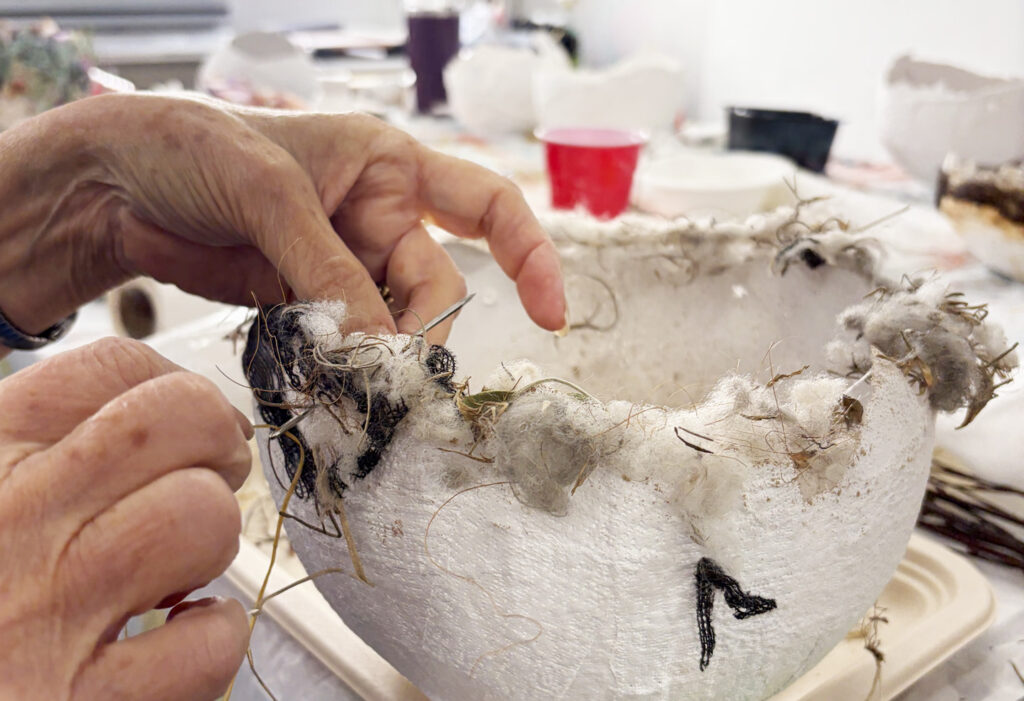
But what truly stopped me was their understanding of language.

  • They understood — instinctively — that words do not merely decorate a vessel.
    They define it.
    They anchor it.
    They release it.

They grasped that words can be embedded like relics, stitched like mending, burned like memory, or inscribed along the interior curve of a bowl. They understood that a vessel does not simply hold words — it is shaped by them.

Here are three examples that I’ve tried to describe with words that mean more than size, shape, and color:


The Interior Script: A Bowl That Remembers
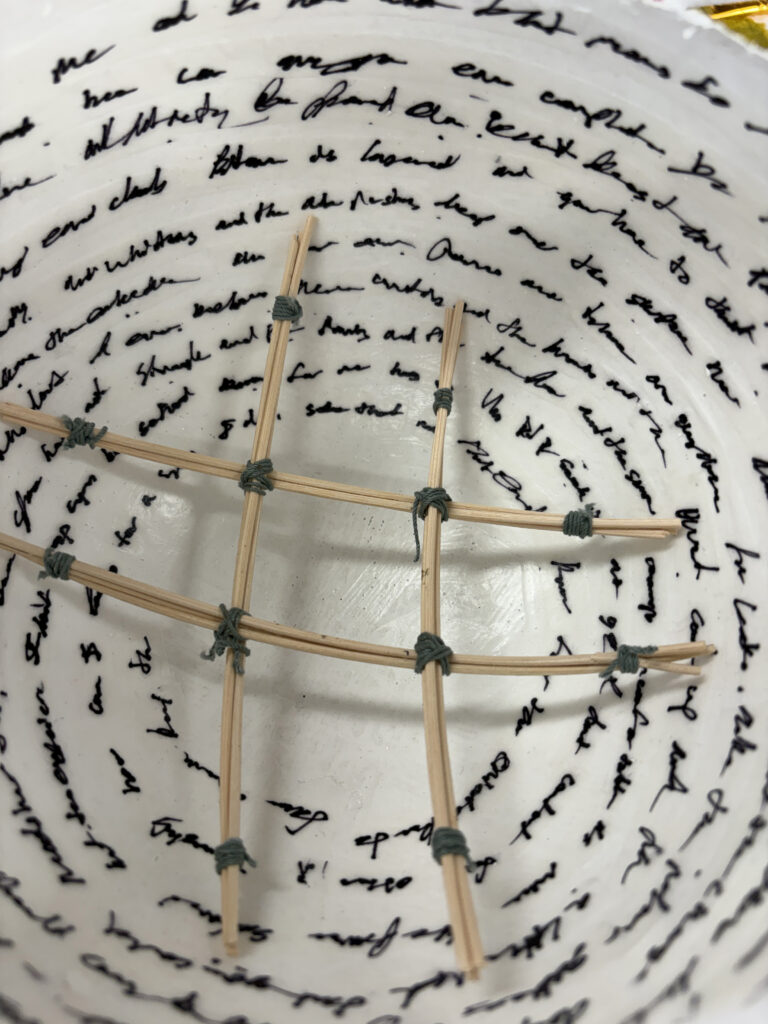
One student (Logan) lined the inside of his vessel with concentric, handwritten text. The words spiral inward, like thought itself. Over this interior landscape rests a simple lattice of thin wooden sticks, bound gently with gray thread — a structure that feels protective, almost like ribs. Actually, it cradles a second structure that fits inside this one like a Russian doll! I’ll show you that picture later.

The vessel invokes words like:

  • remember
    contain
    listen
    underneath
    crossing

The spiral script suggests that meaning accumulates over time, layer upon layer, sentence upon sentence. The wooden lattice feels like a quiet restraint — or perhaps a trellis. The words are both sheltered and structured. The vessel becomes a meditation on interior life. Here is the vessel with its nested second vessel – the scrip becomes secret language. The second vessel is lined with gold joss paper. Breathtaking!
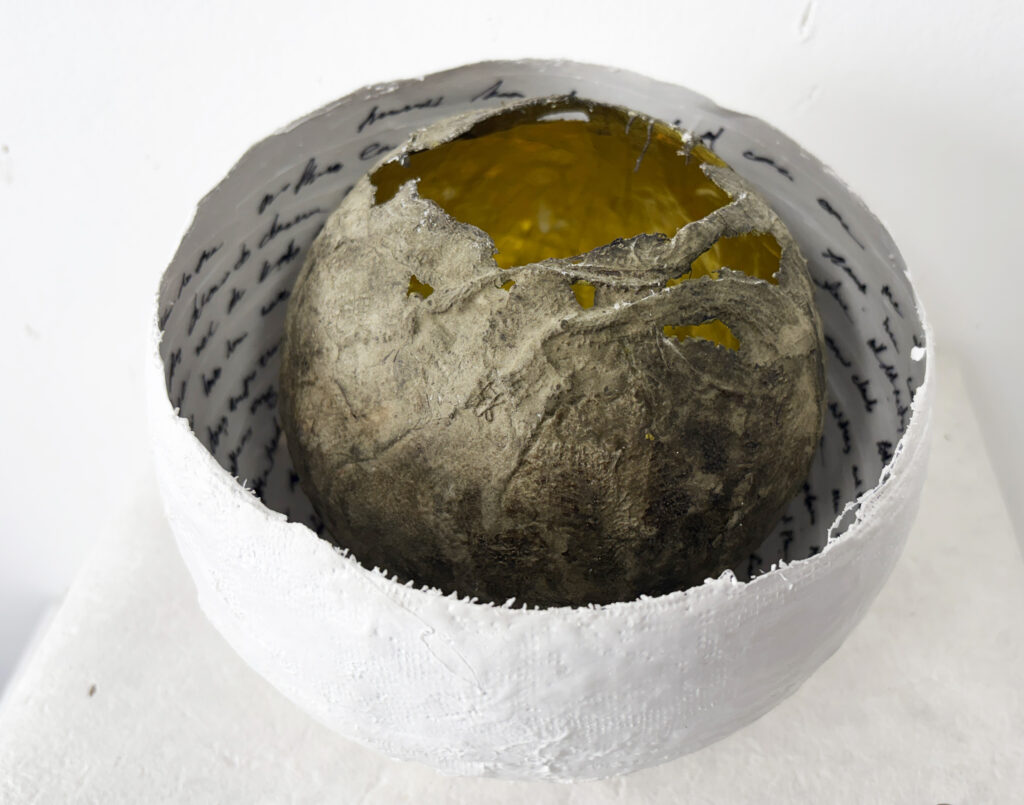

The Furrowed Edge: A Vessel of Shelter and Weather
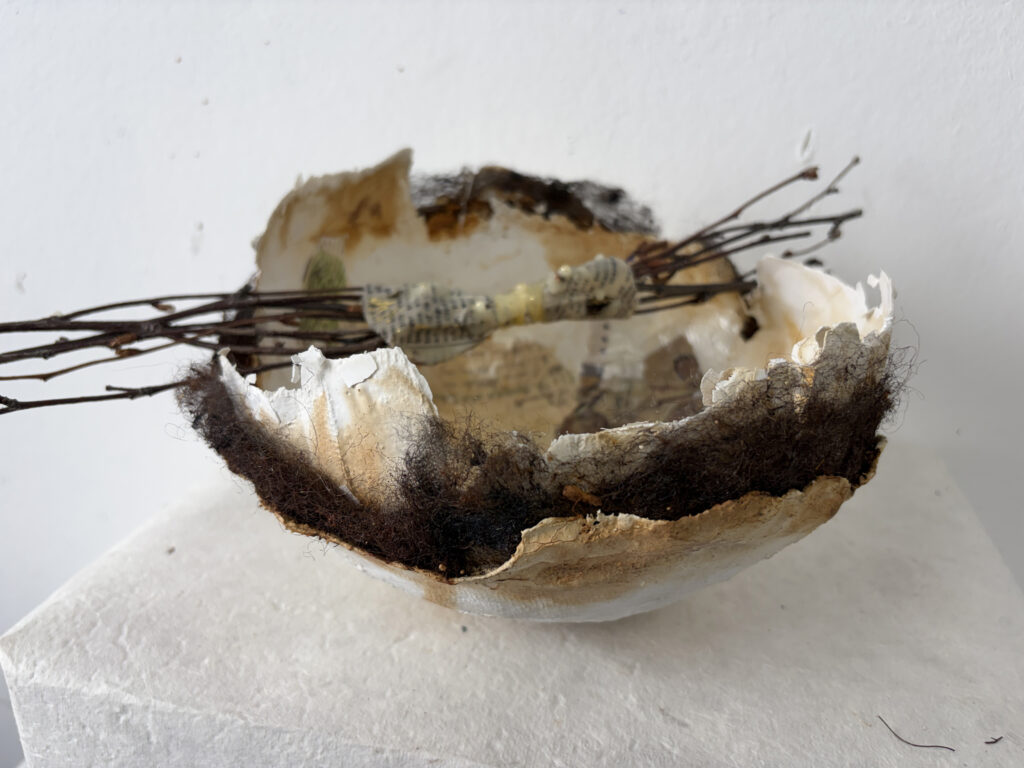
Another student (Carol) created a bowl with torn, irregular edges, rimmed in dark fiber that reads almost like char or earth. Across its opening stretches a small bundle of paper and twigs — bound, weathered, fragile.

This vessel calls forth words like:

  • weathered
    threshold
    endurance
    tenderness
    scar

The torn plaster edge feels vulnerable but deliberate. The dark fiber suggests something elemental — soil, ash, hair, memory. Can you guess what it is? The bound paper at the top feels like a message carried across a crossing. It is not pristine. It is honest. The vessel speaks of protection that has already been tested.

Two Vessels: What Opens / What Remains

These are two vessels created by Dawn, who made a total of five beautiful containers for her words and poems during the two days we were together.
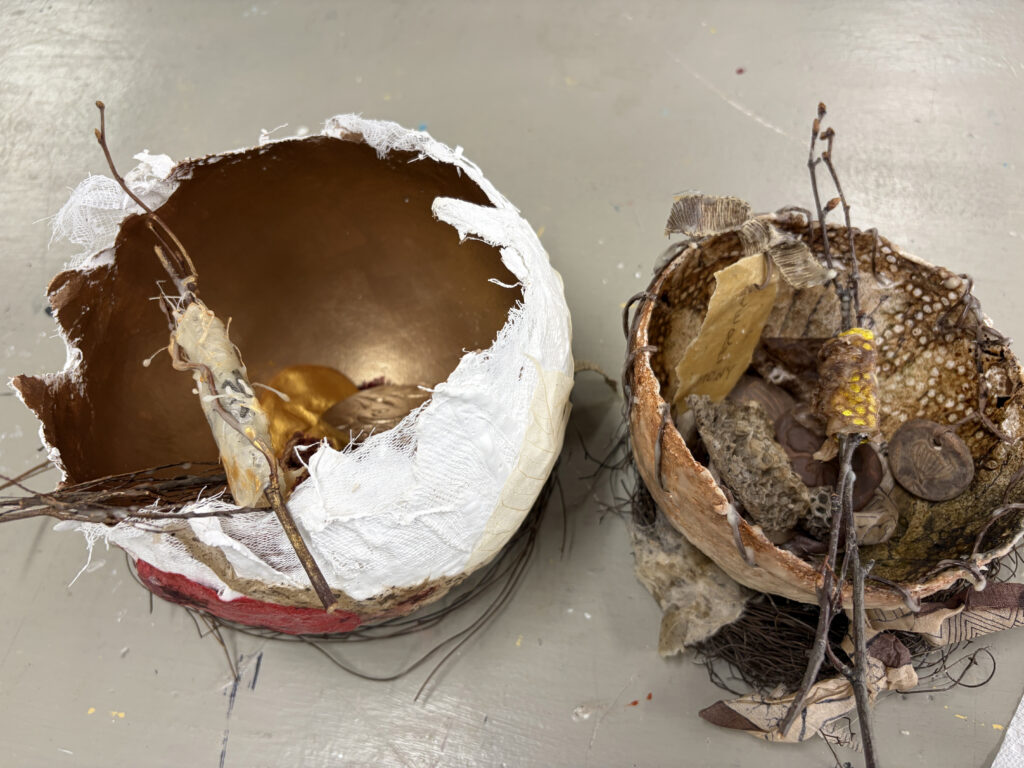
The Luminous Vessel (Left)

This one feels like a breath held and then released.

It evokes:

  • revelation
    offering
    interior light
    vulnerability
    threshold
    secret treasure

There is something tender about its torn white rim. The glowing interior suggests not wealth, but illumination — the kind of light discovered only after something cracks open. The twig-bound element across the top feels less like restraint and more like a blessing.

This vessel whispers:
What is hidden is not lost.
What is broken may be luminous.


The Earth Vessel (Right)

This one feels grounded, sedimentary, layered.

It evokes:

  • memory
    accumulation
    archive
    weathered
    gathered fragments
    ancestral
    talisman
    burial
    keeping
    endurance

The interior reads almost like an excavation — objects embedded, tucked, remembered. The textures feel archaeological. The upright slip of paper suggests a marker, a naming, a quiet declaration among relics.

This vessel’s words are:
Nothing is wasted.
What has been lived becomes structure.


Together

As a pair, they evoke:

light and earth
reveal and retain
blessing and burial
opening and holding
chapter and echo
same story, different hour

They feel like two movements in a single composition — one speaking of illumination, the other of preservation.

______________________________________________________

A final note for this first part – what I saw in these works was not just technique. It was comprehension.

The students understood that when we write inside a vessel, we are mapping an interior. When we bind sticks across an opening, we are negotiating protection and permeability. When we leave an edge torn, we are honoring imperfection rather than correcting it.

They were not simply making objects. They were making language visible. Visible poetry.

And maybe that is what we are always doing — whether with plaster or paper, ink or fiber. We are shaping containers for what matters. We are giving our unspoken words somewhere to rest.

Let’s hope we continue to make vessels that hold what needs holding — and release what no longer does. More to come next week!
Butterfly carrots and pumpkin shepherds

Words are becoming increasingly important in my recent work, both as design components and as inspirations. I’m honestly not sure why, maybe it’s because I’ve been rediscovering some of my beloved Abstract Expressionist heroes  when I was an undergraduate art student — Larry Rivers and Robert Rauschenberg. Those guys were amazing.

Parts of the Face: French Vocabulary Lesson 1961 Larry Rivers 1923-2002

Robert Rauschenberg, Metropolitan Museum of Art is an offset Lithograph poster made in 1970.

Sometimes the words I’m finding are strange and somewhat obscure, like “hiraeth,” the Welsh word that inspired this series, which is now complete and will be shown at my solo exhibit next Saturday. I’ll post those soon.

Sometimes the words are both inspiration and visual elements. I’ve just completed five “story banners” which will also be shown in the exhibit. These were partially inspired by two of three random words from a vintage child’s stamp set that was a gift from my friend Jean. I talked about those delightful word stamps in an earlier post, and am still discovering ways to use them.

Look at these words that are available in the old stamp setlimited but evocative. Picking any two or three can can conjure stories that blend nostalgia and weirdness and wonder. Try it! Butterfly carrots?? Pumpkin shepherd??

For a narrative artist like me, this is gold! And when these words are combined with synthographic and vintage images in fiber and mixed media, the results are really intriguing.

Here are the five banners. Each one is about 14×24″ with layers of fabric and images and old milagro charms.

Lyn Belisle, Mother Nest, 2024

Lyn Belisle, Seven Horse, 2024

Lyn Belisle, She Know, 2024

Lyn Belisle, We Were Sisters, 2024

Lyn Belisle, Little Tiger, 2024

During this process, I continue to learn that “shards” can be more than just pieces of stuff for assemblage – they can be scraps of fabric and synchronistic words that appear from unusual places. And these “shards”—whether bits of fabric, stray words, or found objects—are fragments of meaning waiting to be woven into something whole.

By embracing them, we give ourselves permission to see beyond the ordinary, to let coincidence and curiosity guide us. In this way, each piece or word becomes part of a larger narrative, inviting us to craft stories that feel both ancient and freshly our own, across any medium we choose. And then it’s up to the viewer to join us in figuring out these stories in a way that speaks to them. What fun!

Thanks for reading!!

What do you have to say to yourself?

That was the question in yesterday’s workshop at the studio called “Postcards to Myself.”

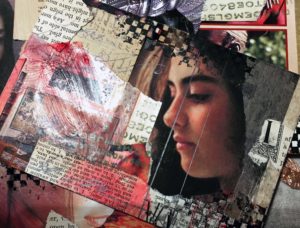
It’s a new workshop, one that I designed to see if we, as artists, create unconscious messages to ourselves as we work on art pieces that combine random images and text. The small works that were produced were amazingly lyrical, and many did seem to have meaningful messages.

The project itself was done in seven stages on an 11×14″ sheet of archival matboard.

  • Stage One – images and objects
  • Stage Two – veiling
  • Stage Three – vintage text chosen randomly
  • Stage four – enhancement and alteration
  • Stage five – selection
  • Stage six – wax or acrylic medium
  • Stage Seven – interpretation

When the collage layers were complete, 4×6″ post-card size areas were selected with transparent plexiglass rectangles. Those were cut out, and then finished either with beeswax or acrylic mat medium. We even wrote notes to ourselves on the backs of our “postcards.”

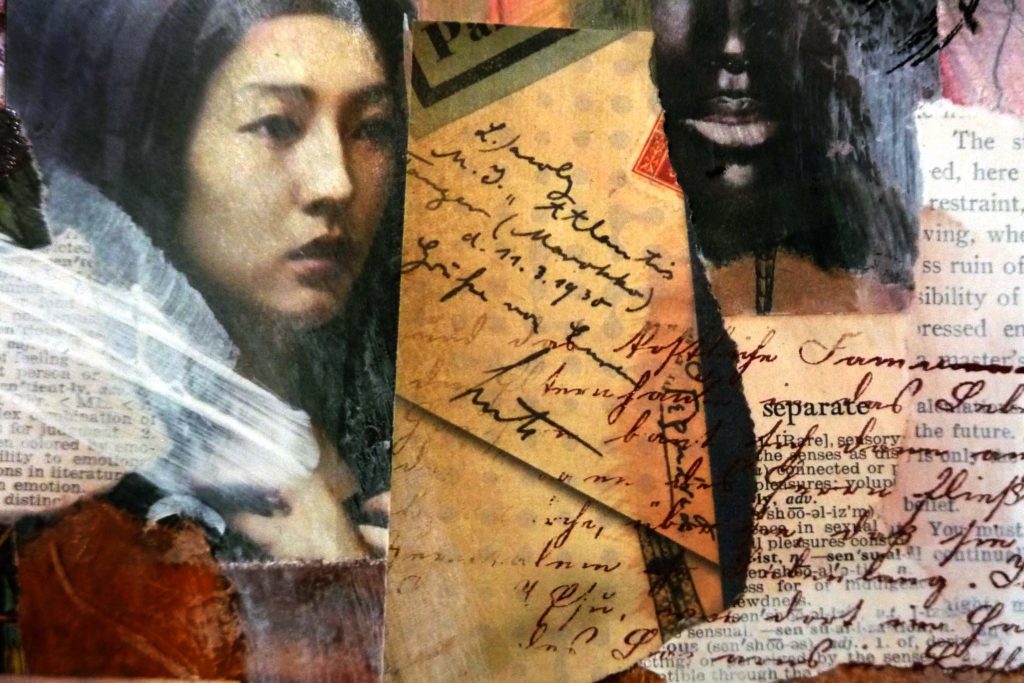
postcard

In the example above, this postcard-size section from the larger work shows faces from two different cultures and contains words such as “separate,” “restrain,” and “ruin.” It sounds like a trailer for a mini-drama! And yet it’s a completely coincidental juxtaposition within the larger collage.

We had such fun and learned so much from this project. I’ll definitely repeat it, and will probably create an eBook with with a list of materials and instructions. In the meantime, please enjoy the video from “Postcards to Myself.”

By the way, the first prototype postcard I did included text that said “eat one’s words” – so I was very careful about what I said during our critique!

proto

Save

Save

Save

Wax and Words – no worries, everything worked!

After a month away from teaching workshops, I was a little fearful about starting off the new sessions with something I hadn’t done before, a class called Words and Wax. It was inspired by some of Nancy Crawfords beautiful Love and Gratitude encaustic series pieces.

Nancy Crawford, 4x4", Even More Love and Gratitude

Nancy Crawford, 4×4″, Even More Love and Gratitude

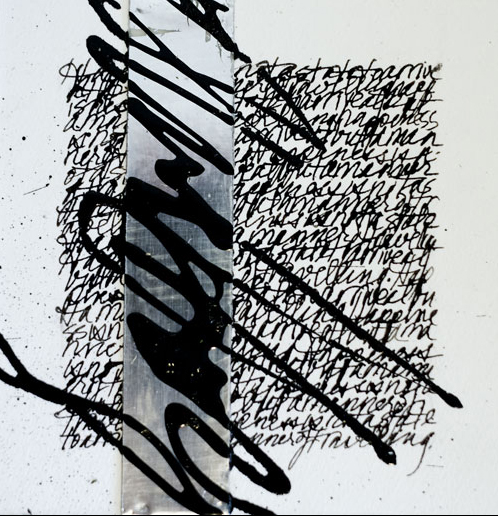
I wanted to emphasize the mark-making within the words, so I designed a four-layer process that involved ink, stencils, graphite and stamping as the initial approach,followed by the addition of beeswax, and incising into that. The results were wonderful, thoughtful, accidental but purposeful. Please see what the students did in the video below.

I’m happy to share with you the general outline of the class in case you want to play around with this idea. You can find the steps here.


Postscript:

Ironically, just as I was writing this post about words, I received some sad news about the death of an old friend and consummate man of words, Professor John Igo. John was a San Antonio educator, writer, artist, photographer, producer, and critic. He kept us all on the straight and narrow path with our word usage in his delightful radio program called Grammar Gripes.

John leaves a legacy that is wide and deep across the arts and letters community – he will be greatly missed.

John Igo

Save