Fragments, Forms and Layers: Part Three

Part 3: Layered Images — The Original Language in My Practice

A three-part series on Fragments, Vessels & Layers
(Part Three: Layered Images)

Series Introduction

Recently, the artist and teacher Crystal Marie Neubauer invited me to talk with her online group about my work. It was an honor — Crystal’s influence on my creative life goes back years — but it also presented a surprising challenge. How do you describe an art practice that moves through so many materials and forms? Encaustic, collage, fiber, clay, found objects… I’ve never been a one-medium artist, and trying to explain everything at once felt impossible.

Then I realized that my work isn’t united by medium at all. It’s united by object and intention — by the three forms that keep reappearing no matter what I’m making.
And when I stepped back, those paths became clear:

  • Santos & Shards — guardians, icons, and the stories held in fragments

  • Vessels — boats, bowls, pods, and the metaphor of holding

  • Layered Images — collage, wax, and the  revelations inside translucence

These three paths intertwine across everything I do. And this series grows out of that realization — an invitation to look closely at where my work comes from and how meaning travels across forms.

Today’s final post in this series returns to the oldest language in my practice: layered collage.


Layered Images — The Core and Heart of My Work

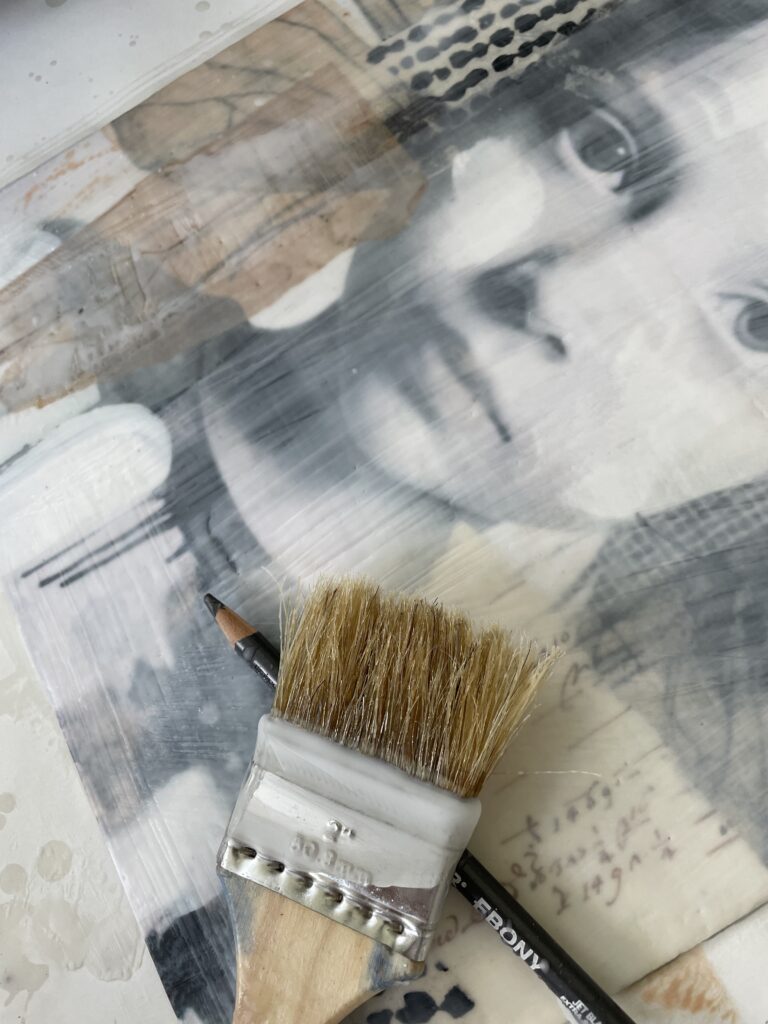
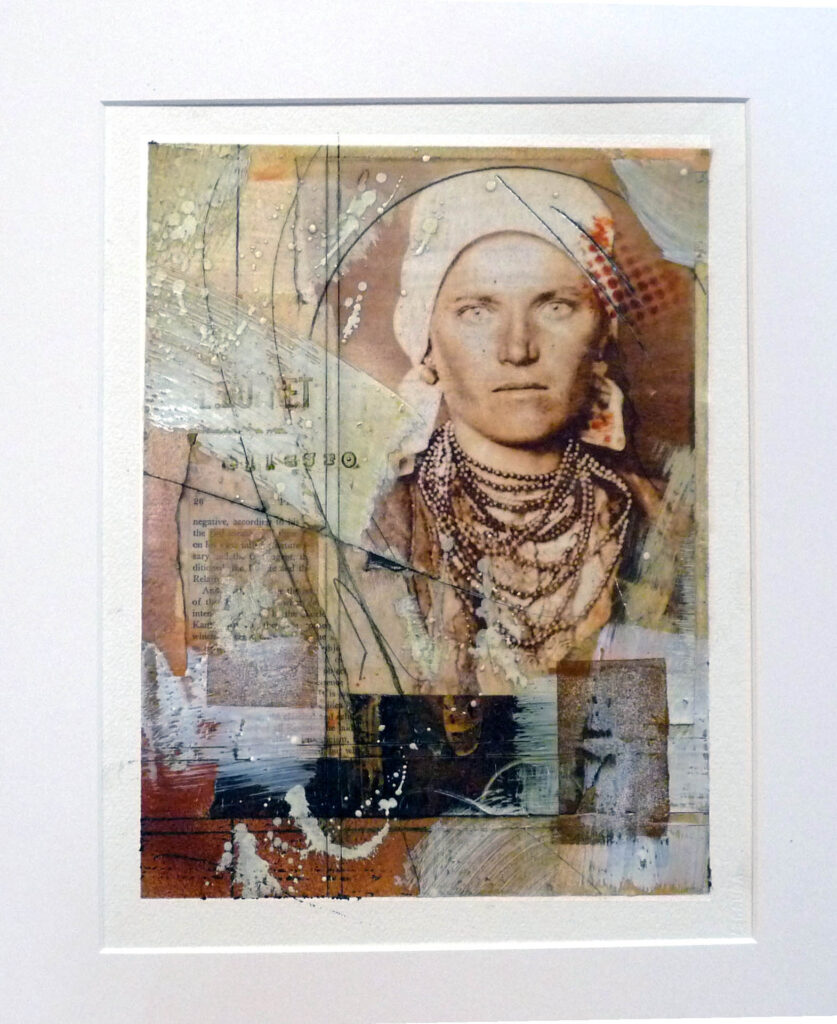
Before my Santos emerged, before I began building boats and pods and sheltering forms, I was working in layers — paper, pigment, image, and – more recently – wax. Collage was my first real artistic home on the flat surface, and it remains the place I return to whenever I need to rediscover what I’m trying to say.

If Shards & Santos are about what we mend, and Vessels are about what we hold, then Layered Images are about what we choose to reveal — and what we allow to remain veiled. I’ve always worked in collage and for the last 15 year I’ve concentrated on encaustic layering thanks to my dear friend Michelle Belto who introduced me to the medium.

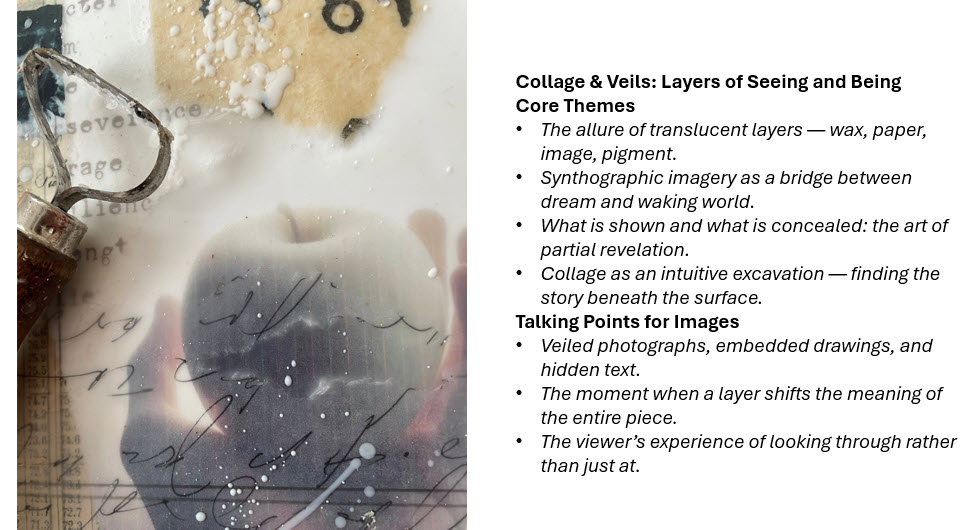
Why does Wax play so well with collage? Because It behaves Like Memory

Encaustic wax feels like the perfect collaborator because it mirrors the way memory works:

  • luminous in some places

  • fogged or obscured in others

  • layered with traces of earlier thoughts

  • holding what came before, even as new layers are added

Wax isn’t just a sealant or surface — it’s a way of thinking. It slows everything down. It requires heat, patience, and attention. It asks: Are you sure you want this visible? Are you sure you want that hidden?

I don’t use much colored wax at all – I’m not an “encaustic painter,” rather an artist who uses encaustic techniques to tell mixed-media stories. The pale translucency of beeswax is my go-to collage medium of choice.

A Layered Image Is a Conversation

When I work in collage and wax, I’m not composing an image; I’m listening to it. Layer by layer, the piece begins to speak –a scrap of ledger paper peeks through, a synthographic figure emerges or dissolves, an accidental texture becomes the thing the piece needed all along. Even removal becomes part of the conversation. Scraping back a surface to reveal earlier marks often leads me to meanings I didn’t anticipate. Encaustic is not a linear process. It loops. It reveals. It forgets and remembers.
Just like we do.

A Return to Old / A Portal to New

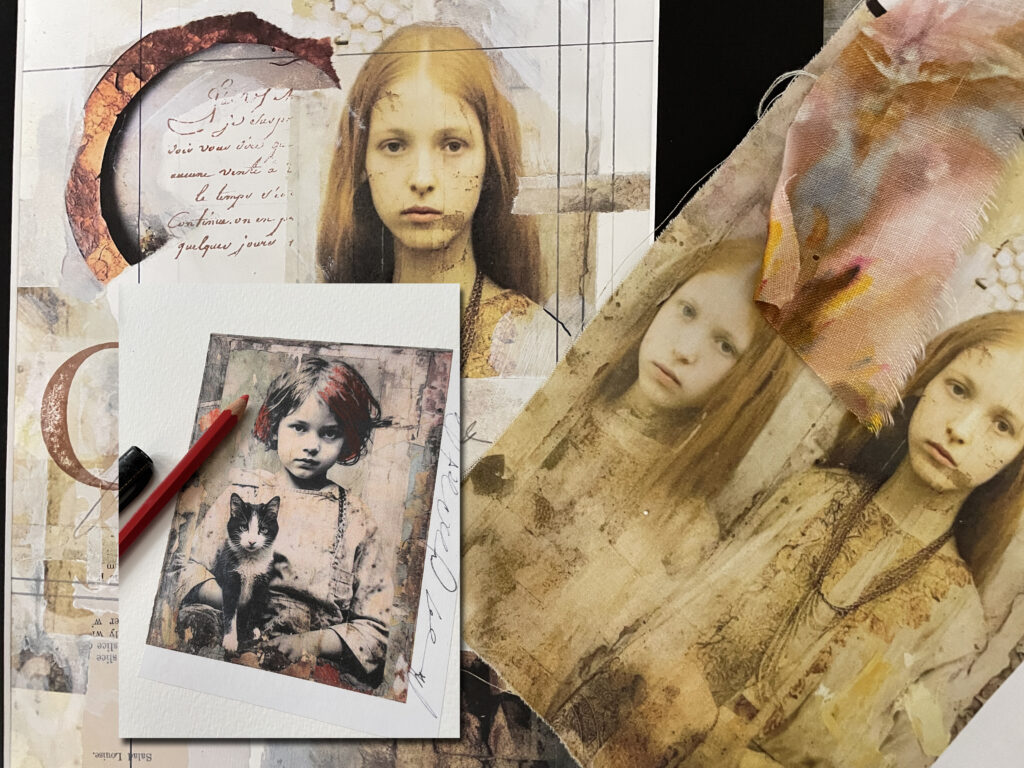
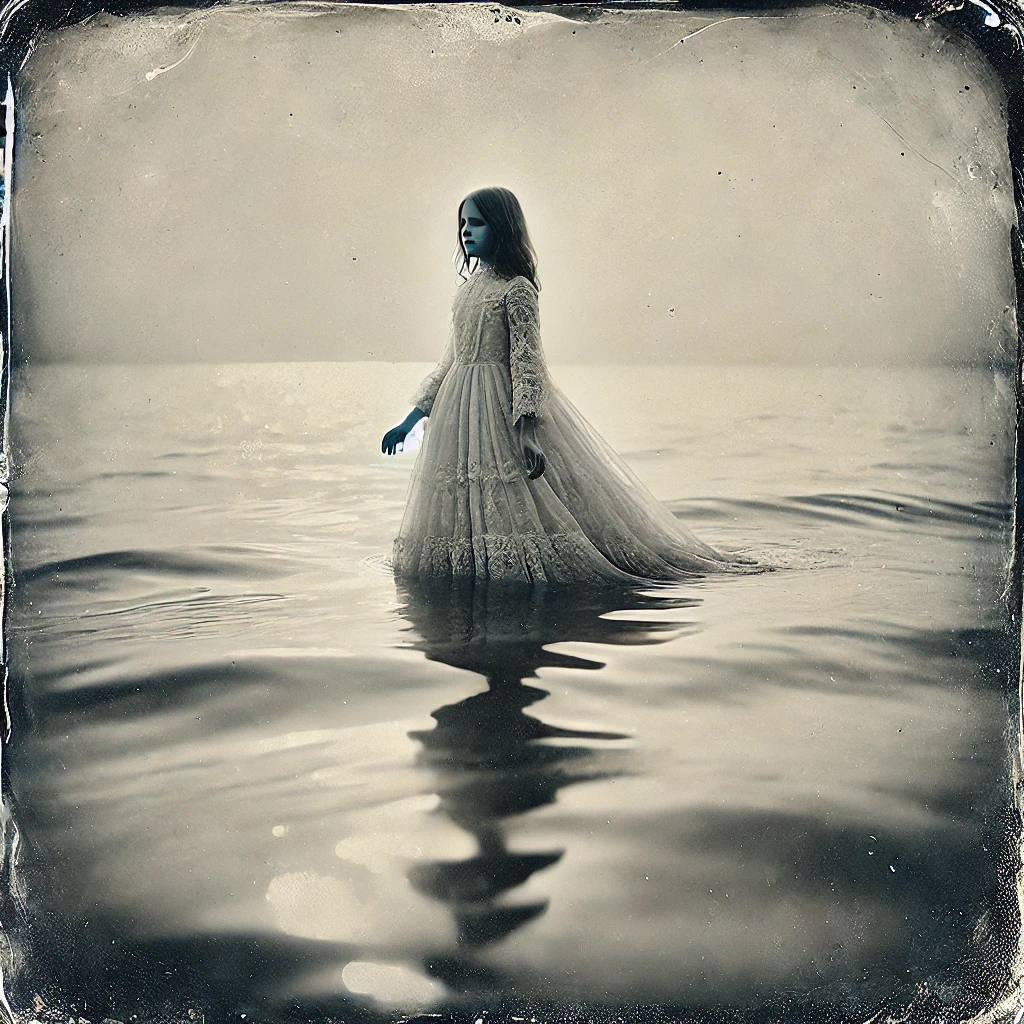
What I love most is that this old, familiar collage path has become a bridge to my newest work with synthographic imagery. The dream-logic of AI images blends beautifully with the ancient, tactile behavior of wax. One creates possibility; the other brings it to earth. If you’ve taken my recent Painting with Fire Lesson, Synthography and Wax, you understand.

The two together create a layered world where fantasy becomes grounded, realism becomes dreamlike, and the viewer is invited inside the luminous in-between

It feels like a collaboration across centuries — digital imagination meeting an art form older than painting itself. These aren’t just surfaces — they are strata.

Inviting You Into the Layers

Even if you don’t work in collage or encaustic, layering is a language almost every artist speaks. It’s about building meaning slowly, letting some things rest beneath the surface, allowing others to shine through.

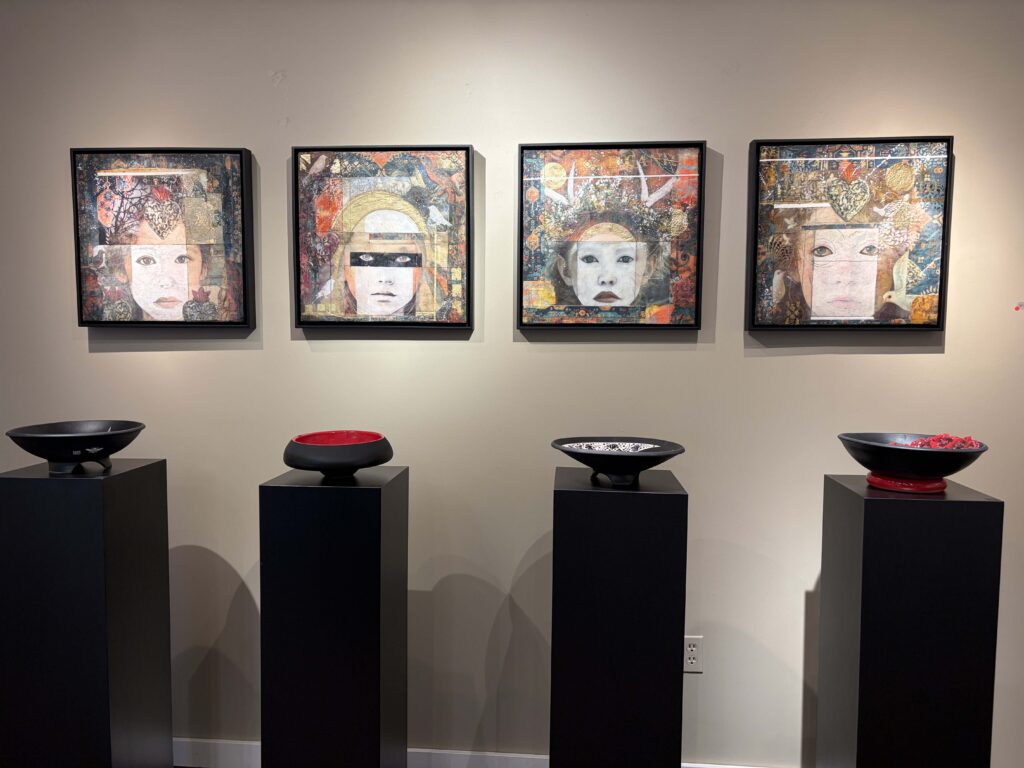
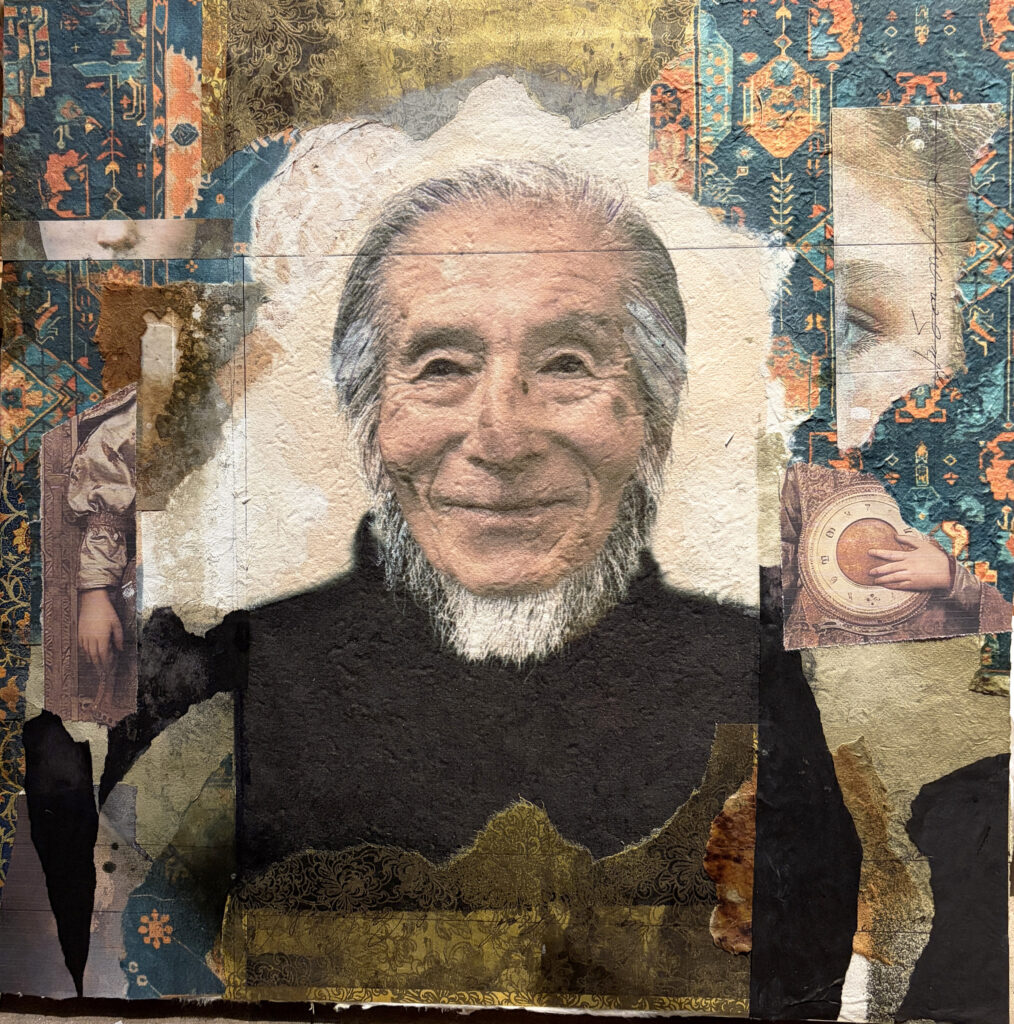
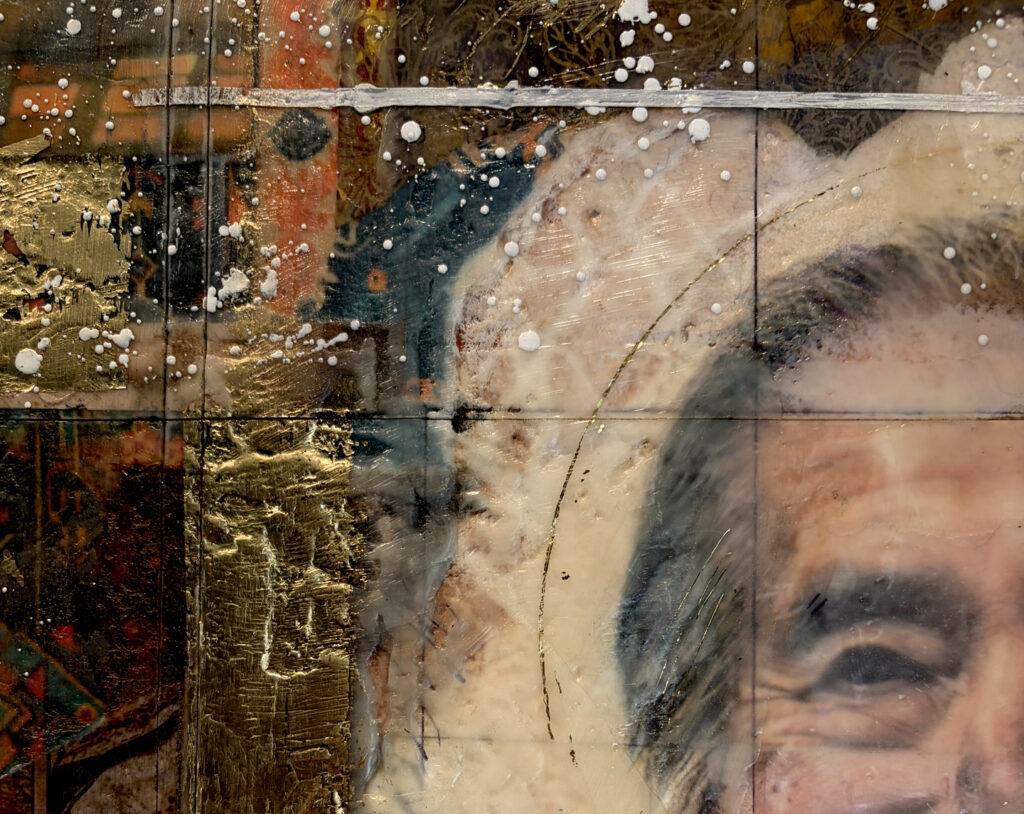
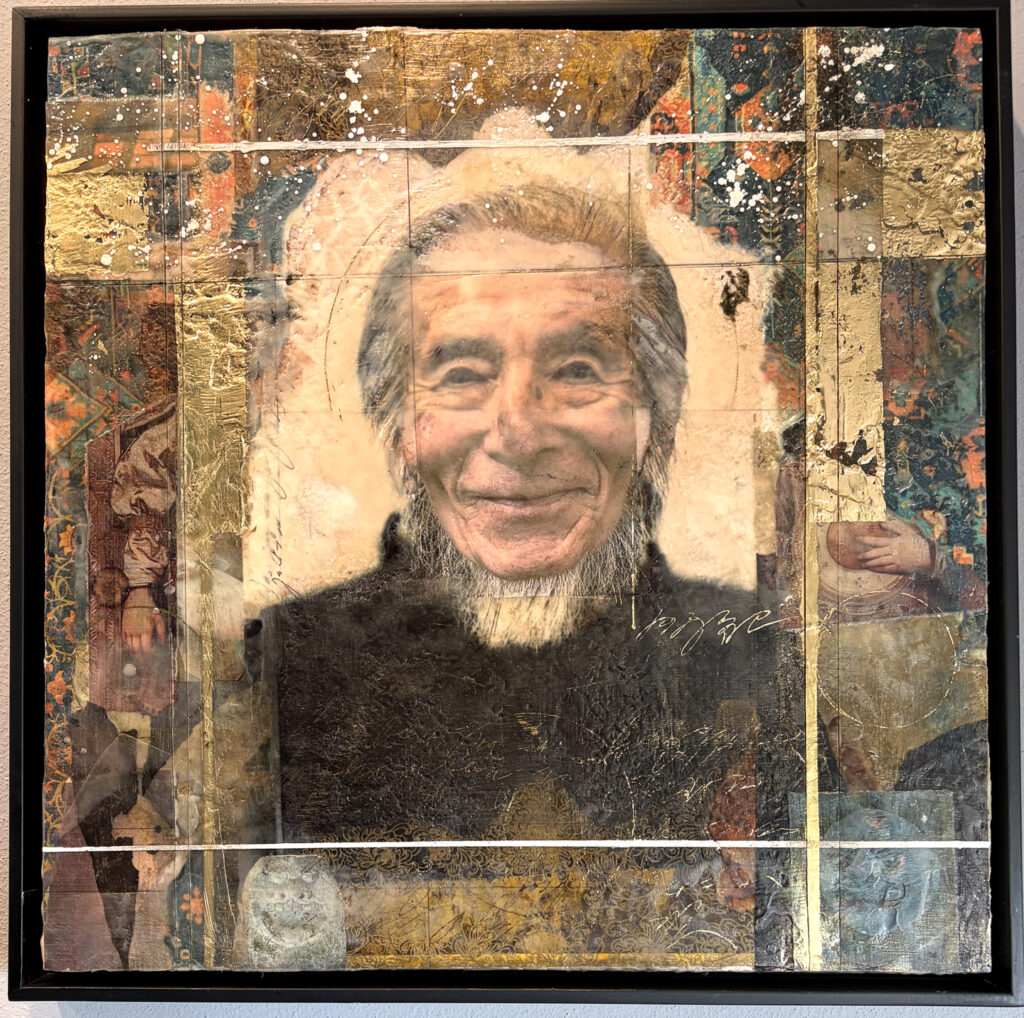
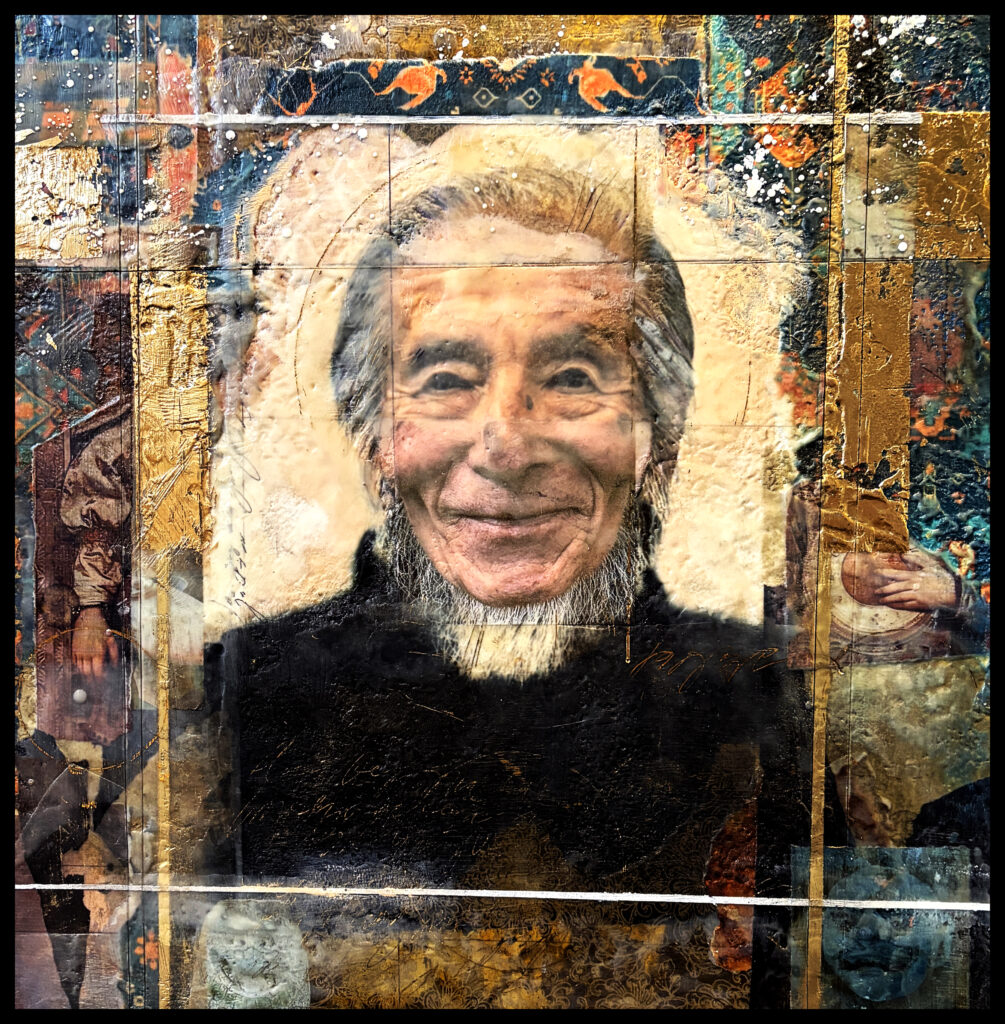
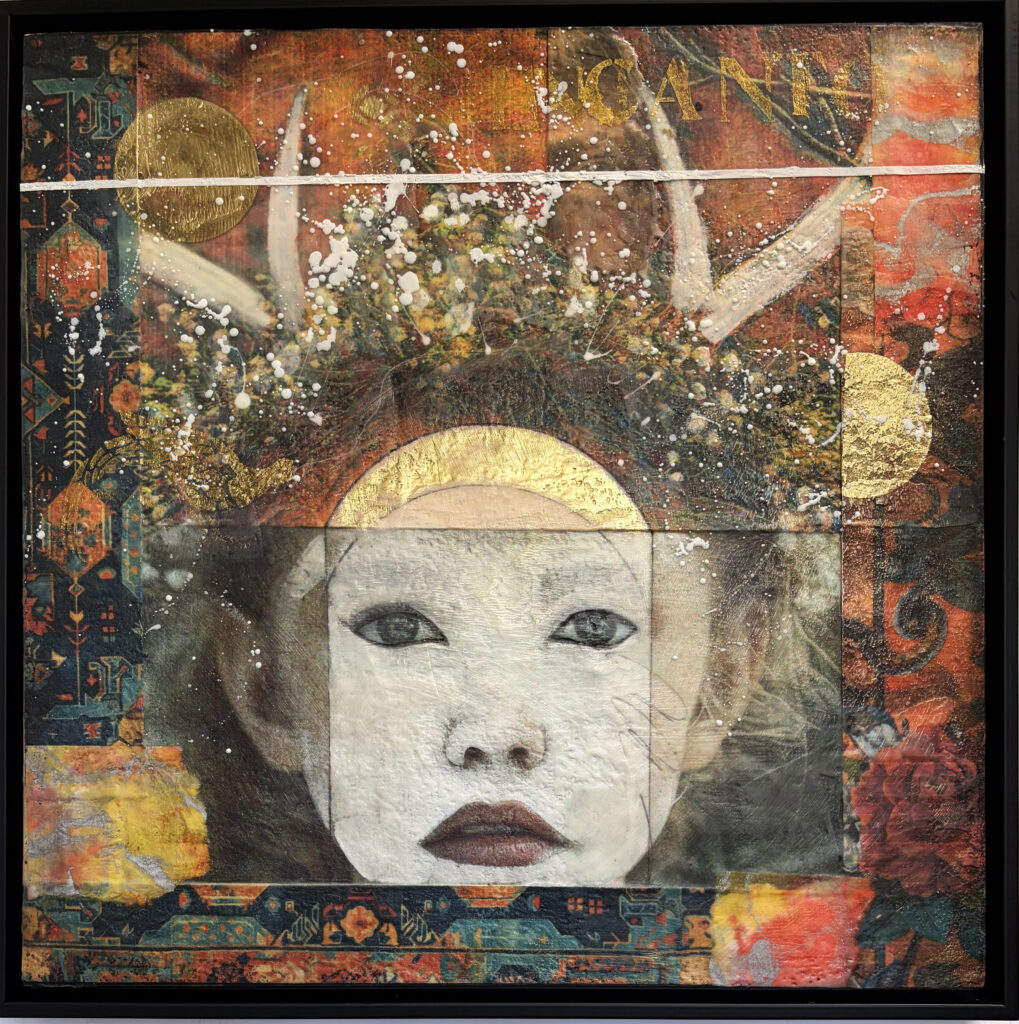
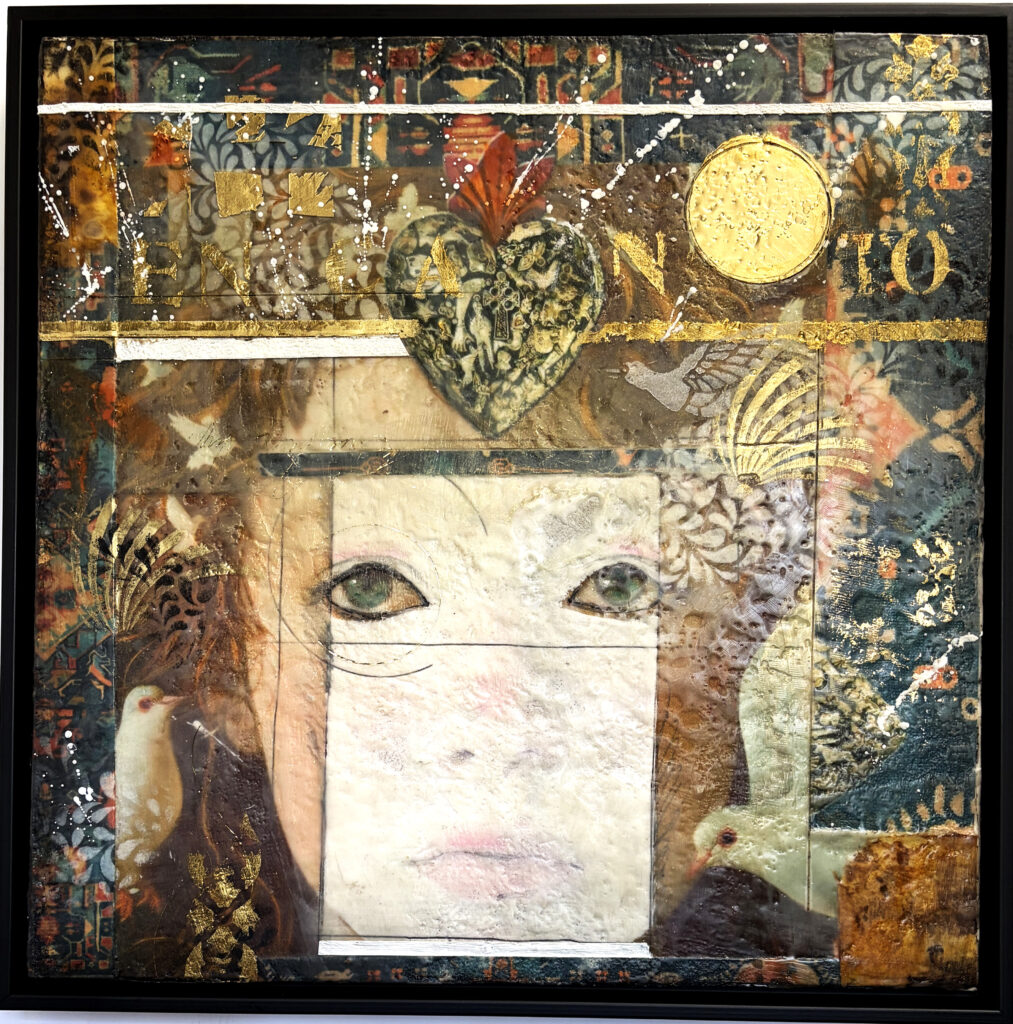
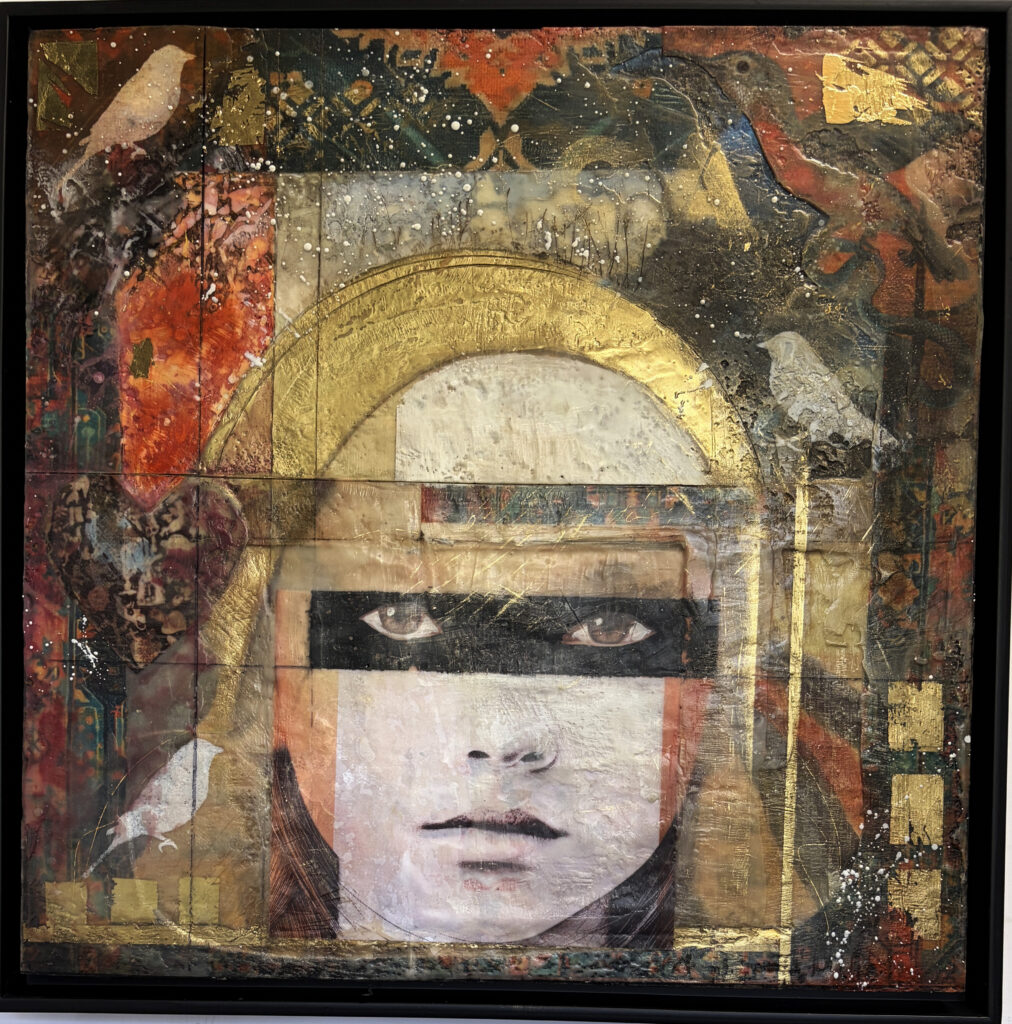
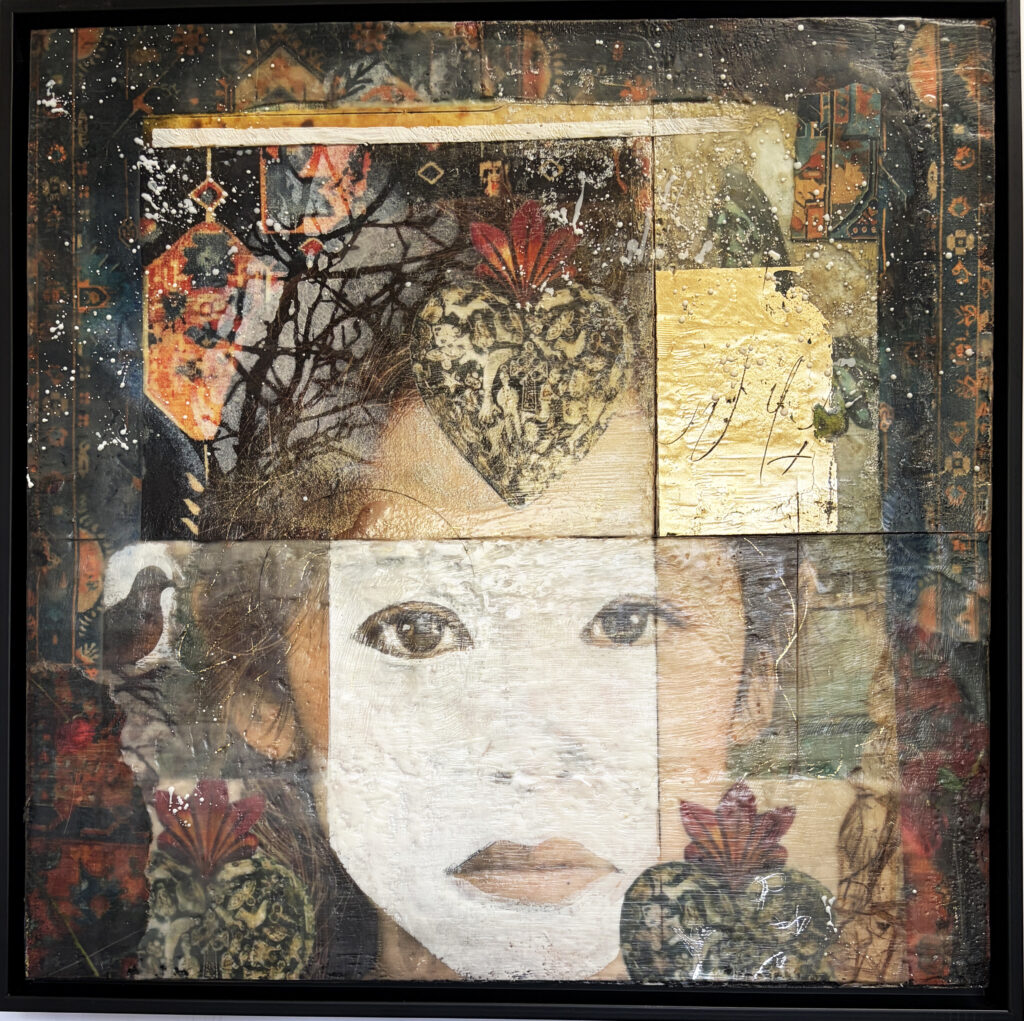
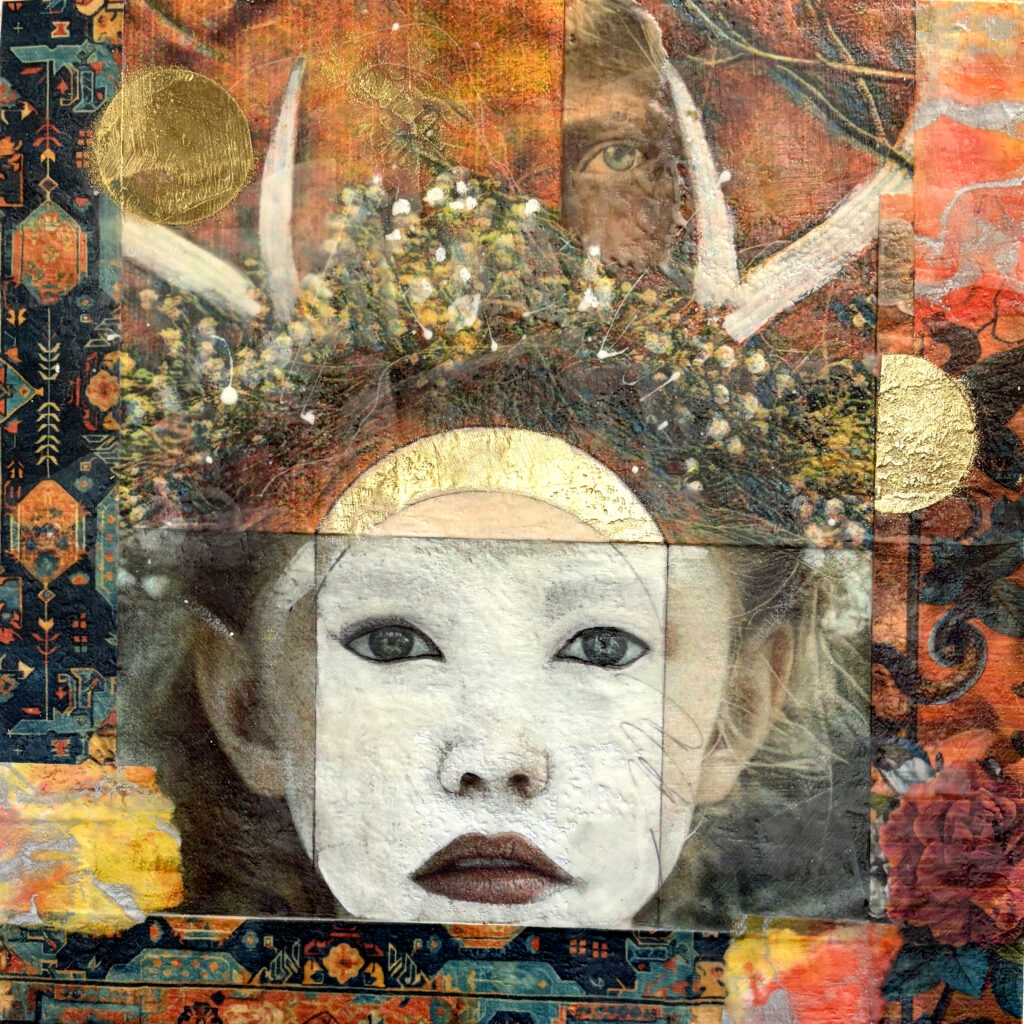
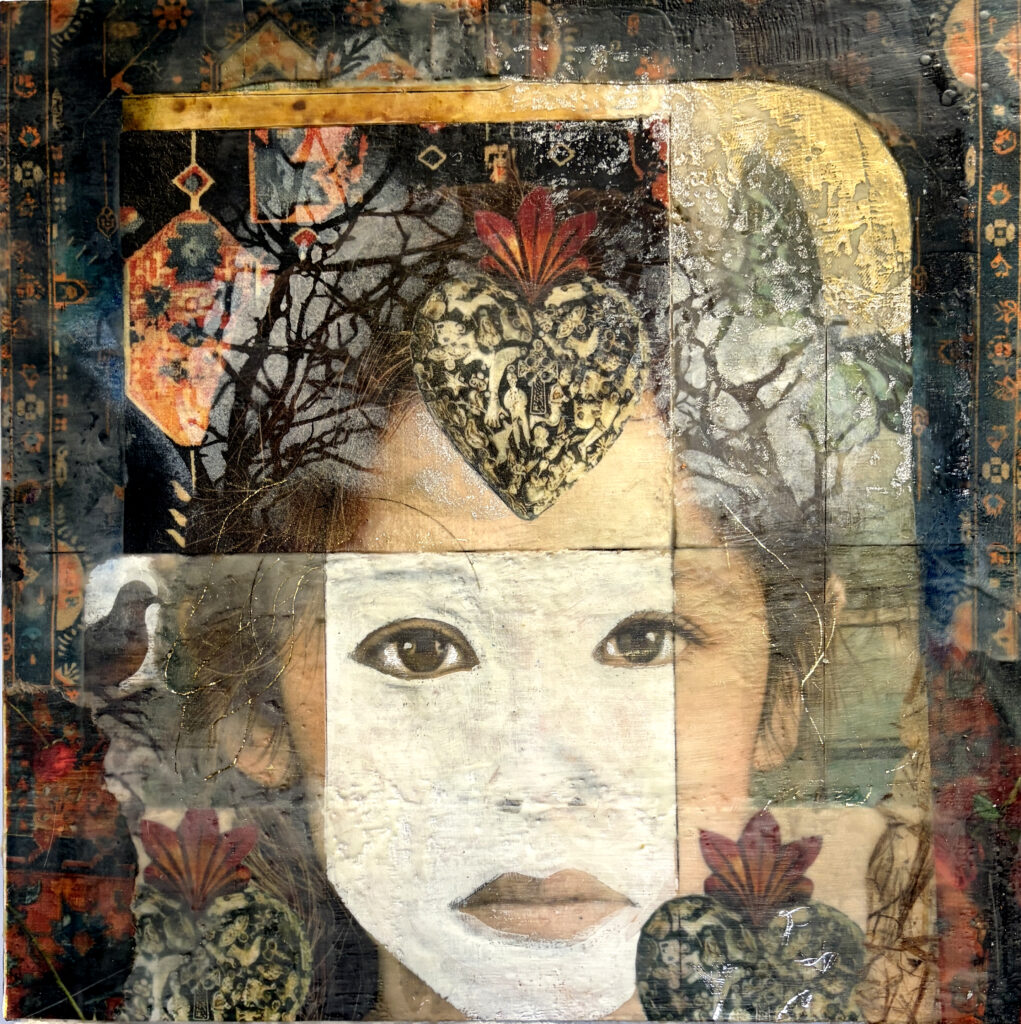
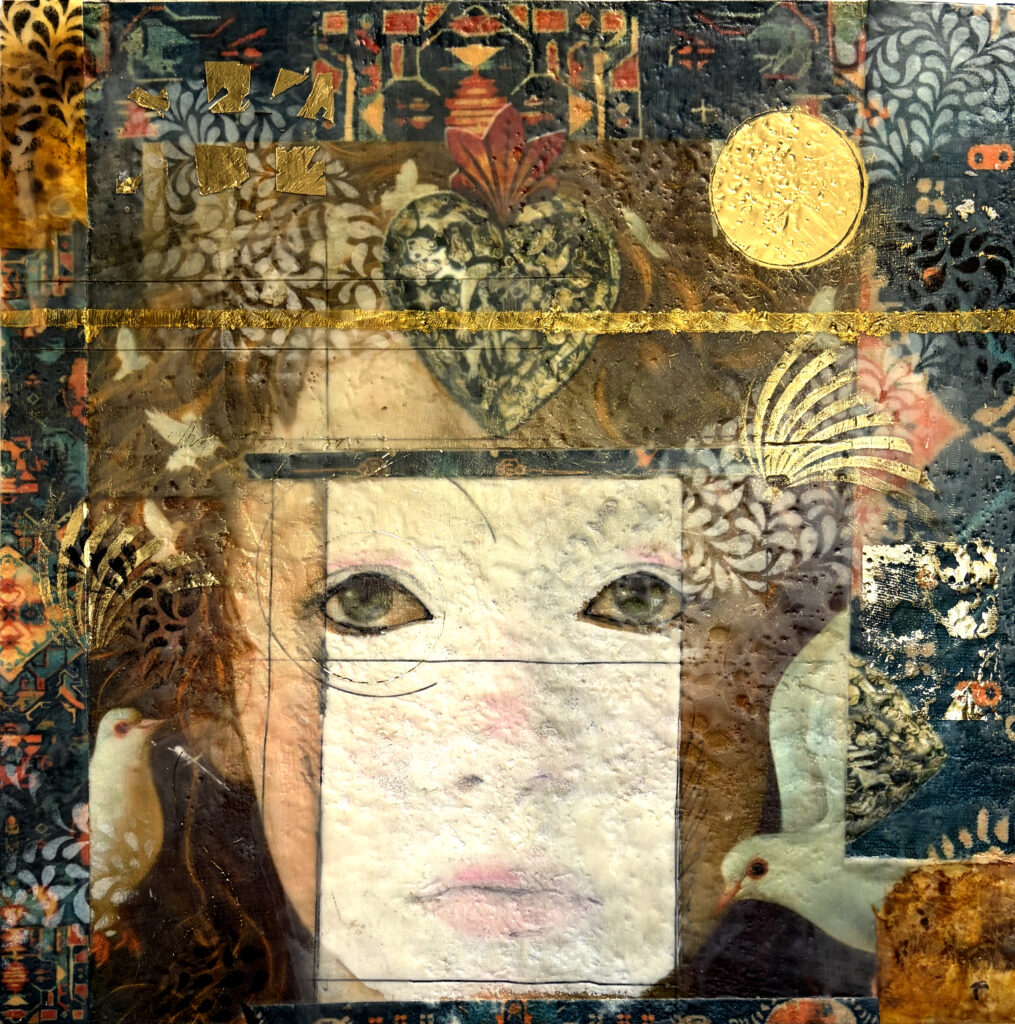
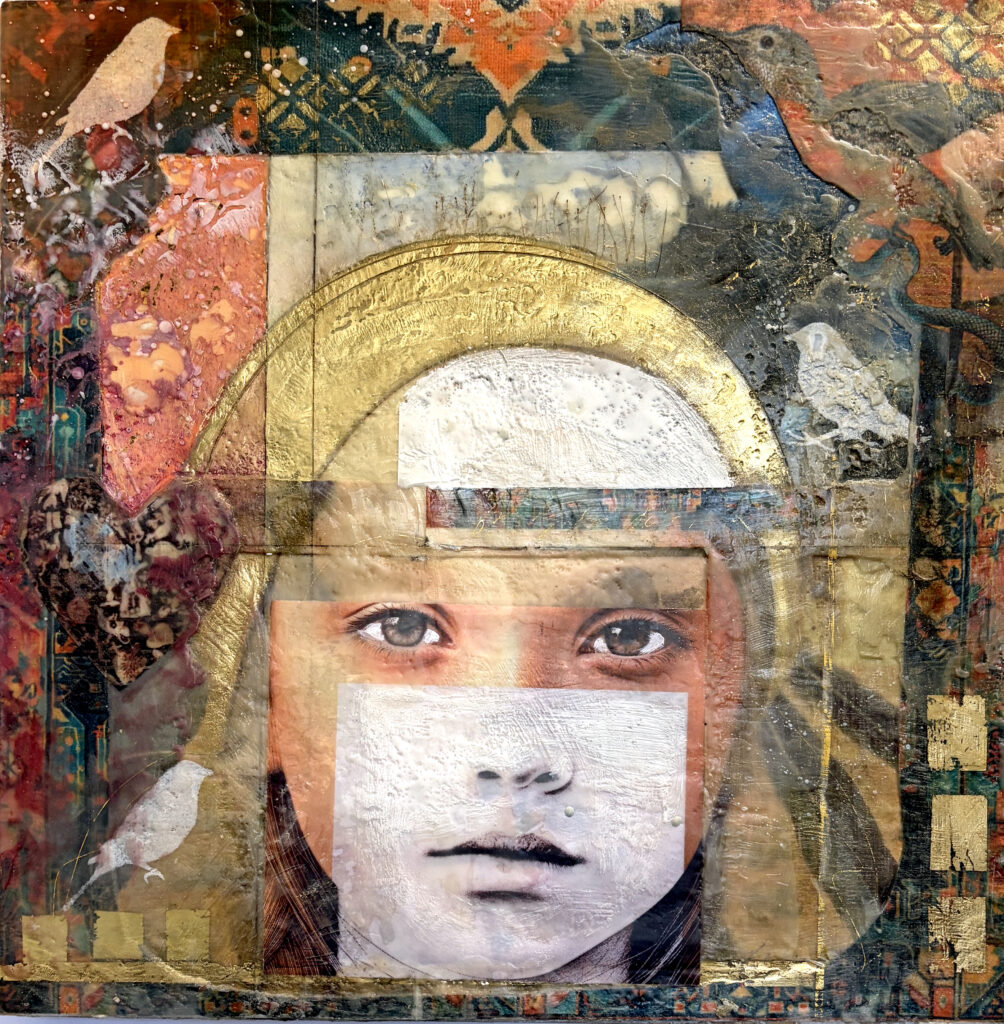
Layers give us permission to be complex. To hold contradictions. To let time become part of the piece. As an example, here is a new (almost done but not yet – the edges are still taped) series that goes with my Encanto assemblages and will be in the Taos Exhibit in 2026.

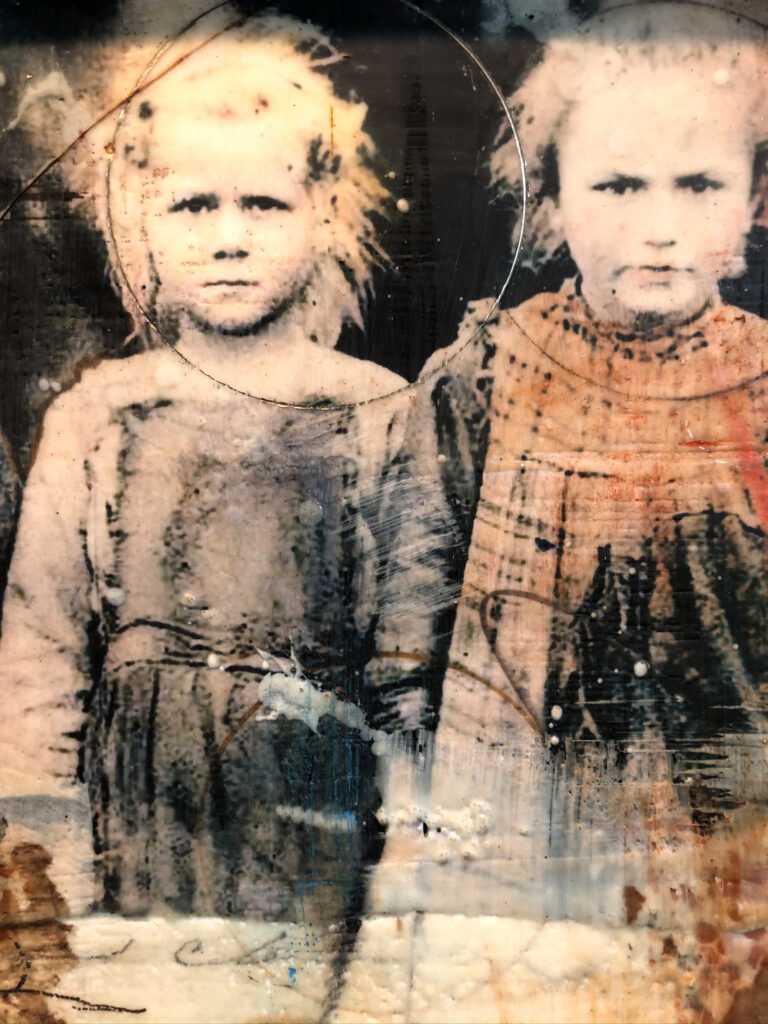
I’m creating four layered encaustic collages, 20″x20″, each representing a child saint or Santo Niño. Technically, some are probably female Santas, but gender is not an issue here. Fusion is, fusion of layers and culture.

These Santo Niños inhabit the liminal space where Indigenous cosmologies and European Catholic iconography meet, overlap, and transform one another. The white-painted faces echo ritual marking found across Native traditions, signaling spiritual passage, ancestral presence, and worlds in transition. Their frames and gold-leaf halos recall Spanish devotional art, yet the children themselves do not belong fully to that lineage.

They are hybrid beings—part saint, part spirit-guardian—born of a cultural collision that reshaped the sacred landscape of the Southwest. 

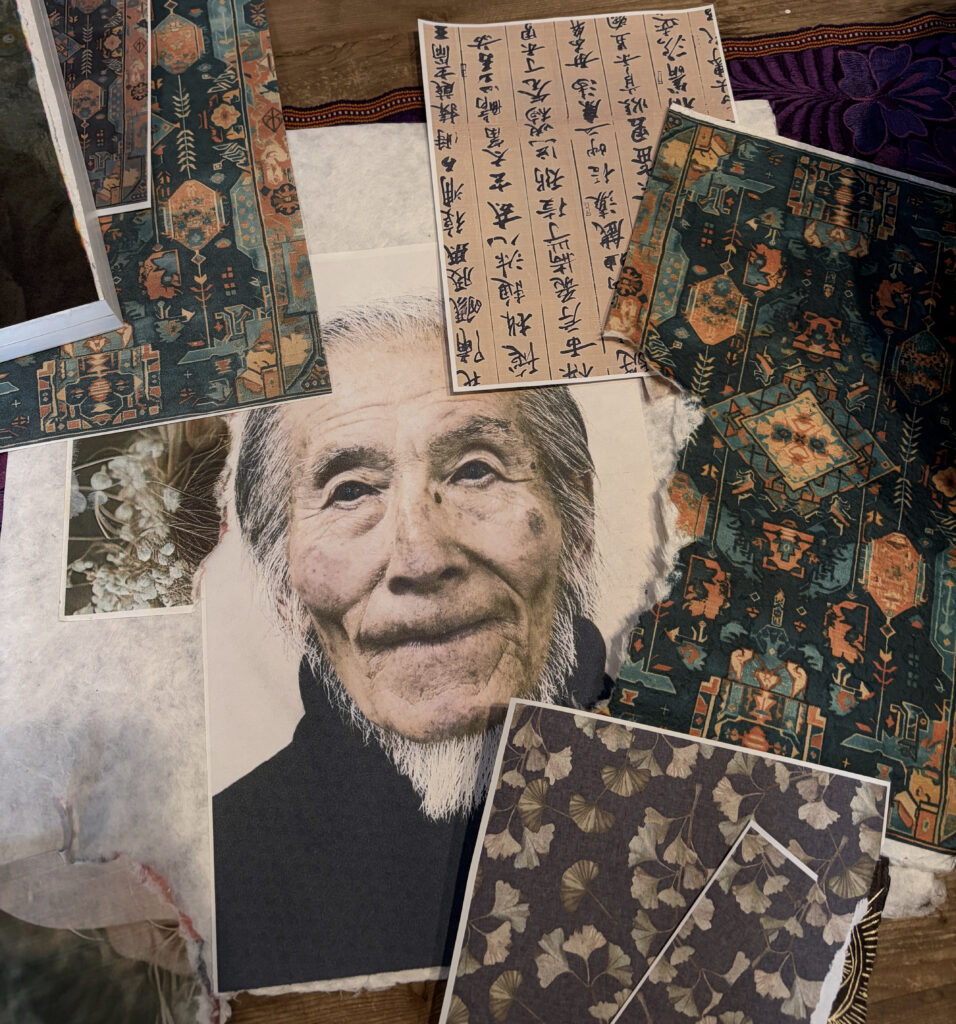
I’ve layered mulberry paper printed with carpet designs and birds than might be found in a European drawing room with white painted synthographic faces of anonymous children to create contradictions and layers of metaphor and storytelling. Here they are so far – they may end up with one more layer of meaning but I’m just not sure:

Santo Niño of the Antlers and the Hidden Path

Santo Niño of the Sacred Heart Seed

Santo Niño of the Two Doves

Santo Niño of the Watching Birds

There is more color in these layered pieces (surprise!), but the printed color is pushed back by the veiling layers of wax, almost as if time-faded. I’m having an amazing time fitting the images to the layers of history and meaning in the whole concept of Encantos and objects of hope and devotion in a world where such things need to be extracted again from our deep sense of humanity.

Whew! That was  lot to talk about!

Here are a few prompts to bring into your own studio:

  • What early layer in your work deserves to resurface?

  • What do you want to soften — not erase — with a new layer?

  • How might your materials become translucent instead of opaque?

  • Is there an image in your practice that wants to hide and reveal itself at the same time?


Closing the Trilogy

With this third post — fragments, vessels, layers — the series comes full circle. Each path has shaped my work in different ways, but together they form a single through-line:

We create meaning from what we mend, what we hold, and what we choose to reveal.

Thank you for walking with me through all three.

Butterfly carrots and pumpkin shepherds

Words are becoming increasingly important in my recent work, both as design components and as inspirations. I’m honestly not sure why, maybe it’s because I’ve been rediscovering some of my beloved Abstract Expressionist heroes  when I was an undergraduate art student — Larry Rivers and Robert Rauschenberg. Those guys were amazing.

Parts of the Face: French Vocabulary Lesson 1961 Larry Rivers 1923-2002

Robert Rauschenberg, Metropolitan Museum of Art is an offset Lithograph poster made in 1970.

Sometimes the words I’m finding are strange and somewhat obscure, like “hiraeth,” the Welsh word that inspired this series, which is now complete and will be shown at my solo exhibit next Saturday. I’ll post those soon.

Sometimes the words are both inspiration and visual elements. I’ve just completed five “story banners” which will also be shown in the exhibit. These were partially inspired by two of three random words from a vintage child’s stamp set that was a gift from my friend Jean. I talked about those delightful word stamps in an earlier post, and am still discovering ways to use them.

Look at these words that are available in the old stamp setlimited but evocative. Picking any two or three can can conjure stories that blend nostalgia and weirdness and wonder. Try it! Butterfly carrots?? Pumpkin shepherd??

For a narrative artist like me, this is gold! And when these words are combined with synthographic and vintage images in fiber and mixed media, the results are really intriguing.

Here are the five banners. Each one is about 14×24″ with layers of fabric and images and old milagro charms.

Lyn Belisle, Mother Nest, 2024
Lyn Belisle, Seven Horse, 2024
Lyn Belisle, She Know, 2024

Lyn Belisle, We Were Sisters, 2024

Lyn Belisle, Little Tiger, 2024

During this process, I continue to learn that “shards” can be more than just pieces of stuff for assemblage – they can be scraps of fabric and synchronistic words that appear from unusual places. And these “shards”—whether bits of fabric, stray words, or found objects—are fragments of meaning waiting to be woven into something whole.

By embracing them, we give ourselves permission to see beyond the ordinary, to let coincidence and curiosity guide us. In this way, each piece or word becomes part of a larger narrative, inviting us to craft stories that feel both ancient and freshly our own, across any medium we choose. And then it’s up to the viewer to join us in figuring out these stories in a way that speaks to them. What fun!

Thanks for reading!!

Patched up . . .

I started this blog in its current form back in 2010 and it has become my invaluable journal of where the creative path has taken me. Recently, however, my SHARDS blog site completely crashed and I thought 15 years of entries and over 1000 posts were lost forever. Thanks to George Howard, a smart techie and highly-recommended good guy, we are patched up and running again. Sending you a shout-out, George!

I’m back just in time to share something lovely that Jude Hill wrote this morning

“So what if I concentrate on story building with loose patches for a while? Language Patches is what I have come to call them.  They are simple and small and maybe you can play along?”

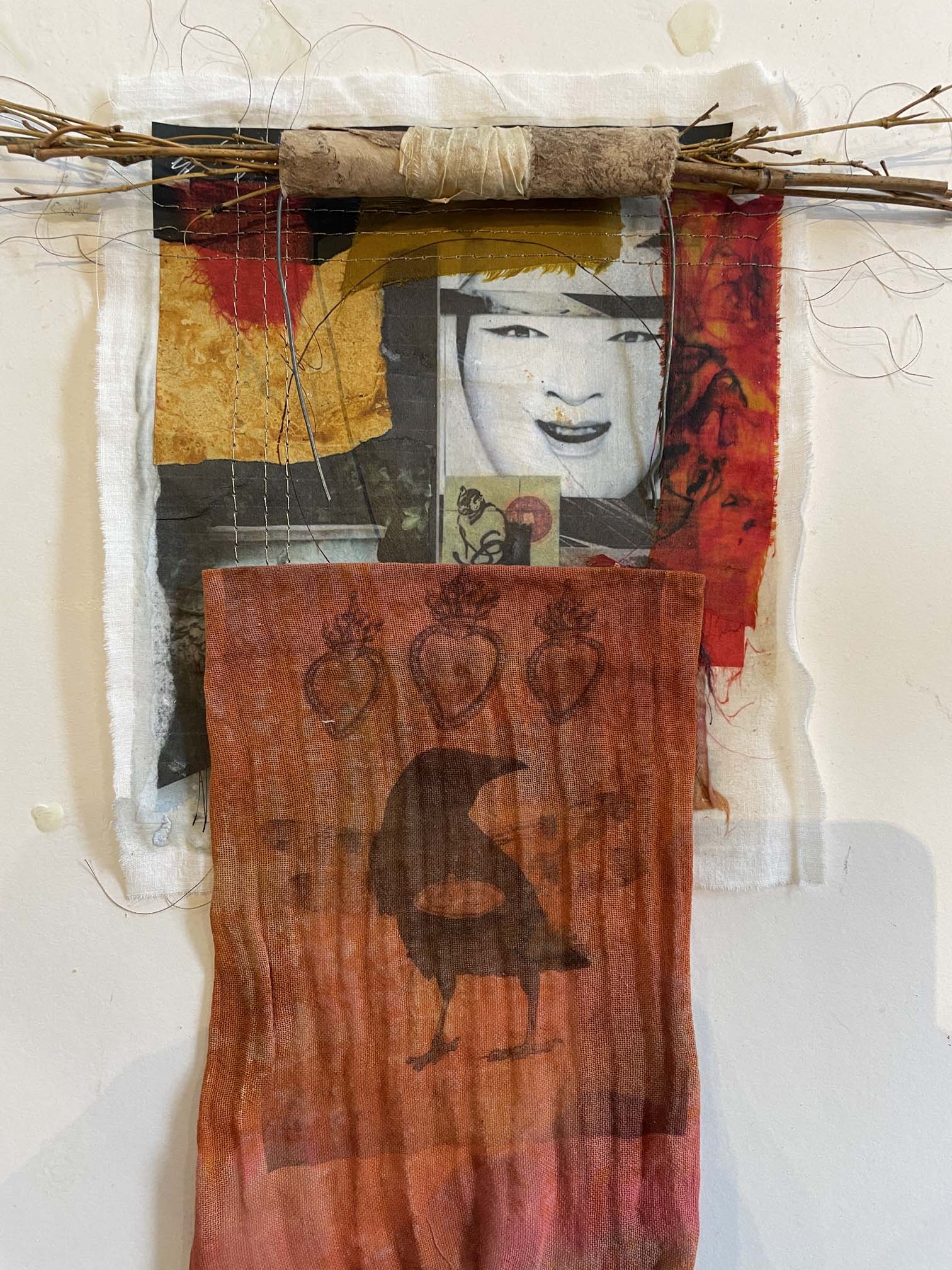
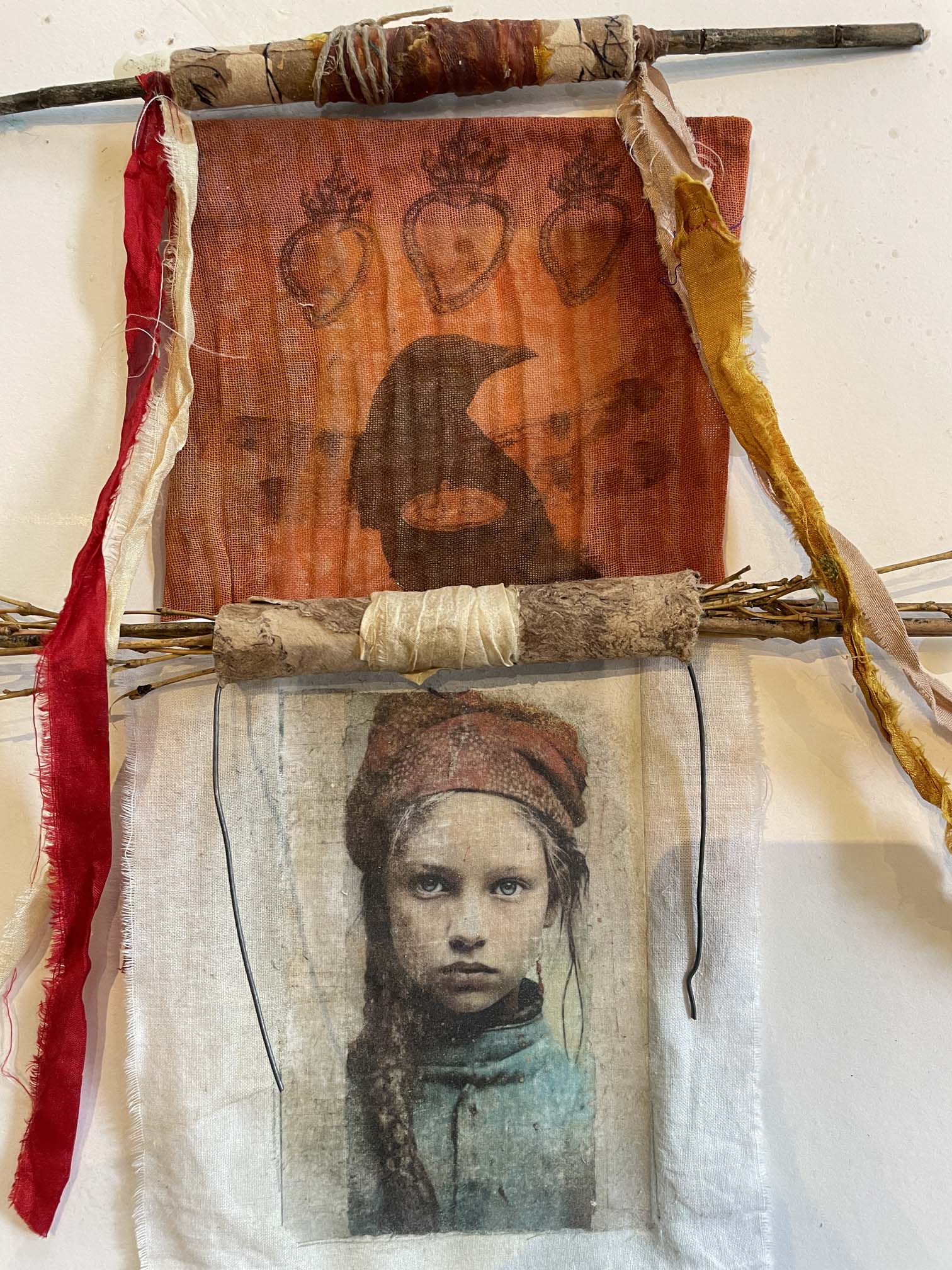
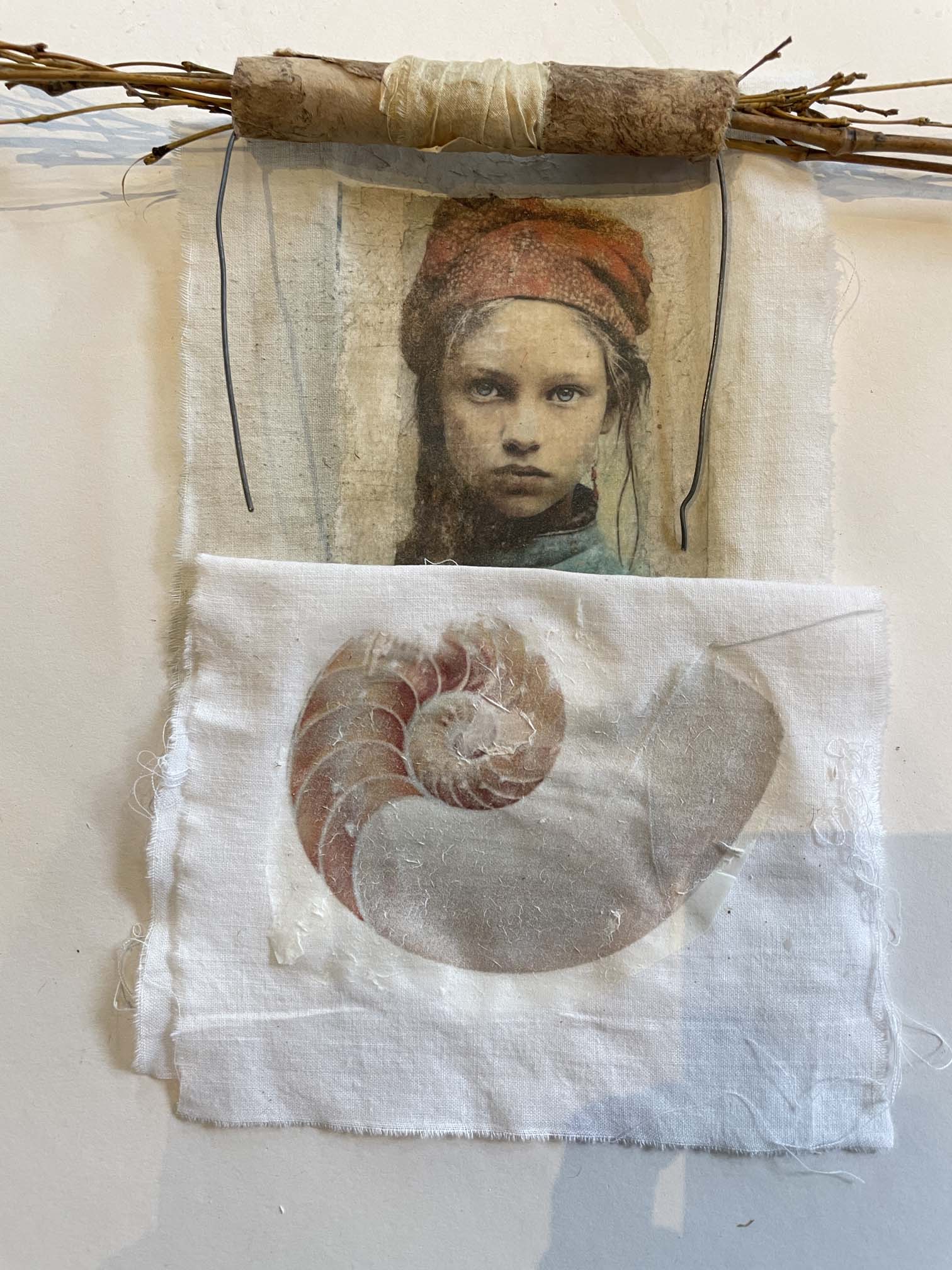
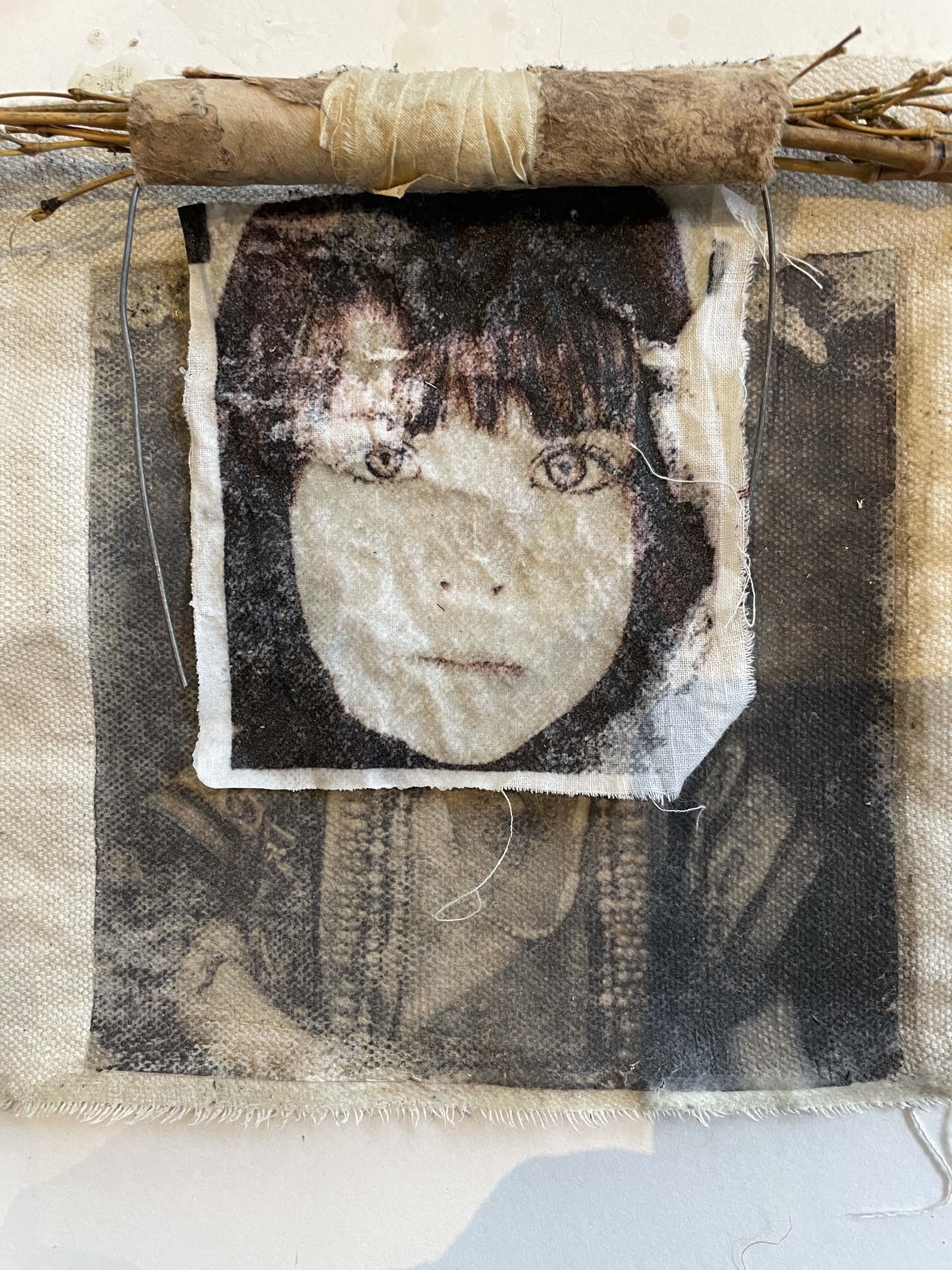
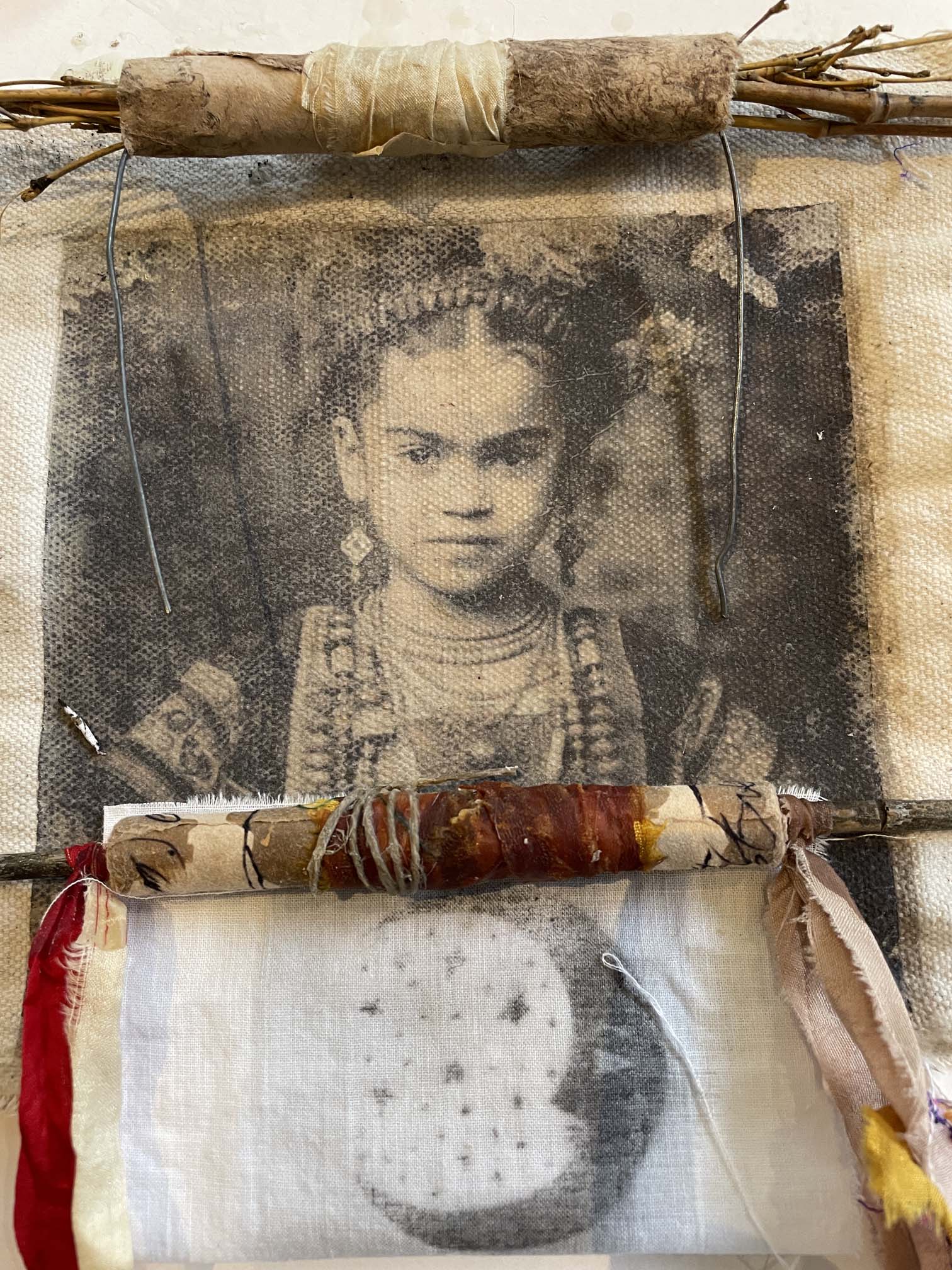
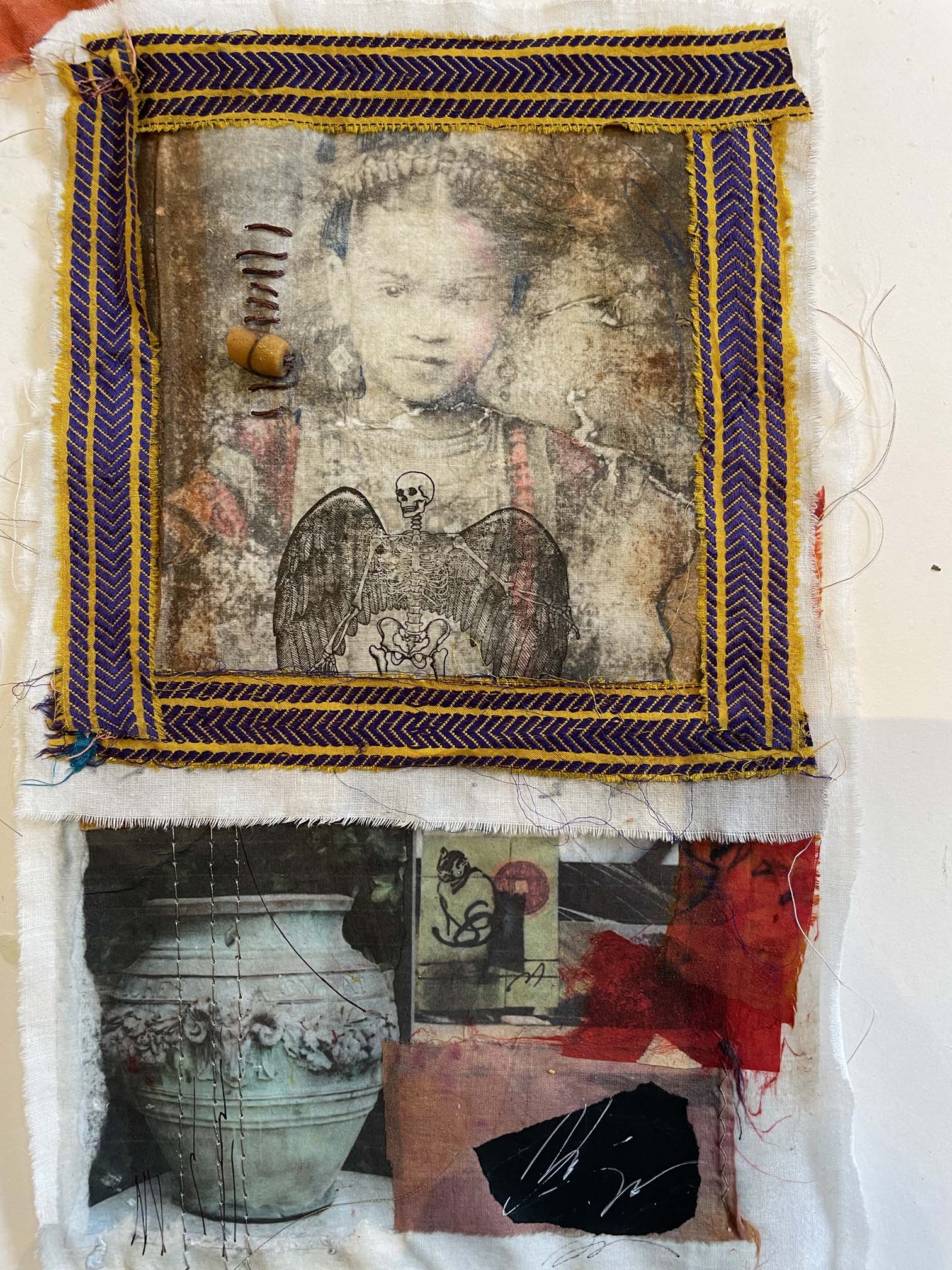
This is so much like what I’m doing with my new workshop, Scrolls and Surface, that I wanted to expand on the idea. The scrolls that I’m assembling as prototypes for the class are nothing more than a collection small “patches” of narrative. They go together in various ways, much like chapters in a book, and because they are small, they can be rearranged.

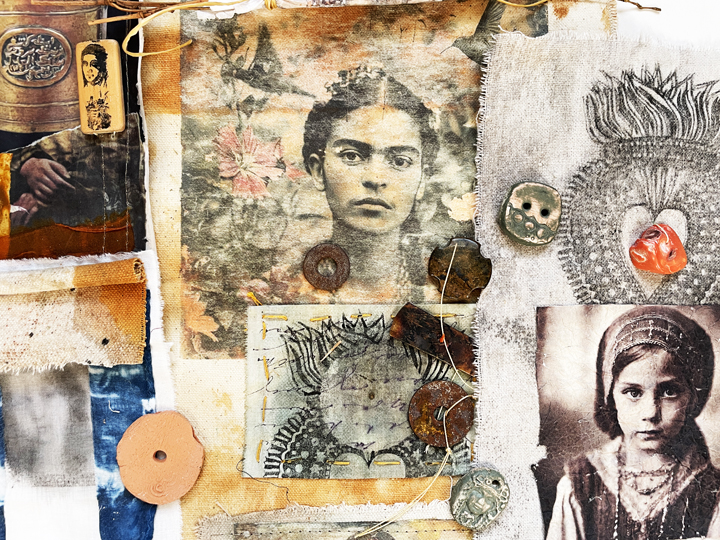
Here are a few examples – some of these are image transfers on fabric, some are what I call “fusion patches,” and some are handmade or found objects.

The images that I choose incorporate on these “patches” reflect my personal themes: neo-santos, shards, paradoxical connections, lost children, myth and mystery. Your images will be different just as your story is different.

Once you start working this way, creating small components that will ultimately go together as a larger picture, you’ll discover all kids of possibilities and combinations. It’s great composition practice, but more than that, it’s a lesson in how one element affects another.

Assorted combinations of fusion patches and transfers to fabric – are there stories here? Can they be rearranged to tell a different narrative?

It really is so much fun to lose yourself in this task. And it’s equally as much fun to actually create the patches using all kinds of experimental methods. Even when something doesn’t work, it’s a good lesson. Jane Dunnewold makes Citrasolv transfer look so easy – when I first tried it, I got blobs. But at least they were mysterious blobs.

A Mysterious Blob

I’m filming a lot of these experiences for a new online workshop called The Pilgrim’s Scroll: Stories in Paper and Cloth which should be ready in a couple of weeks.  In the meantime, it sure is great to have my blob – er, I mean, BLOG, back!

Thanks, Jude and George and all the people that help us stay connected and inspired!


Finding answers in your own work-stash Shards

It seems fitting to start the new year with a post on the whole idea of Shards.

My work has always been strongly influenced by the idea of “shards” as a metaphor for human communication across time. A shard can be a found fragment of clay, a rusty nail, a scrap of handwriting – any little clue that becomes a “secret handshake” between the maker and the discoverer.

But sometimes the maker and the discoverer are the same person. Have you ever gone through work you’ve done earlier and found the answer to something you are doing right now? Perhaps it was a sketch, or a scrap of dyed fiber, or an unfinished collage. These are your shards, fragments of creations that were waiting for re-discovery to be put to good use in the place they had been waiting for.

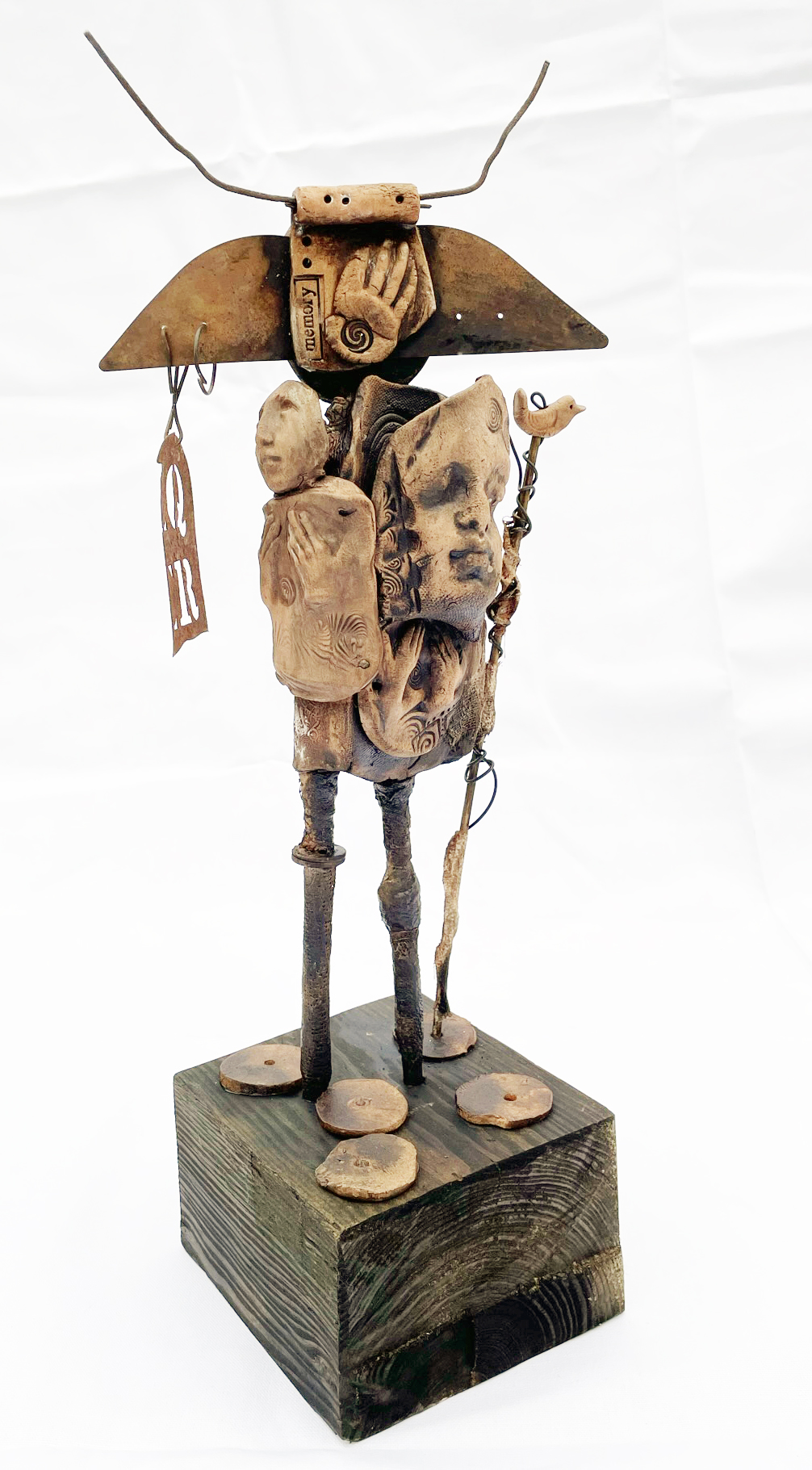
Such was the case with this sculptural piece which garnered many comments when I posted it on Facebook.

Child of the Universe. Lyn Belisle 2022

I had completed the main body and really liked it, but there was something in this piece that wanted more. I envisioned him as a pilgrim coming home. He needed to be bringing something with him, but pilgrims bring only what they can carry.

I searched through my own older clay shards for answers and found four pieces that fit perfectly and answered the question of what he is carrying – he is carrying memories on his back.

Child of the Universe, back view


The four shards I found in the “shard stash pile” fit so perfectly on the back of the pilgrim that you cannot see them from the front. One piece even has the word “Memory” on it. Who are these people carried in the pilgrim’s memories? We don’t know, but we want to.

All of this reminds us that sometimes our own burdens are not visible to the people we encounter in our face to face dealings. It is only when we take the time to look behind the facade that we can discover and empathize.

It’s amazing to me that when we look to our own work for “shards” in our past stash pile, we often find and answer to a story that is deeper than we could have imagined if we had started out all fresh and new.

Nicholas Wilton had a great quote this morning that inspired this post – it really resonated with me, especially with this earthenware piece I’d just completed.

“Even in the mess we make, there’s hope! Beautiful clues emerge, like certain colors together or how a line relates to a shape, to inform your way forward and keep you progressing. Rather than looking at others’ work, staying immersed and attentive in your art-making will provide the solutions. It’s a self-generating process that comes from within.” – Nicholas Wilton

Now go through your own stash pile this morning for clues from your earlier self that will shape and inform your work!

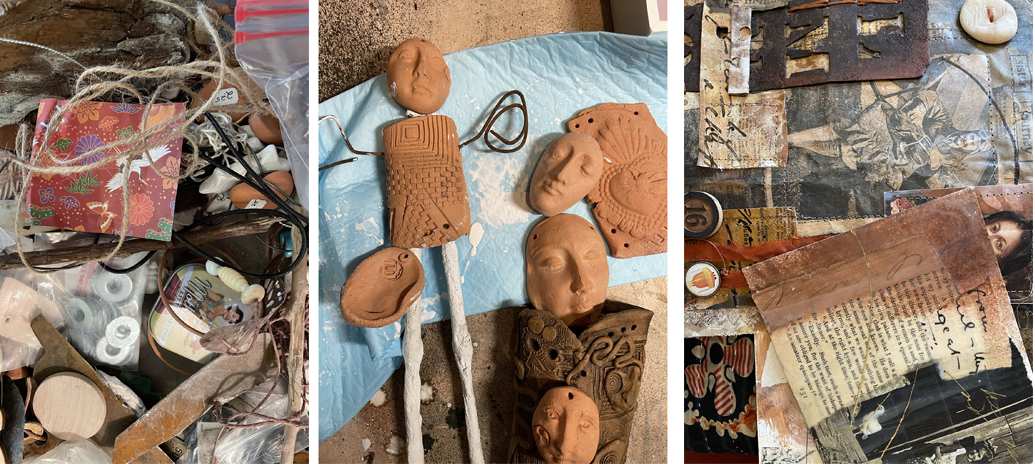
Three of a zillion stash piles in my studio


Provenance

I’ve been negligent about posting to SHARDS for several reasons. I wanted to change the look of the blog, and work on some website redesign as well.  So I’ve been busy, yes, but that’s no excuse.

Have you ever felt that the longer you go without doing something you should do, the harder it gets to do it? My brothers and I are of the generation that got swats on the bottom from our dad when we were little and did something REALLY bad. Daddy would let us choose the time for our swat, but would tell us that “the longer you wait, the harder it gets.” Sigh. The anticipation was worse than the swat, of course. Sometimes you just have to get it done and move on 🙂

But I digress – today I want to discuss “provenance,” a word that refers to the historical origin of a piece of art, or really any object. As an assemblage artist, provenance is hugely important to me. I believe that an object’s history can be sensed in some weird way, kind of like a shard of clay gives a clue to its history.

I’ve been working lately on a series of wrapped and bundles figures inspired by the Peruvian Chancay Burial dolls. Here’s the Chancay doll on the right and my interpretation is on the left.

Part of my process involves selecting specially-curated objects to wrap into the form. Here is another example:

Below are several little objects I want to wrap into the next figure – two seed pods and a feather.

No one who sees the finished doll will know about the provenance of these objects – they could be just some stuff I picked up anyplace. But the seed pods came from my Pride of Barbados tree which seemed completely dead after the snow disaster this year, but manages to come back gloriously despite the trauma. The feather came from the construction yard at SAY Si where they are building a wonderful new place to share art with the youth in San Antonio who really need it. So all three of these objects have a special “provenance,” a story of rebuilding and renewal.

As I said, no one but me knows about the provenance of these objects, but somehow they carry an aura of their story with them, and that infuses the finished piece with a sense of inexpiable mystery and meaning. You can do this with objects, with paper, with fiber.

When you have a choice in your own work of using something that has a special provenance even though it may not look quite as bright and shiny as something you bought at a craft store, consider the source, and go with what your heart says.

If you look up “provenance” as it relates to collecting art, you’ll find that it refers to the trail of ownership of an art object, or the history that got it from there to here. But every object has a history and a story based on where it is found. As an artist, you can incorporate those stories to give richness to your work.


Painting with Fire

The title sounds like something my mother would have warned me against, but it’s actually one of the best things that could happened to an artist/teacher!

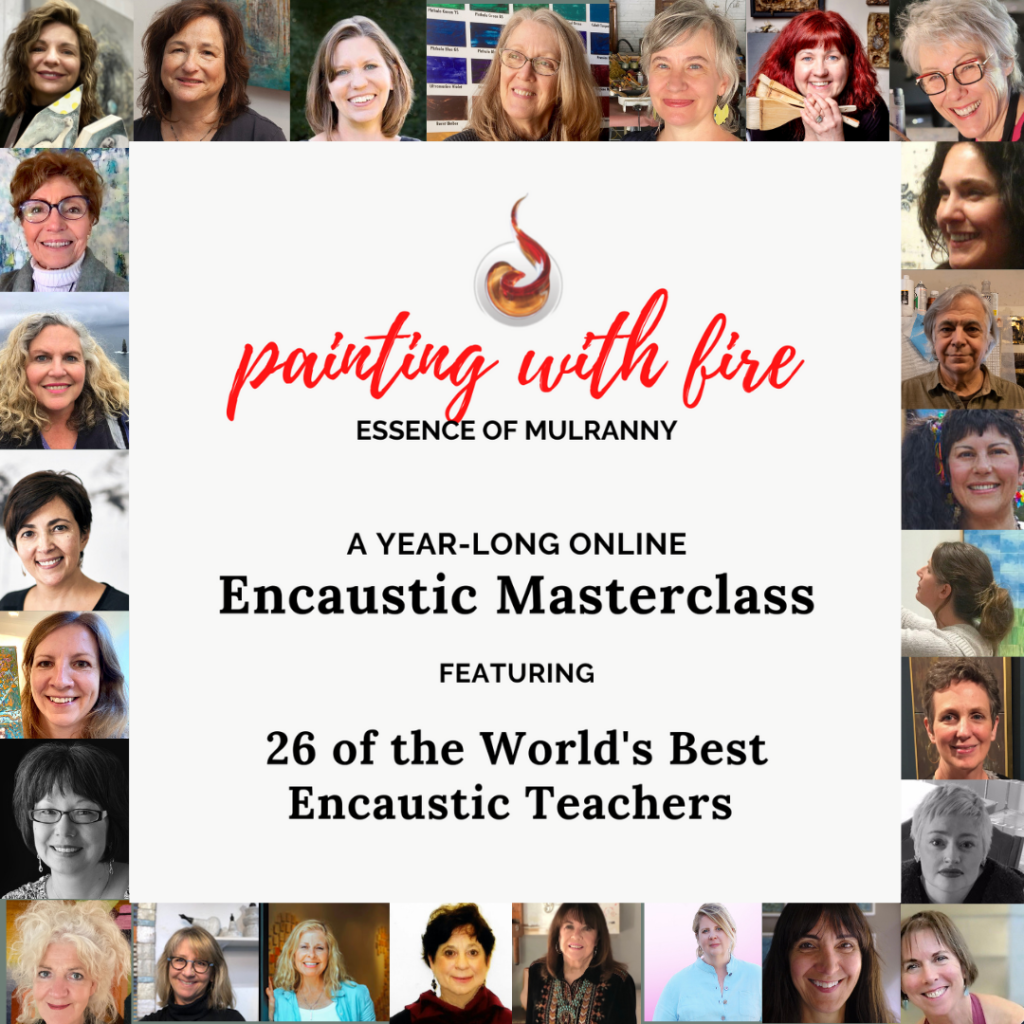
I’ve been invited to join a group of the Best Encaustic Teachers in the World (yes, they let me in!!) to participate in a year-long learning experience called Painting with Fire.

Click here to visit Painting with Fire Essence of Mulranny .

Would you like to meet these artists and see what their work looks like? It’s pretty awesome – check out the video.

Painting with Fire Online Workshop A Year of Encaustic from Lyn Belisle on Vimeo.

The program was founded by Lora Murphy, an encaustic artist who was born in Ireland and has a school there in County Mayo called Essence of Mulranny. Lora sent out an invitation to us, scattered all over the world, and brought us together to teach this Masterclass. And it’s for beginners, too!

My pals Michelle Belto and Clare O’Neill are teaching in Painting with Fire, as well. I’ve learned so much from both of them. And when you sign up, you can take every single class offered by every single teacher over the course of a year, including mine and Michelle’s and Clare’s. Oooh, and Crystal Neubauer and Trish Seggebruch and Shary Bartlett and so many more of my favorite encaustic aritsts are in this, too!

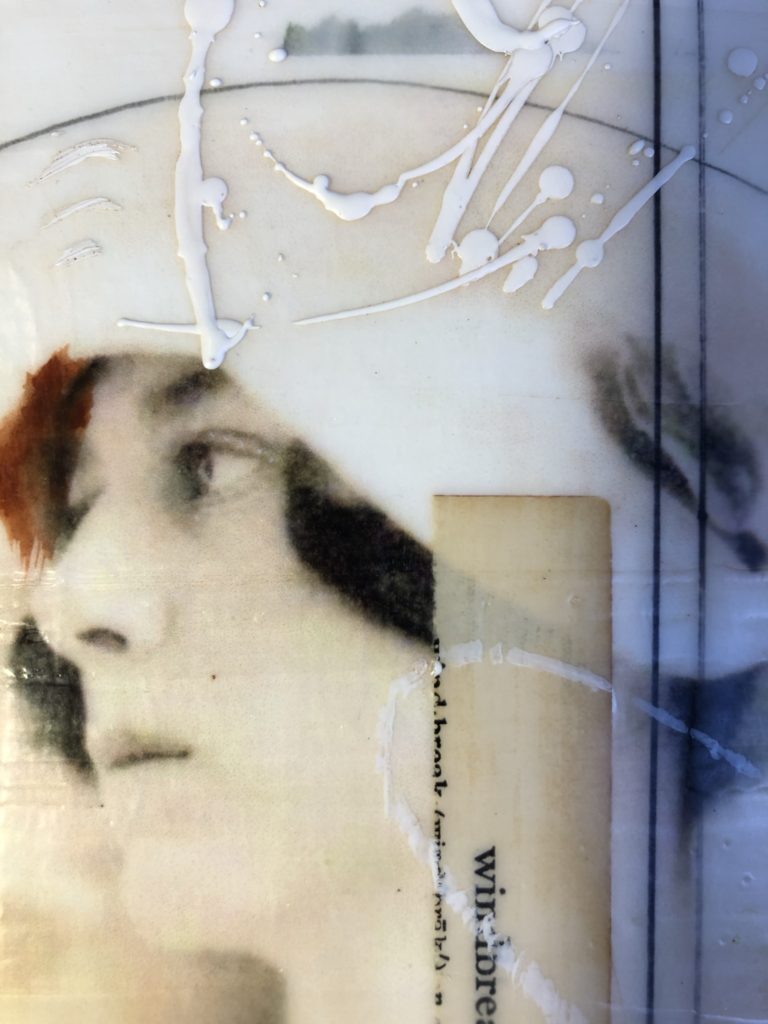
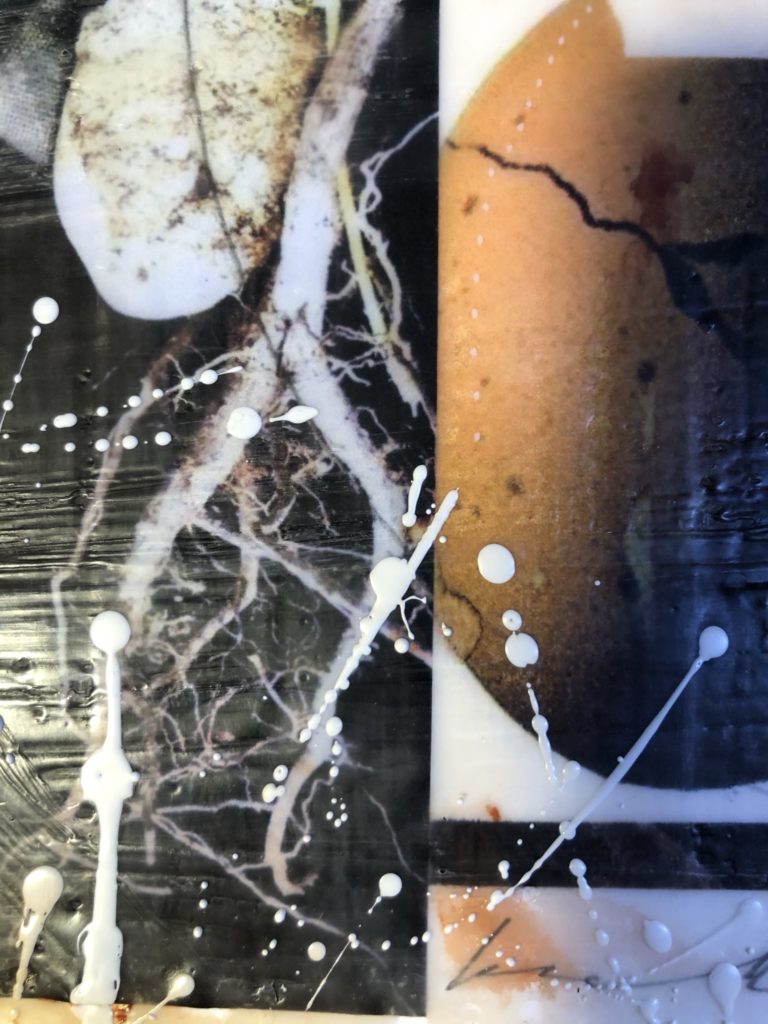
The class that I am teaching is called MYTH AND MIST: Fusing Image and Imagination in Wax. It’s a combination of all the things I love about encaustic – pale translucent layers, mysterious photos and objects, fragrant beeswax – well, take a look for yourself. Here are some details from one of the first pieces I’ve been working on::

I honestly can’t wait to participate in Painting with Fire. Maybe Lora will invite me to Ireland to teach in person next year!!

I almost hesitate to say this, because I feel like I might jinx it, but there’s this new stirring amongst us creative creatures – a cautious optimism that’s reminding us that spring is coming and we can start reaching out again rather than just hanging on in survival mode.

By the way, The Enso Circle is certainly stirring! Michelle Belto and I have had a number of incredible applicants who want to join us in virtual residency. If you didn’t get a chance to read about it, here’s my last post that will explain it. It’s a program for the long-term, and when you are ready to consider it, we will be around! Applications are still open until February 21st, which is a week from this Sunday. Applicants will be notified of acceptance on February 23rd.

I hope to see you at Painting with Fire — it opens today!! Warm your hands with us at the encaustic griddle!

Click here to visit Painting with Fire Essence of Mulranny .

Take good care, trust the process – ♥

Lyn


The Story of The Enso Circle

Creative work is rarely done by a lone genius. Artists, writers, scientists and other professionals often do their most creative work when collaborating within a circle of like-minded friends. Experimenting together and challenging one another, they develop the courage to rebel against the established traditions in their field. Working alone or in pairs, then meeting as a group to discuss their emerging ideas, they forge a new, shared vision that guides their work. When circles work well, the unusual interactions that occur in them draw out creativity in each of the members.

Michael Farrell, Collaborative Circles: Friendship Dynamics and Creative Work (2001)

After six years of hatching, percolating, and polishing this concept, Michelle Belto and I are (at last) introducing you to The Enso Circle, our Invitational Online Artists’ Residency program. When we previewed the new website to several artist friends, here were their reactions:

  • “I just read your note on the class/residency that you and Michelle will be teaching and just wanted to let you know that this sounds truly amazing. Love both of your artwork and this sounds perfect! I have been creating art for over 50 years so I think it’s time I joined your tribe.” Bosha S.
  • “Brilliant idea. Brava!” Jean D.
  • “What a fabulous idea!!! Love this! This is a BRILLIANT venture!” Christine S.

When we began talking about what has ultimately become The Enso Circle, we wanted to create a structured, collaborative community that we ourselves would want to belong to.

This community would offer a supportive space in which to both expand and focus our present art practice, and to offer us a safe place for sharing ideas with like-minded creatives. It would have a starting time and an ending time, and be long enough to be meaningful but short enough to keep the energy going.

We knew from experience that we both need certain guidelines to make this work for us. Among those are:

  • A time-defined goal to motivate us (an art show submission, an article deadline, a workshop design, a group exhibit)
  • Private time to generate or refine a creative concept
  • A concrete plan to reach our goal with focus but flexibility
  • Group time to get feedback on where we are, where we were, and where we are going with our project
  • A collection of resources, always available, that can give us both technical and aesthetic advice and answers
  • Input from mentors outside the community who have expertise and objectivity
  • Small-group opportunities to brainstorm and problem solve the small steps in the process that sometimes get us stuck

Why did we name our community The Enso Circle? Because the Enso is a manifestation of the artist at the moment of creation and the acceptance of our innermost self. It symbolizes strength, elegance, and one-mindedness.

The very imperfections and hand-created contours are exactly what makes the Enso beautiful.

If you want to cut to the chase and learn more right this moment, just click here.

(And here’s what I know that you’re wondering up front . . .the program costs $325, it’s 12-weeks long, only 12 people can be accepted, and yes, it’s absolutely worth it)

But there’s more, and it’s important – and unusual – read on:

The Enso Circle is based on the idea of an Artist’s Residency – a twelve-week commitment that results in a personal body of work, large or small, conceived and completed through goals that you set with the support of the community throughout the process. You do need to apply and have a goal in mind, although that can change over the course of the term.

The Enso Circle is a unique experience for several reasons.

  • It has all the advantages of an in-depth workshop: resources, technique videos, handouts and printables.
  • Like an academic residency, it allows you to select your individual goal and work toward it with peer and mentor support.
  • It has the power of a critique group through frequent informal Zoom meetings and discussions in our private Slack space.
  • It is led by nationally known teacher/artists Michelle Belto and Lyn Belisle, who will model the process by working toward their own goals right along with you during the three-month program.
  • And it culminates in an online exhibition.
  • Lyn and Michelle plan to offer three twelve-week Residency terms throughout the year. The first one will start on March 2nd, 2021.

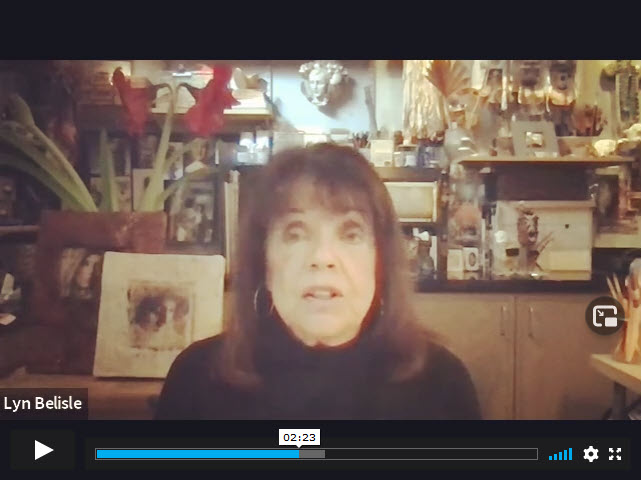
Here’s an up-close and personal invitation from both of us, via our Zoom recording. Just click on the video image.

VIMEO LINK

We hope you choose to apply to be one of the first twelve residents of The Enso Circle!

HERE’S THE LINK TO THE ENSO CIRCLE CLASSROOM./RESIDENCY WEBSITE WITH ALL THE INFORMATION AND THE APPLICATION FORM FOR YOUR CONSIDERATION

Thanks for reading – you’ll know if it’s right for you, and if it’s not, thanks for learning about our Enso Circle story!

Take good care,

Lyn

Susie King Taylor – Inspiring Discovery, Remarkable Woman

Upcoming Black History Month is the perfect time to share what I have learned about a remarkable woman named Susie King Taylor.

Several months ago, I was looking thrugh old photos in the archives of the Library of Congress and saw this one. Sometimes, images reach out like a compelling force, and this was one of them. What a presence!

After I learned that her name was Susie King Taylor, I started researching her remarkable life, then used her image to inspire an artwork.

Born into slavery in Georgia in 1848, Susie King Taylor (born Susan Baker) lived on a plantation for the first seven years of her life. In 1855, Susie was allowed to go live with her free grandmother in Savannah. Despite Georgia’s harsh laws prohibiting formal education for African Americans, Susie attended two secret schools taught by black women and was tutored by two white youths.

In April 1862, Susie was able to escape slavery with her uncle and other African Americans who fled to a federal gunboat near Confederate-held Fort Pulaski. She went to live on Union-occupied St. Simons Island off the southern Georgia coast along with hundreds of other formerly enslaved refugees. There, at only 14 years old, Susie became the first black teacher to openly educate African Americans in Georgia.

That same year Susie married Edward King, a black officer in the 33rd United States Colored Infantry Regiment, and began serving as a nurse and laundress for his regiment. Off hours she taught the soldiers reading and writing and, according to her memoirs, “…learned to handle a musket very well…and could shoot straight and often hit the target.”

Susie served as a nurse at a hospital for African American soldiers in Beaumont, South Carolina, where she met and worked with Clara Barton. For four years and three months, she served the Union military without pay. Susie and Edward remained with the 33rd Regiment until they were mustered out at the end of the war. (Source)

Susie King Taylor’s autobiographic book, Reminiscences of My Life in Camp, was written in 1906 and is still in publication. I ordered her book and  was transported by her wisdom and graciousness. She is a skilled and objective writer.

I was compelled to use her striking mage in an encaustic mixed-media collage, which was recently included in an article in the Winter 2020 issue of Encaustic Arts magazine.

In the article, I wrote, “In one of my latest pieces, the subject is a striking African American woman. As usual, I knew nothing about her until her photograph almost leaped out at me from the screen as I was looking through Library of Congress for inspiration.  She was identified in the photograph as Susie King Taylor, and through research I learned that she was the first Black Army nurse. During the Civil War, she tended to the all-Black 33rd United States Colored Infantry Regiment. In my encaustic collage titled Susie, I included gauze and horsehair as material symbols of her life in the regiment.”

You can see the gauze and horsehair embedded in the beeswax layers in this detail. I used colors of indigo and sepia as the primary palette:

As always, photos and stories from the past continue to inspire and fascinate me as inspirations for my work. Susie’s story was one of the best discoveries I’ve made.

If you’d like to learn more about her, please watch this brief video about the life of Susie King Taylor, produced by the Georgia Women of Achievement when she was inducted in 2018. You’ll be glad you did.

See you next time, and take good care,

Lyn

Blessings from Bri – prayer flag inspirations

I just finished the last video for my new workshop called Strands of Light: A Prayer Flag Sampler. Now comes the editing, the writing, and the uploading to my online classroom – and it WILL be done by October first. Yikes, that’s just a week from now!

The person I called on for advice when I got the idea for this prayer flag workshop was my friend Briana Saussey, writer, teacher, and spiritual counselor. Bri holds a B.A. and M.A. in Eastern and Western classics, philosophy, mathematics and science from St. John’s College (Annapolis and Santa Fe), and is a student of Ancient Greek and Sanskrit.

While I can (joyfully) teach the techniques for making prayer flags, it’s Bri who is the expert on the heart of the matter – creating and offering prayers and blessings. She graciously agreed to partner with me as my “expert witness” to the power of spirituality  in our art making. Without that component, a prayer flag is simply a piece of decorated cloth.

Bri has agreed to share her Daily Blessings with the workshops participants as well as her thoughts on the subject. Here is an excerpt from an interview we did earlier in September. I asked her about the nature of prayer and blessings.

Excerpt from an interview with Briana Saussey for the Strands of Light Prayer Flag workshop from Lyn Belisle on Vimeo.

I am so grateful to Briana for her help. Incidentally, she has a new book out called Making Magic. I love my copy of this book – it’s very surprising in many ways, and very practical.

Here are two of the prayer flag/blessing banners that I made for the upcoming Strands of Light workshop. Both use Bri’s Daily Blessings as inspiration.

So when the workshop opens on October 1st, you’ve got all kinds of resources, both artistic and spiritual, to make a fine flock of prayer flags and blessing banners! Hope to see you then. I’m off to the studio make a little prayer flag to honor RBG.

♥Lyn

From frustration to fruition, blobs and all

Do you have a “frustration pile”?  It’s a stack of artwork that isn’t bad enough to trash or paint over completely, but it isn’t going anywhere, and maybe never will.

While I was working on my Lotus Book workshop, I found several 11×14″ encaustic and mixed media collages in that pile that had never quite come together for me and were just sitting there. It occurred to me that I could make cover-sized (4.5″ x 4.5″) squares for Lotus Books from the work.

Here’s one of those collages. It’s not terrible, but it lacks focus and purpose. I remember that I was trying six or seven techniques, and I learned a lot, but the piece already looks as if it’s begging to be  cut into squares. Right?

I whacked it mercilessly (but carefully) with my trusty Ingento paper cutter. Here are the resulting six book covers.

If you’ve taken my free Lotus Book workshop, you know that the back side of a cover doesn’t have to be waxed because the pages stick directly to it.

But there is one more important step to make these more suitable for Lotus Book covers. Because the paper cutter leaves a clean, but unfinished edge, it’s best to dip each of the four edges into the wax medium to smooth and seal them.

You can see, below, that the wax-dip barely noticeable, but it makes a big difference in helping the newly-cut covers feel finished.

Here’s a tip – let the dipped edges cool a bit before you turn it to dip the next edge. Otherwise, you will end up with a blob.

Oops. The blob can be scraped off, but best to do it right and be patient (which is NOT one of my best virtues).

And, Voila! A new Lotus Book arises like the Phoenix from the Pile of Frustration!

Now, if you have sharp eyes, you’ll see that I left the Blob on that cover. Blobs add character, and don’t let anybody talk you out of your blobs, personal or artistic! Perfection is boring.

A couple of notes:

The free Lotus Book workshop is going strong, and I encourage you to check out my workshop studio on Teachable. You’ll be joining a group of almost 200 satisfied lotus-bookies. Here’s the link.

If you want to see a fun, short video on a related subject, check out my buddy Michelle Belto‘s take on reusing her encaustic collages – it will inspire you to start cutting! Here’s the link.

Be safe, trust the process, and celebrate your blobs today!

Lyn